Floor Lamps for Living Room: Height, Placement and Types
Reading light or ambient light, sofa, armchair or corner: the measurements, types and lighting rules to find the floor lamp that makes your living room truly cosy.
Floor lamps for the living room do one of two jobs. As a reading light, the lamp stands to the side of and slightly behind the armchair, is 140 to 165 cm tall, and the bottom of its shade sits at roughly seated shoulder height, between 110 and 130 cm. As ambient light it can be taller, but it must hide the bulb from every seat or send its light up and onto the wall. In both cases, choose warm white light at 2700 to 3000 K, ideally dimmable.
How tall should a floor lamp for the living room be?
The right height depends on whether the lamp should give focused reading light or soft ambient light. The table sums up the guide values.
| Job | Lamp height | Bottom of shade / light output | Position | Light direction |
|---|---|---|---|---|
| Reading light by the armchair | 140–165 cm | 110–130 cm above the floor | to the side, slightly behind the shoulder | focused downwards |
| Mood light by the sofa | 120–165 cm | bulb hidden when seated and standing | at the sofa arm or in the corner of the sofa | diffused through fabric or glass |
| Arc lamp over the sofa | 170–220 cm | 140–160 cm above the floor | base to the side of or behind the sofa | downwards, a pool of light on the seat |
| Uplighter floor lamp | 175–200 cm | above standing eye level, at least 60 cm below the ceiling | corner, 20–30 cm from the wall | upwards onto ceiling and wall |
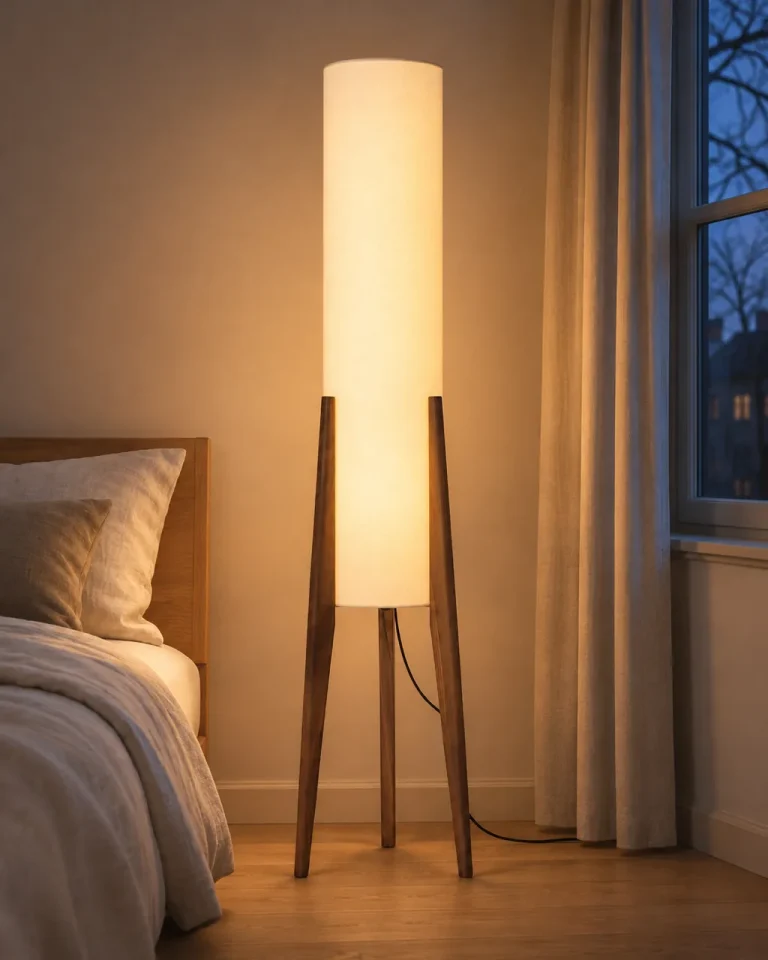
| Light column or LED light stick | 100–160 cm | the glowing surface itself is glare-free | corner, alcove, behind the armchair | all round or onto the wall |
Reading light: low enough for the book
For reading, light needs to fall onto the page from the side and slightly from behind, not into your face from the front. So place the reading lamp next to the back of the chair, where the beam falls over your shoulder onto the page. If the bottom of the shade is higher than 130 cm, the light falls too flat and you look straight into the bulb. If it is lower than 110 cm, you bump into the shade when you stand up. A reading lamp should put at least 400 to 600 lumens onto the page.
Ambient light: tall enough that nothing dazzles
With ambient light, shielding matters more than the exact height: a fabric shade, opal glass or an upward-facing reflector hides the bulb from the sofa and when you stand. For mood lighting 200 to 400 lumens are enough; an uplighter that also brightens the room needs 1,500 lumens or more.
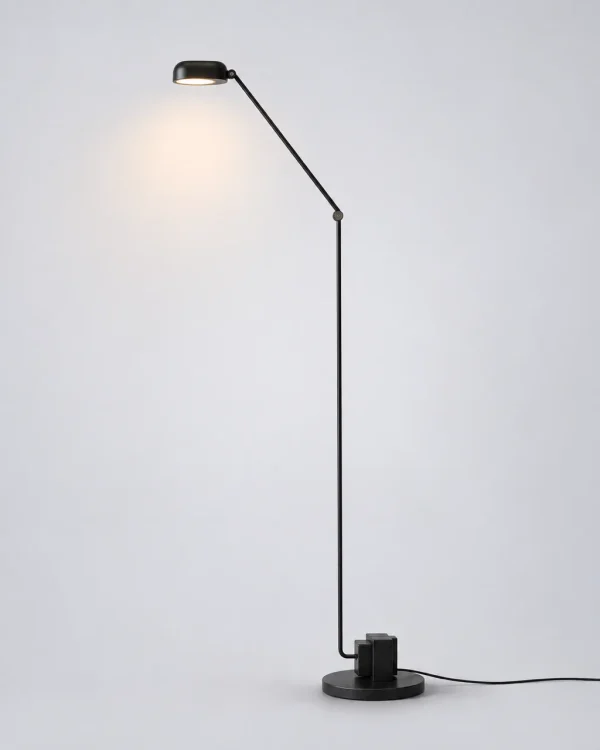
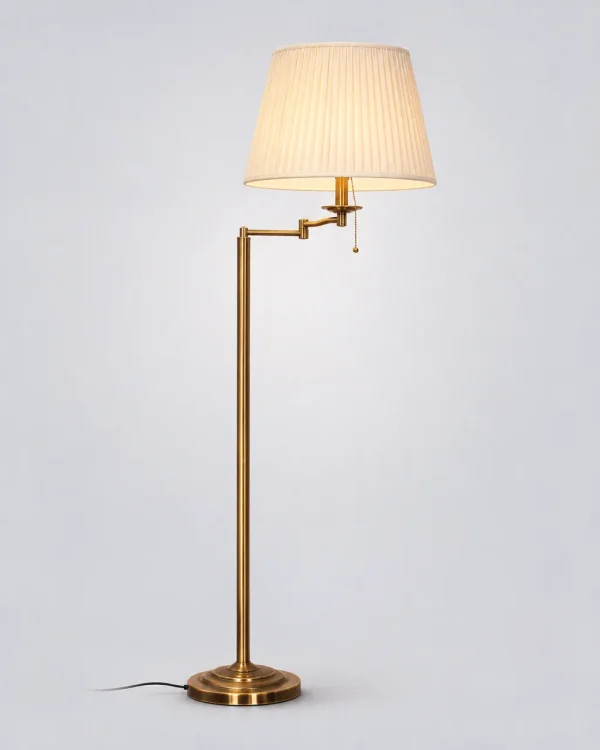
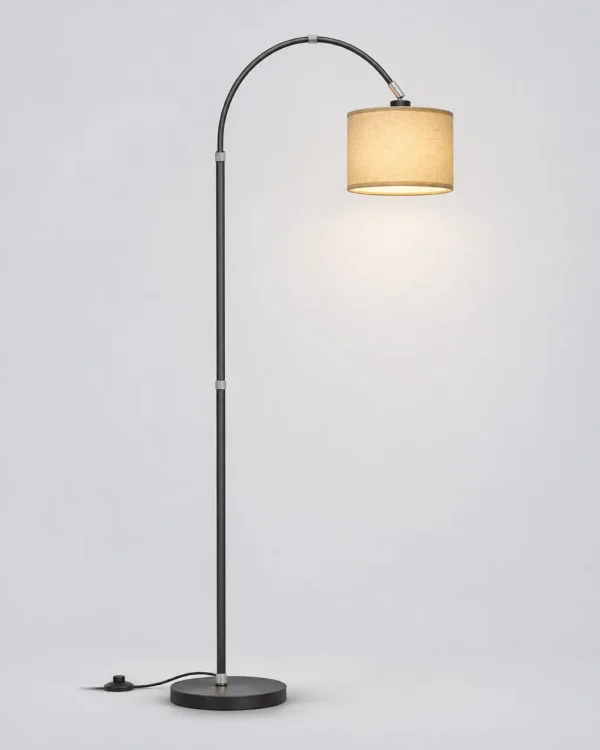
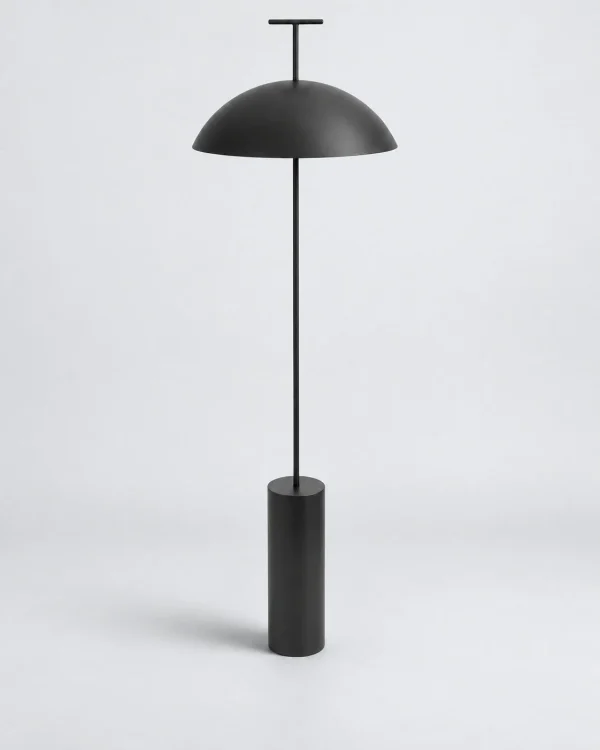
For the reading corner, lamps with an adjustable head or arm work best. BIRK is 161 cm tall, with an articulated arm and a tilting lamp head only 8 cm high that you can point exactly at your book; the base measures just Ø 21 cm. DEVA, in a country-house style, swings its pleated shade (Ø 45 cm at the bottom) on a jointed arm over the arm of the chair; the column is 120 cm and the whole lamp 160 cm tall. ISLA is a small curved floor lamp, 170 cm tall, with a linen shade (Ø 25 cm) that hangs right above the armrest. SCANDI directs its light downwards with a 40 cm wide mushroom shade and stands 150 cm tall.
Where is the best place for a floor lamp in the living room?
Plan the floor lamp where you actually sit in the evening, not wherever there happens to be space. Four positions almost always work.
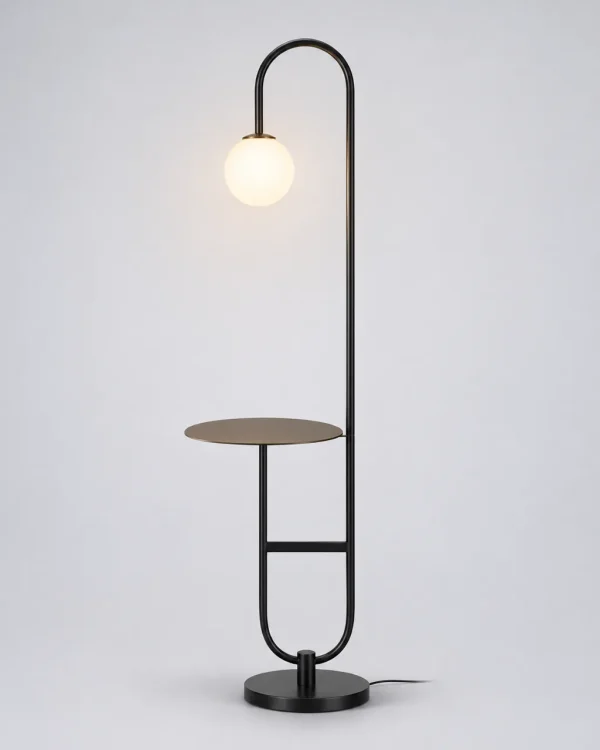
- Next to the sofa: the lamp stands right by the sofa arm, with the shade reaching just above the armrest. A shade 35 to 45 cm across covers one end of the sofa. If there is no room for a side table, a floor lamp with a built-in table does both jobs.
- By the armchair: this is where the reading lamp belongs, to the side and 20 to 40 cm behind your shoulder. That way no shadow from your head or hand falls on the page.
- In the corner: a floor lamp in the corner of the living room lights up two walls and makes the room feel bigger. Indirect light works best here: an uplighter, an LED light stick or a light column. Keep it 20 to 30 cm from the wall so you don’t get a harsh hot spot.
- Behind the sofa: a floor lamp behind the sofa works if the sofa stands at least 30 cm away from the wall or the lamp is very slim. Arc lamps also stand behind or beside the sofa and bring their shade over the seat.
A cable running across a walkway is a trip hazard. Leave around 80 cm clear between the lamp and the walkway, and make sure you can reach the foot switch or inline switch from your seat.
Which floor lamps for the living room? The main types
Choose the type by the job first, and only then the colour and material. You will find every shape in our living room floor lamps collection.
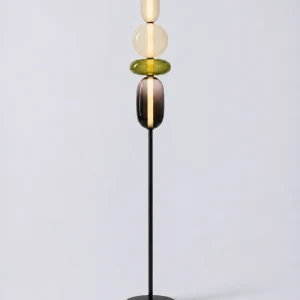 Collection · 58 designsLiving Room Floor LampsView all 58 designs
Arc floor lamp: light over the sofa without a ceiling point
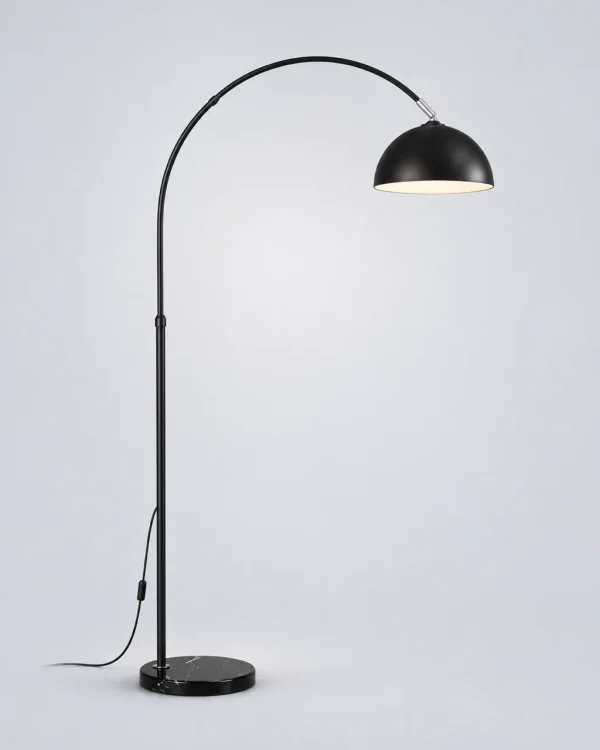
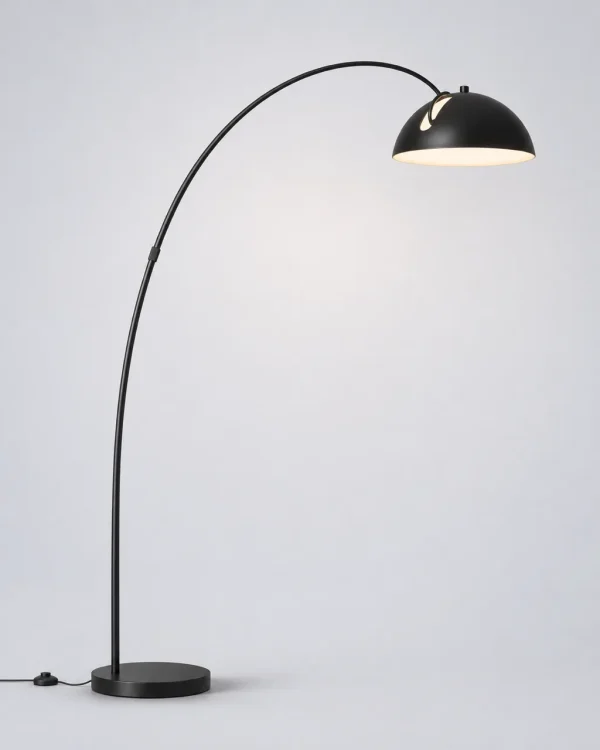
In the living room, an arc floor lamp replaces a pendant over the sofa or coffee table. What matters is the reach between base and shade: 50 to 80 cm for an armchair, 70 to 100 cm for the middle of a sofa. Our arc floor lamp guide explains all the measurements.
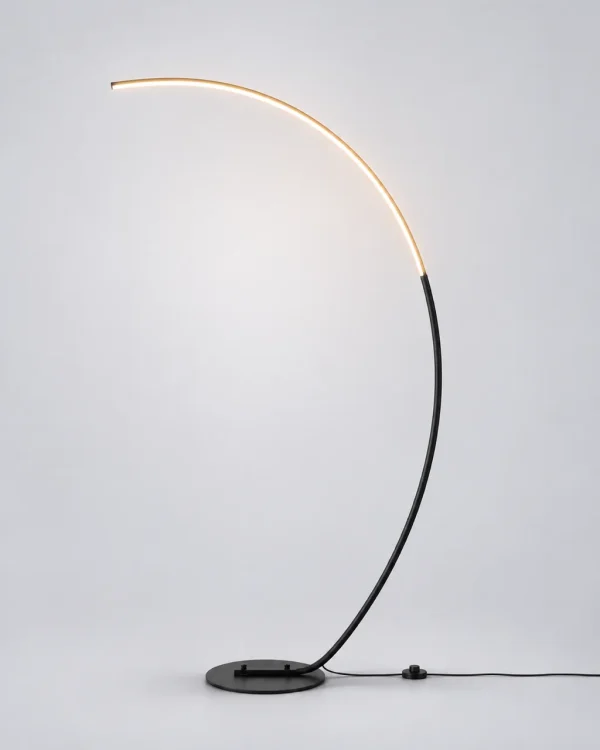
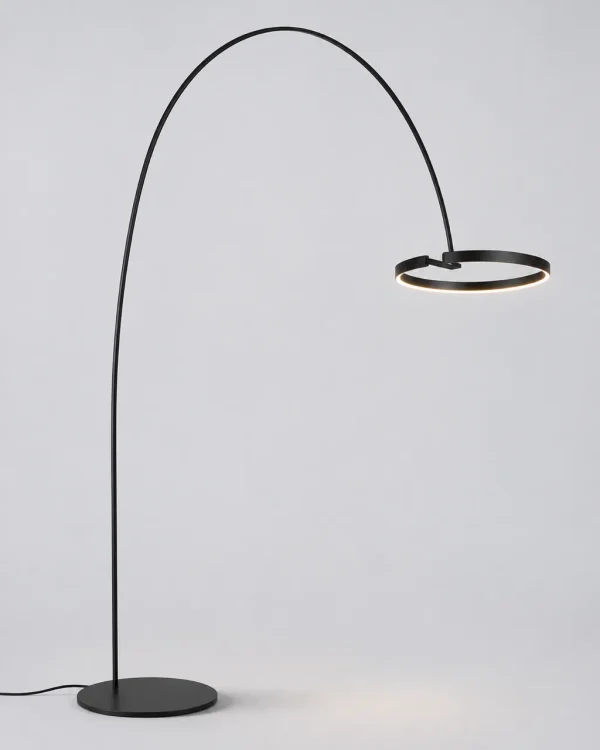
ALVA adjusts between 145 and 180 cm in height, has a 94 cm reach and a marble base of Ø 30 cm that keeps it steady. FJOR is more compact at 180 cm high with a 70 cm reach, dimmable and switchable between three colour temperatures. GILA stretches its arc up to 185 cm, and its Ø 30 cm dome shade tilts. For large rooms, NERA, at 220 cm tall and up to 180 cm wide overall, draws a glowing LED ring over the seating area. You will find every model under arc floor lamps.
Floor lamp with a fabric shade: the cosiest light
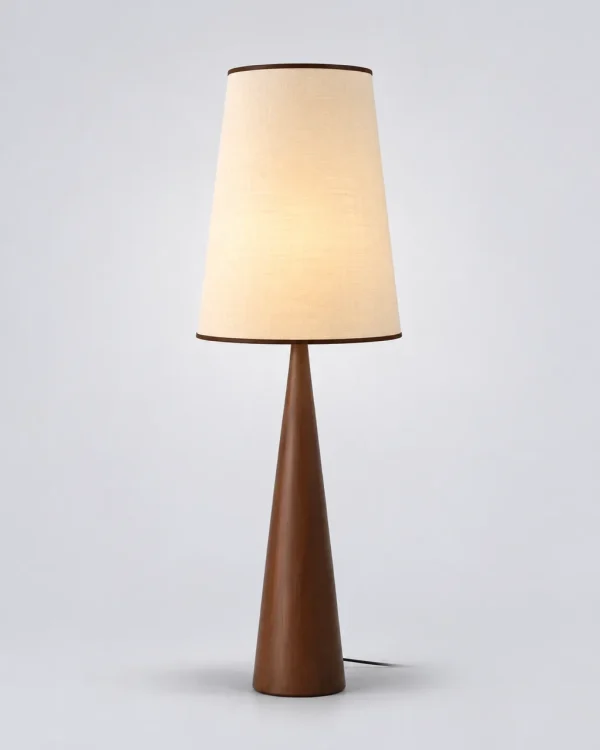
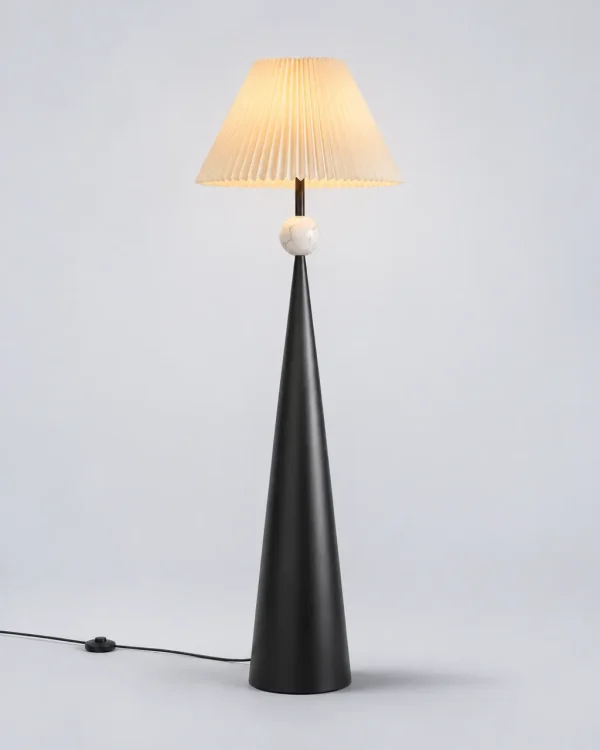
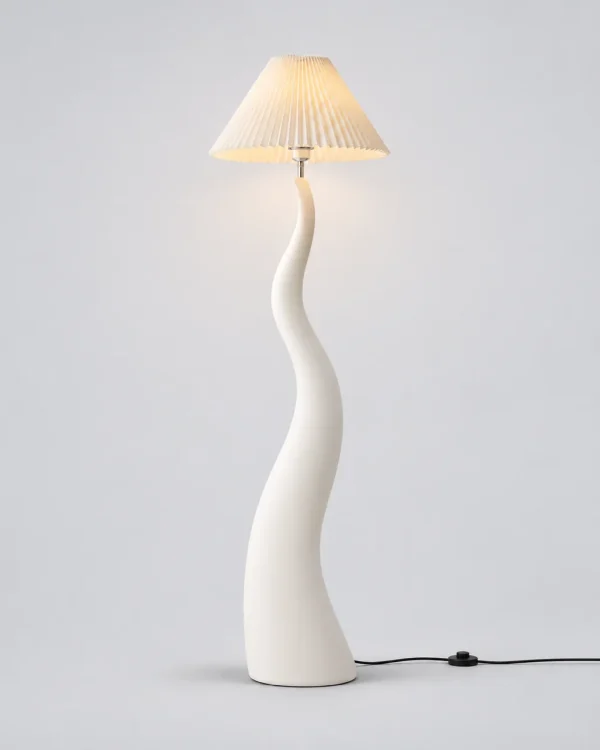
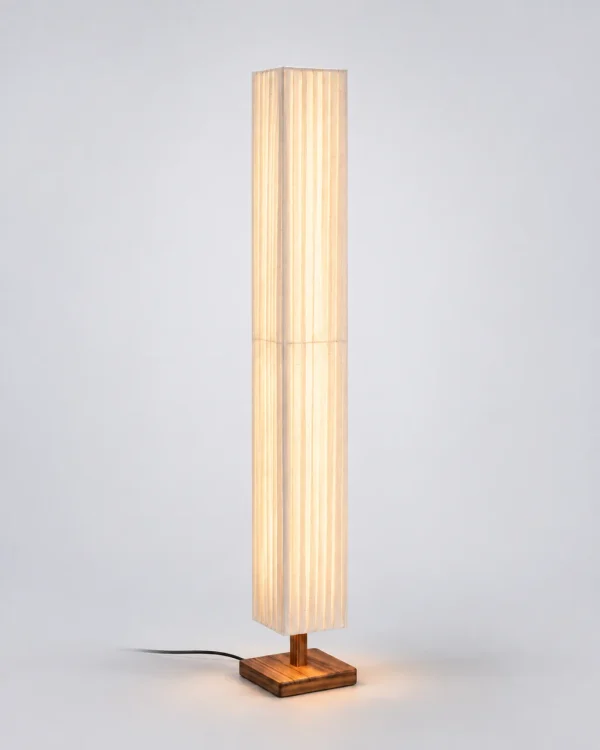
If you are looking for a cosy floor lamp for the living room, you will almost always end up with a fabric shade: it filters the light softly and warmly. Shades from 40 cm across suit a sofa; slim fabric columns suit alcoves.
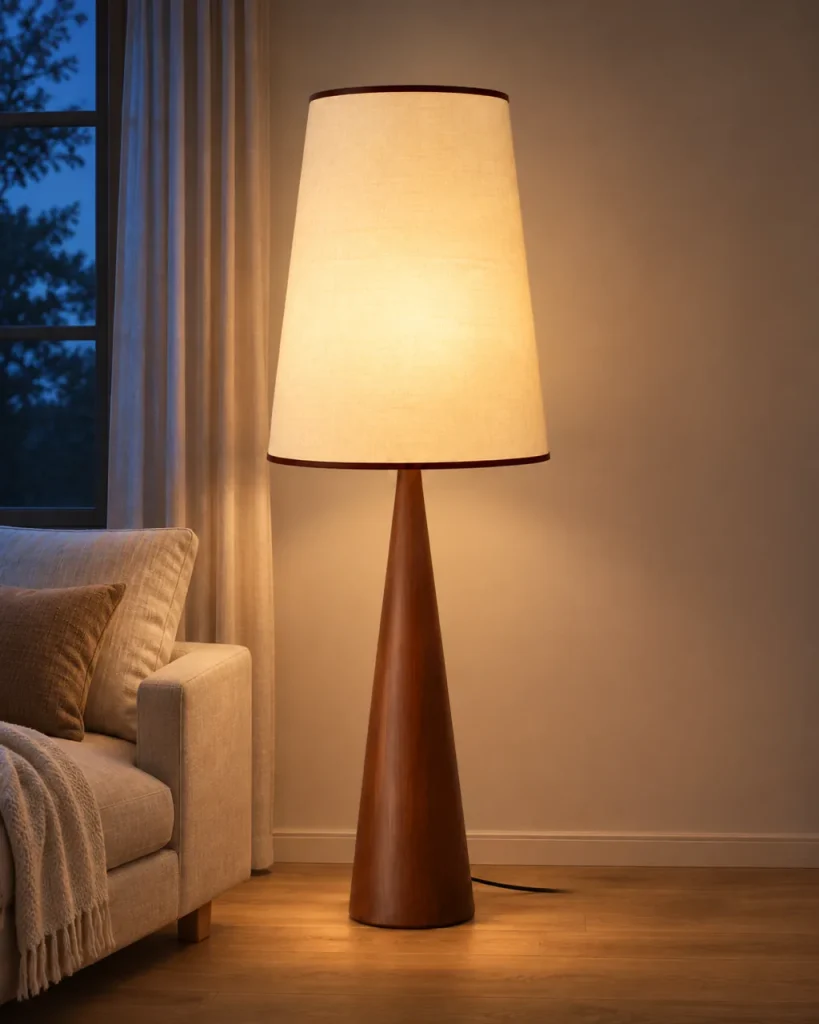
OLVA sets a shade 48 cm wide and 65 cm tall (150 cm version) on a conical wood-effect base, and its light falls both up and down. TOVA pairs a slim metal cone with a Ø 44 cm pleated shade and an E27 lamp holder, so you choose the bulb yourself. ZARA is 165 cm tall and carries a Ø 45 cm pleated shade on a curved body. As a slim floor lamp for the living room, HEDA is just 14 cm wide, stands on a wooden base and comes 120 or 160 cm tall. You will find more models among our floor lamps with fabric shades, and versions with wooden legs or a wooden base among our wooden floor lamps.
Glass floor lamps: clean design, soft light
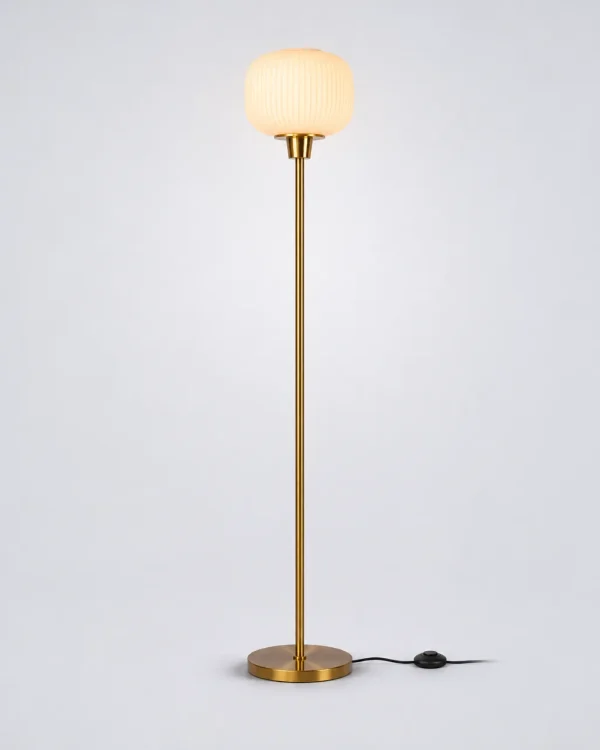
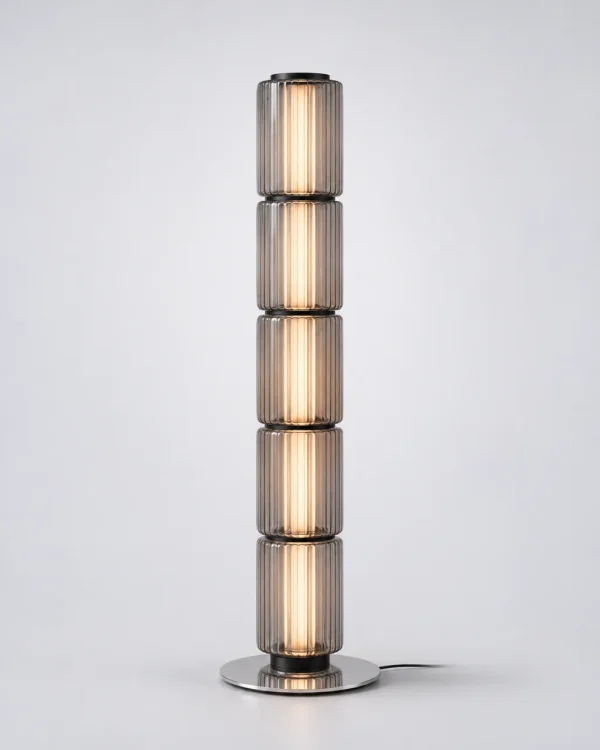
Opal glass spreads light evenly and hides the light source; fluted glass breaks it into fine lines. Glass lamps look lighter than fabric shades.
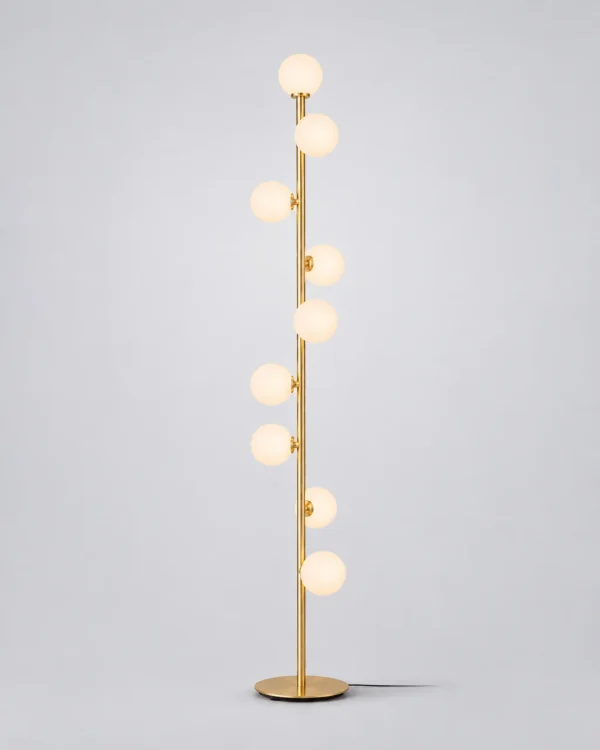
TEVA is 164 cm tall and carries a ribbed opal glass head, 26 cm wide, on a gold-coloured stem. KAJA is a column of fluted glass, 125 or 155 cm tall, and according to the product data gives 3000 K light, in either smoked or frosted glass. KOLA has an opal glass globe of Ø 15 cm and a round Ø 33 cm shelf at a height of 60 cm, which takes the place of a side table next to the sofa. EIRA arranges nine glass globes, each Ø 10 cm, along a 165 cm stem. You will find every model under glass floor lamps.
Uplighters and indirect light for the corner
An uplighter floor lamp in the living room throws its light upwards, the ceiling reflects it and spreads it around the room without glare. This only works under a light-coloured ceiling and with at least 60 cm between the light output and the ceiling.
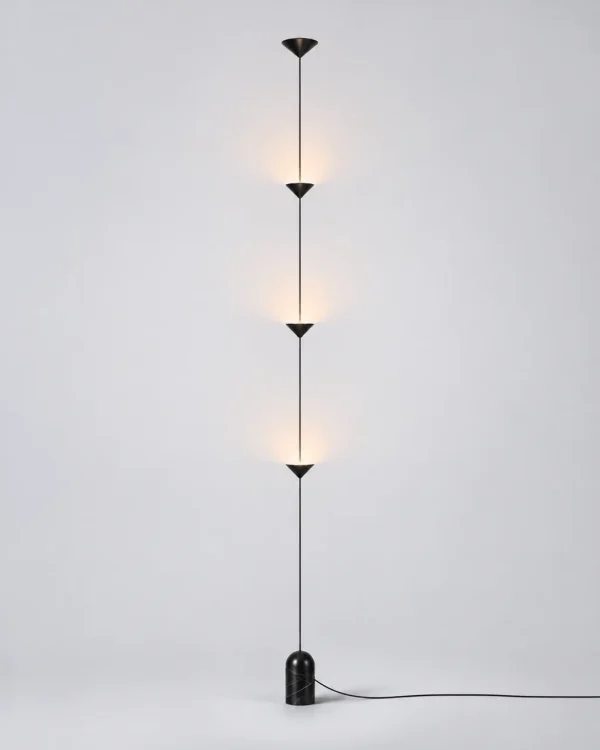
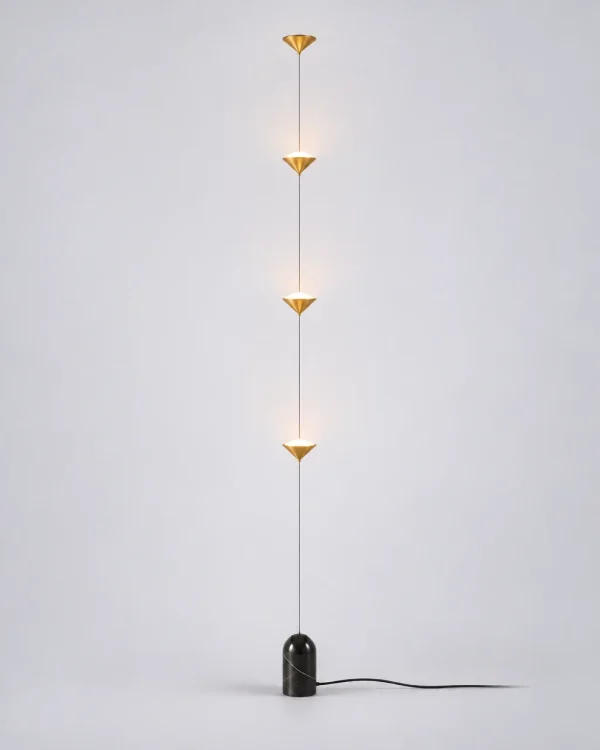
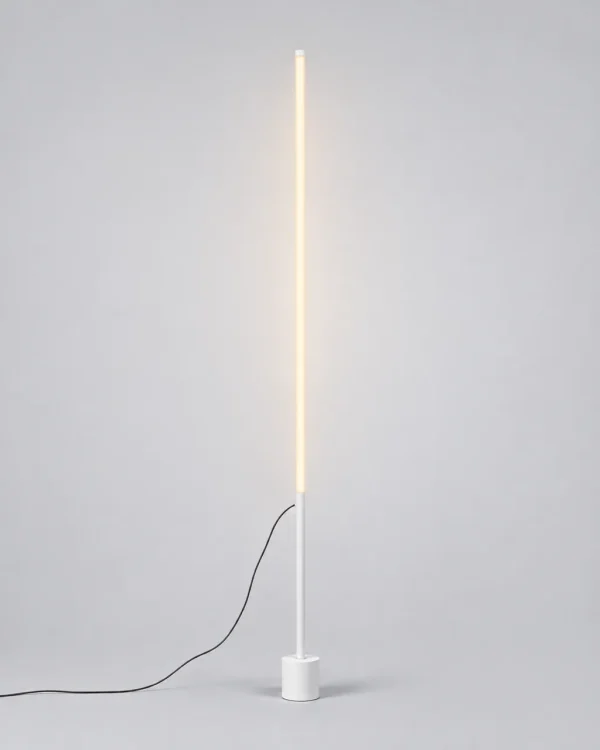
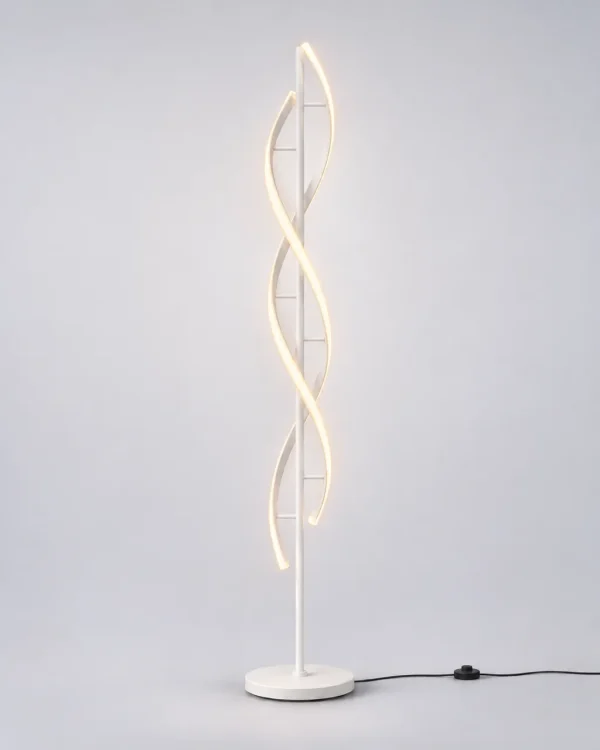
If you want indirect light in the corner without a bulky bowl, tension and stick lamps are a modern alternative. RENA is fixed between floor and ceiling, and its one to three light bowls shine upwards onto wall and ceiling. ASKA places one to three heads with warm white light on a cable, for ceiling heights up to 350 cm. EBBA is an LED light stick on a base only 8 cm wide, 100, 140 or 160 cm tall, and gently lights the wall behind it. The LED spiral ILVA (152 cm) is dimmable and switchable between three colour temperatures.
How big should a floor lamp be for your living room?
A delicate lamp gets lost in a 40 m² open-plan space, while a large floor lamp with a 50 cm shade overwhelms a 12 m² living room.
| Living room | Floor lamps | Suitable types | Size |
|---|---|---|---|
| up to 15 m² | 1 | slim fabric column, LED light stick, floor lamp with a table, reading lamp with an articulated arm | shade up to 30 cm, base up to Ø 25 cm |
| 15–25 m² | 1–2 | fabric-shade floor lamp by the sofa plus a reading lamp, or a compact arc lamp | shade 35–45 cm, reach around 70 cm |
| 25–35 m² | 2 | arc lamp over the sofa plus a floor lamp or light column in the corner | shade 45–50 cm, reach from 90 cm |
| over 35 m² or open-plan | 2–3 | one arc or floor lamp per seating area, uplighters for the corners | large shapes, arcs up to 180 cm wide overall |
Under period-home ceilings above 3 m, lamps from 165 cm tall look better balanced; with ceilings below 2.40 m, stay at around 160 cm. A small floor lamp for the living room is not automatically dimmer: the bulb sets the brightness, not the shade.
Which light is right: colour temperature, brightness, dimmable?
For a floor lamp in the living room, warm white light at 2700 K is the cosiest choice. 3000 K is a touch crisper and suits a reading lamp if you read late into the evening. Neutral white from 4000 K feels cold in a living room at night and belongs at a desk.
- Dimmable: a dimmable floor lamp in the living room covers both needs: full light for reading and 20 to 30 per cent for a film night. According to the product data, FJOR and ILVA have a built-in dimmer and three colour temperatures.
- E27 lamp holder: with lamps that take an E27 bulb, such as TOVA, the bulb sets the colour temperature and brightness. If you want to dim, pair a dimmable LED bulb with a plug-in dimmer or use a smart bulb.
- One colour temperature: every light in the room should have the same colour temperature. A 2700 K floor lamp next to a 4000 K ceiling light makes the room look patchy.
Modern floor lamps for the living room often have integrated LEDs. In that case, check the spec sheet to see whether the lamp is dimmable, because an add-on dimmer usually won’t work with it. For the side table, there are dimmable table lamps.
How do you combine a floor lamp, ceiling light and table lamp?
The floor lamp is rarely the only light in a living room. A well-balanced living room has three layers: general light from the ceiling, floor and reading lamps at the seats, and table and wall lights at eye level.
- General light from above: which size and brightness suit your room is explained in our guide to ceiling lights for the living room.
- Floor lamp at the seat: in the evening it becomes the main light. If the sofa stands against the wall opposite the TV, the floor lamp belongs at the end of the sofa, not next to the screen, or it will reflect in it.
- Table and wall lights: a table lamp on a sideboard or console forms a triangle of light with the floor lamp and reading lamp, filling the whole room evenly. Which table lamp goes where is covered in our guide to a table lamp for every room. If there is no room for a base next to the sofa, a wall light is the answer; our guide to wall lights for the living room explains the right fitting height.
You will find the complete lighting plan for the sofa, reading corner and TV in our guide how to light your living room. Slim models such as HEDA or BIRK also fit beside the bed; read more in our guide to bedroom lighting.
Common mistakes with a living room floor lamp
- Shade too high for reading: if the bottom edge is above 130 cm, the light falls on your head from above and you read in your own shadow.
- Visible bulb: open shades that reveal the bulb from below or the side dazzle you from the sofa. Check the lamp from where you sit.
- Light too cold: above 3000 K, the living room feels like an office in the evening.
- Only one light source: a single floor lamp in a 25 m² room leaves the opposite side dark. Allow one light source for every 4 to 6 m².
- Wrong proportions: a 50 cm shade next to a dainty armchair looks heavy; a 25 cm shade next to a large corner sofa looks lost.
- Uplighter too close to the ceiling: with less than 60 cm of clearance you get a harsh bright patch instead of an even glow.
Delivery is free and takes around 6 to 9 working days in total, and you have 30 days to return your order. Models with a black frame that suit almost any style are among our black floor lamps.
 Collection · 17 designsFloor Lamps with Fabric ShadesView all 17 designs
Frequently asked questions
How tall should a floor lamp in the living room be?
A reading lamp is 140 to 165 cm tall, with the bottom of its shade 110 to 130 cm above the floor, roughly at seated shoulder height. A floor lamp for ambient light can be taller, as long as the shade hides the bulb. An uplighter is usually 175 to 200 cm tall.
Where is the best place for a floor lamp in the living room?
Ideally next to the arm of the sofa or to the side of and behind the reading chair. In a corner, a floor lamp with indirect light works well because it lights up two walls. Keep around 80 cm of walkway clear and plan the lamp near a socket.
Which colour temperature is right for a living room floor lamp?
Warm white at 2700 K is the cosiest colour temperature for the living room. For a reading lamp, 3000 K is a good choice because the light is slightly crisper. Cool white light from 4000 K feels uninviting in the evening.
How many floor lamps does a living room need?
In a living room of up to 15 m², one floor lamp is enough; from 25 m², two make sense, for example an arc lamp over the sofa and a floor lamp in the corner. Together with the ceiling light and table lamps, allow one light source for every 4 to 6 m².
Is an arc floor lamp or a regular floor lamp better for the living room?
An arc lamp is better if you need light over the middle of the sofa or the coffee table and have no ceiling point there. A regular floor lamp is better next to the sofa arm, an armchair or in a corner, because it takes up less space.
Can a floor lamp replace a ceiling light?
In a small living room with a light-coloured ceiling, an uplighter of at least 1,500 lumens can provide the general light. In larger rooms, a floor lamp complements the ceiling light rather than replacing it.