Dimmable LED Ceiling Lights: Dimmers, Lumens and Lamp Holders
Built-in LED or E27, triac or remote control, how many lumens per m²: how to find a dimmable LED ceiling light that doesn't flicker.
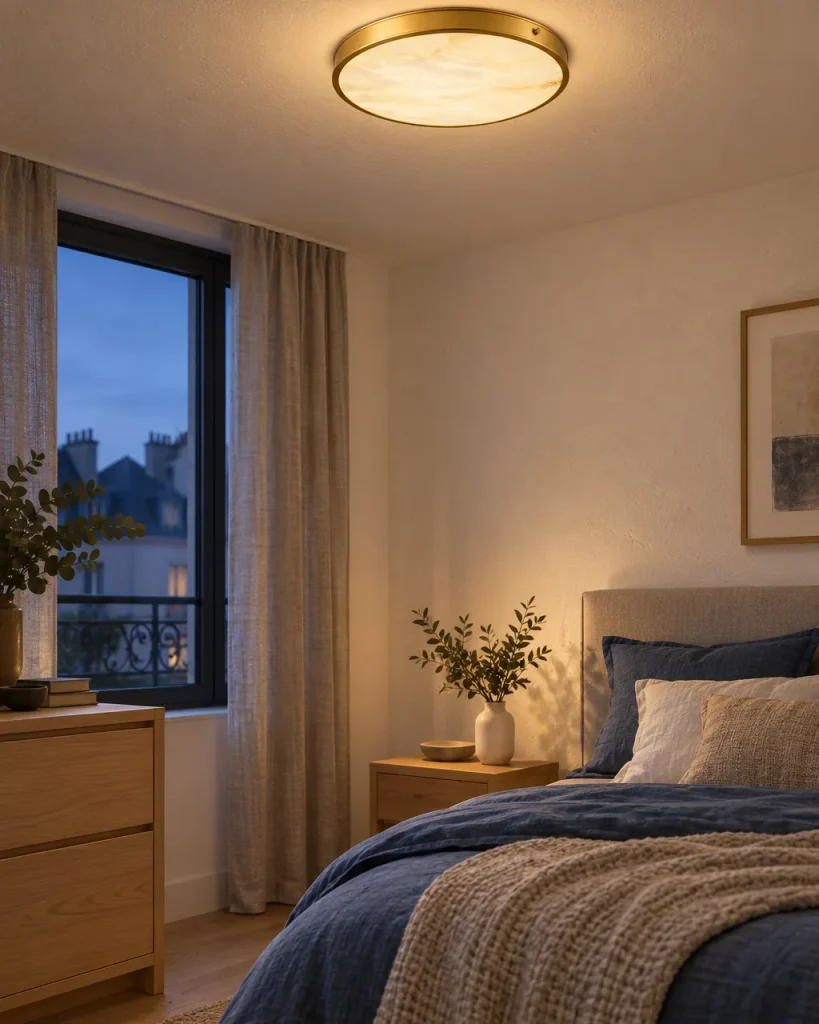
A dimmable LED ceiling light only works properly if the light and the dimmer are compatible: with built-in LED, the light must be expressly specified as dimmable, for example as “triac dimmable”; with a lamp holder such as E27, E14 or G9, you need a dimmable bulb. For LEDs, a trailing-edge dimmer with a low minimum load is generally the right choice. As general light, plan about 100 to 150 lumens per square metre in the living room, and 250 to 300 in the kitchen.
What exactly does “dimmable LED ceiling light” mean?
Dimmable means that the brightness can be reduced steplessly or in steps without the LED flickering, humming or going out. Whether that works is decided not by the LED itself, but by its electronics, known as the driver. An LED ceiling light that isn’t specified as dimmable can flicker or be damaged on a dimmer.
With LED ceiling lights, you will come across three variants:
- Dimmable with a wall dimmer: the light responds to a dimmer in the wall box. Typical wording: “triac dimmable” or “dimmable with trailing edge”.
- Dimmable by remote control or app: the dimmer is inside the light. The wall keeps a normal switch, which stays permanently on.
- In steps via the light switch: switching on and off several times moves between brightness or colour temperature settings. No dimmer is needed for this.
What the light can do is always stated in the product description. If the word “dimmable” is missing, assume that it isn’t.
Built-in LED or lamp holder: which is better for dimming?
With a light with built-in LED, the light source and driver are permanently fitted. That allows very slim designs, often only 5 to 7 cm deep, and an evenly glowing surface without visible points of light. On many models, the service life is around 50,000 hours. But it is only dimmable if the manufacturer has fitted the right driver. This can’t be added later.
With a light with a lamp holder (E27, E14, G9, GU10), you choose the bulb yourself. It becomes dimmable as soon as you fit an LED bulb marked “dimmable”. You can change the colour temperature later, use a brighter bulb or simply replace a faulty one. In return, the light is usually a little deeper.
| Criterion | Built-in LED | Lamp holder (E27, E14, G9, GU10) |
|---|---|---|
| Depth | can be very slim (from approx. 2.5 cm) | usually deeper, depending on the bulb |
| Dimmable? | only in a version specified as dimmable | with a dimmable bulb and a suitable dimmer |
| Changing the colour temperature | only if switchable or selectable when ordering | at any time with a new bulb |
| Light effect | even surface, no points of light | depends on the shade and bulb |
| If faulty | replace the module or the light, depending on the model | replace the bulb |
For low ceilings and a calm, flat light effect, built-in LED is the better choice. If you want to stay flexible, choose a lamp holder.
Which dimmable LED ceiling lights are there with built-in LED?
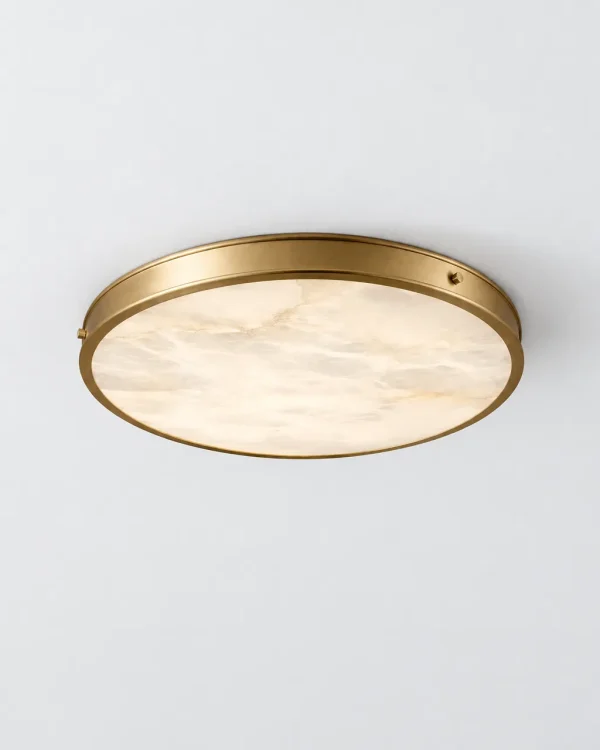
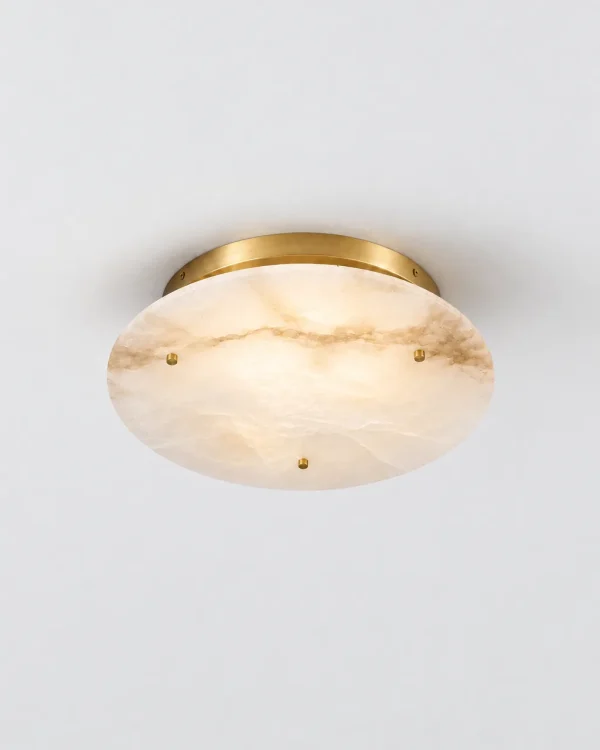
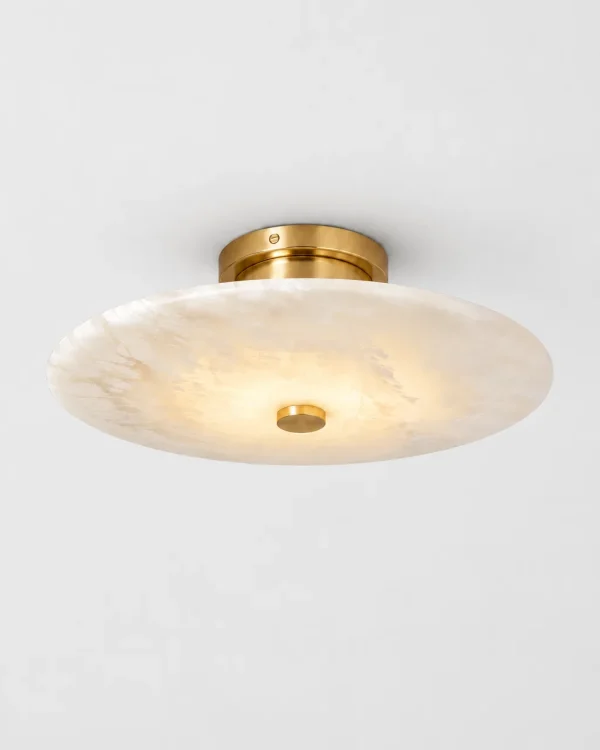
With several alabaster models, you choose dimmability directly in the version. FENZE is a flat alabaster disc in a metal ring, only 5 cm deep, in Ø 30, 40 or 50 cm and gold or black. BILPI sets the stone disc on a brass base, 6.6 cm deep, from Ø 20 to 50 cm. The small bowl CIBI measures Ø 20 cm and is 10 cm deep, and suits a hallway or entrance hall. All three give warm white light at 3000 K and come in a “triac dimmable” version. The dimmer itself is not included.
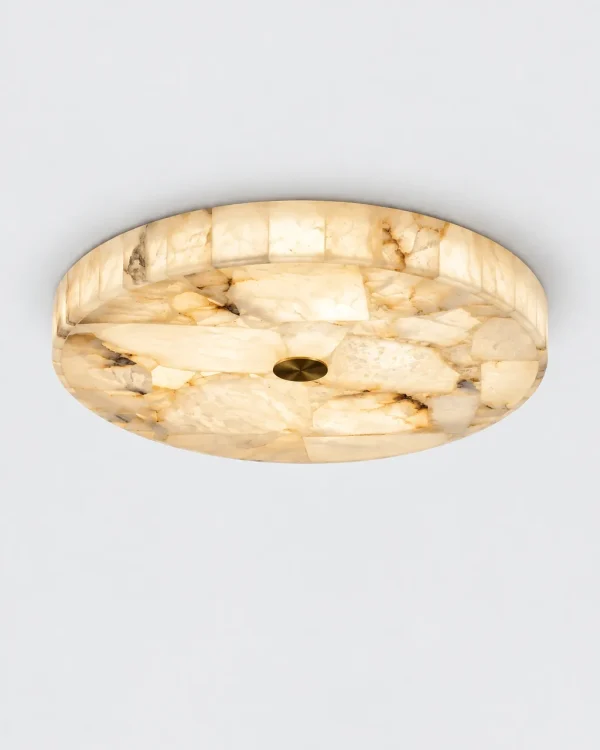
BATRAZ sets a mosaic of alabaster panels in a brass frame, 5 cm deep and Ø 40, 50 or 60 cm. Alongside three fixed colour temperatures, there is a separate dimmable version.
You will find more models in the Alabaster ceiling lights collection. How alabaster diffuses light, and why it suits dimming so well, is explained in our guide to travertine, alabaster and marble lamps.
Which dimmer suits an LED ceiling light?
Most wall dimmers in homes are phase dimmers. They cut off part of the mains voltage and so make the light dimmer. The term “triac dimmable” on a light means it is designed for this type of dimmer.
| Dimmer type | How it works | Suitable for LED? |
|---|---|---|
| Leading edge (often called triac) | cuts off the start of each half-wave | only with lights specified for it, check the minimum load |
| Trailing edge | cuts off the end of each half-wave, quieter | usually the first choice for LED |
| Universal dimmer (LED universal dimmer) | detects the load and chooses the method itself | yes, if marked as LED-compatible |
| Wireless, app, remote control | control sits in the light or bulb | yes, the wall switch stays permanently on |
| Old rotary dimmer for incandescent bulbs | often a high minimum load (e.g. 40–60 W) | frequent flickering, better replaced |
The most common cause of flickering is the minimum load. An 18 W LED light won’t run a dimmer that needs at least 40 W smoothly. So look for a dimmer with a low minimum load for LEDs, which is stated in its data sheet. And check the maximum load too: many LED dimmers handle far fewer LED watts than incandescent watts.
LED ceiling light with a remote control, or dimmable via the switch?
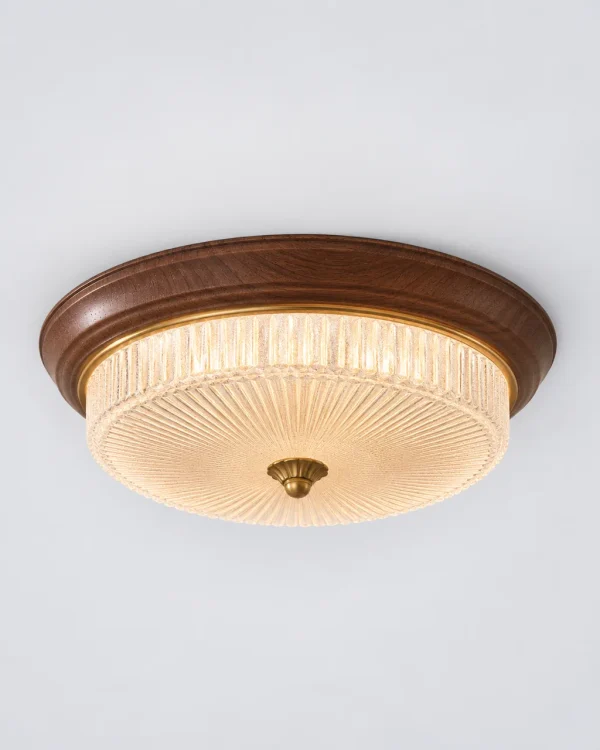
If there is no dimmer in the wall, or you don’t want to have one fitted, there are two simple ways. An LED ceiling light with a remote control dims inside the light itself. JANNE, for example, combines a walnut-effect ring with ribbed glass, is 10 cm deep and comes in Ø 33, 40 or 50 cm. According to the manufacturer, it dims with the remote control supplied, so in the bedroom you can do it straight from the bed.
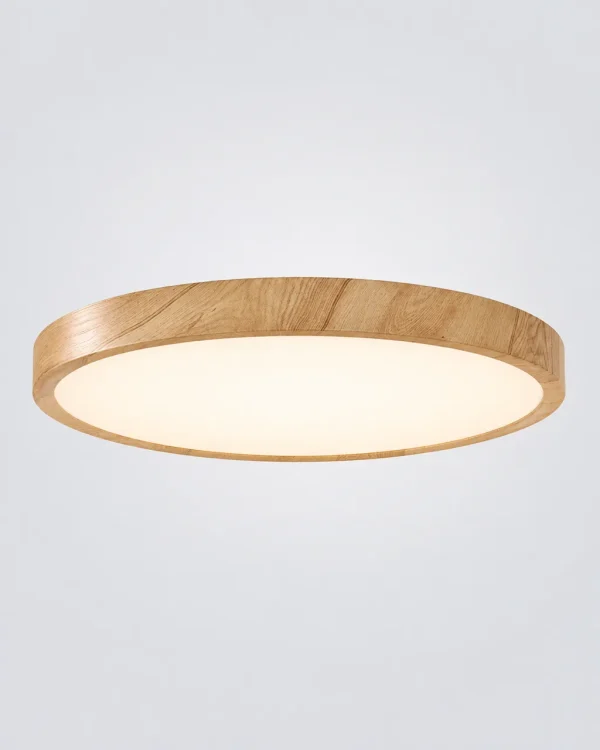
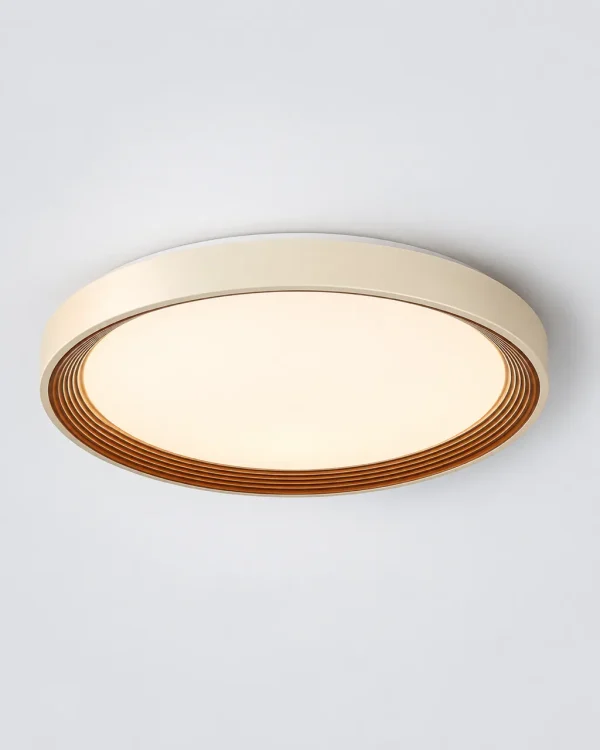
The second solution switches the colour temperature rather than the brightness. HILDE is an LED panel only 2.4 cm deep, in Ø 23, 30 or 40 cm. With the wall switch, you move between 2800 K, 4000 K and 5000 K. IDUN, with a wood-coloured grooved rim and 7 cm deep, also switches between three colour temperatures. According to their descriptions, both are not dimmable. But warmer light in the evening has a similarly calming effect.
Our guide Choosing the right colour temperature, kelvin and lumens explains in detail which colour temperature suits what.
How do you dim a ceiling light with E27, E14 or G9?
With lights that have a lamp holder, the bulb is what counts. Only LED bulbs marked “dimmable” can be used with a dimmer. If you mix dimmable and non-dimmable bulbs in one light, the non-dimmable ones flicker or fail sooner. So always use identical bulbs of the same type in one light.
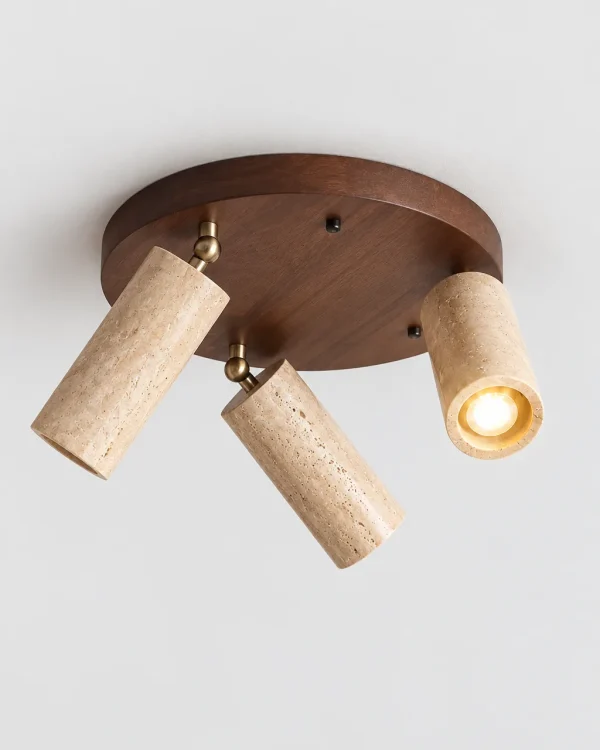
Our natural stone lights with lamp holders are expressly dimmable with a dimmable bulb and a suitable dimmer. BORA has three adjustable travertine spotlights on a round wooden base of Ø 30 cm, fitted with 3 × E27. That way you can aim one spotlight at a picture, one at a shelf and one at the doorway. SIRA lines up two or three satin glass globes under a travertine bowl, 27 or 40 cm long, with E27. JUNO, Ø 16 cm and 15 cm high, is a small travertine cone with an opal glass globe and a G9 lamp holder. The alabaster drum DESA measures Ø 40 or 50 cm and has E14 lamp holders.
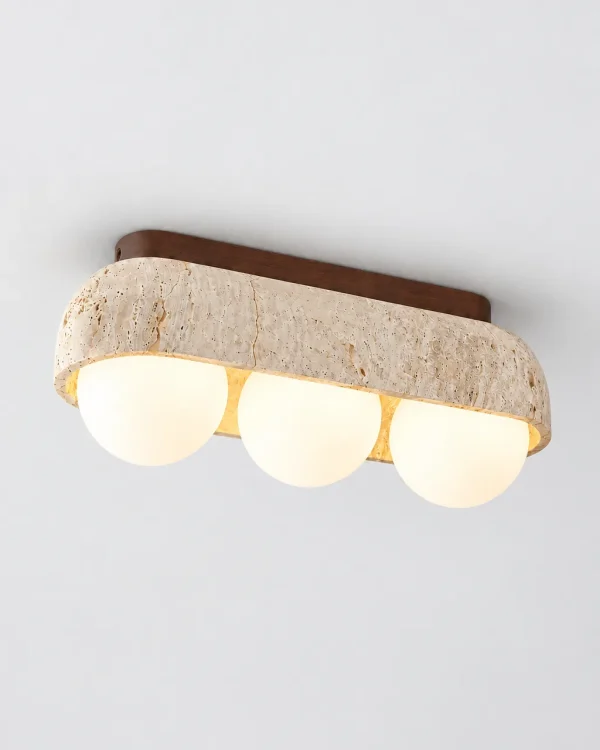
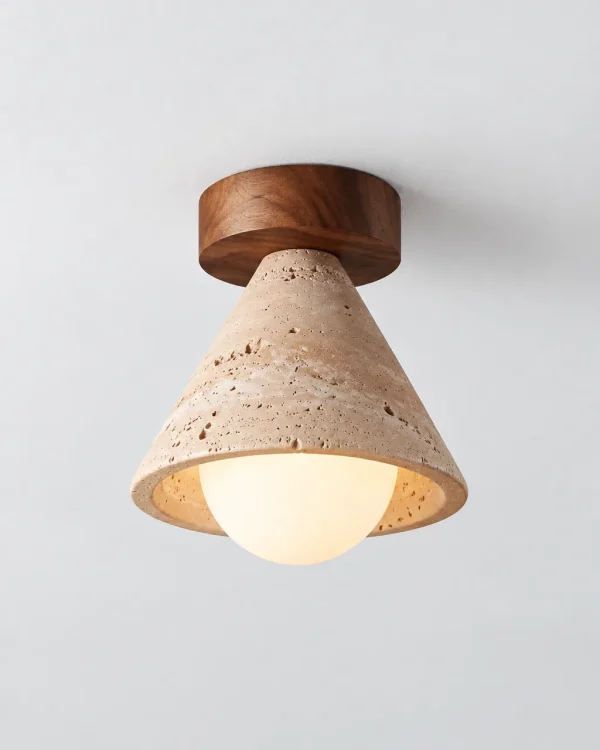
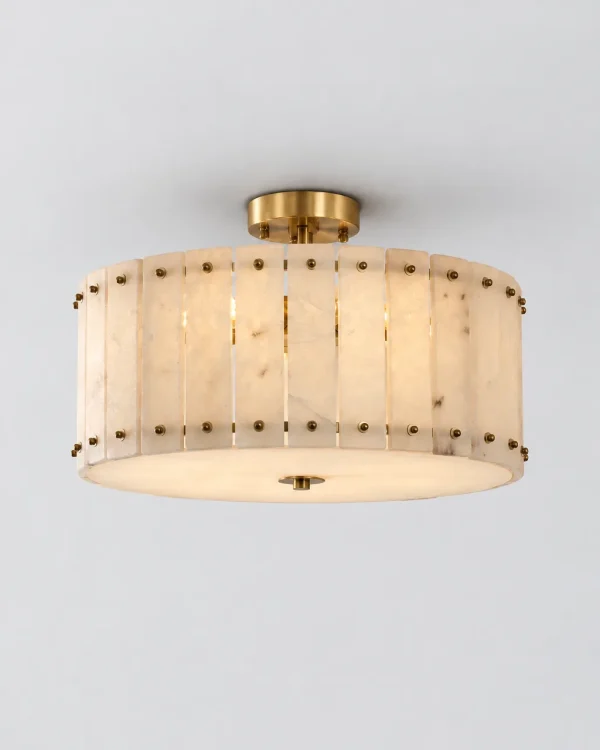
The Dimmable ceiling lights collection shows all the dimmable models, with built-in LED or a lamp holder.
How many lumens per square metre does an LED ceiling light need?
Lumens (lm) describe how much light a bulb gives off. With LEDs, watts say almost nothing about brightness. For planning, multiply the floor area by a guide value per square metre. The values apply to general light with a ceiling height of around 2.50 m and light walls.
| Room | Guide value for general light | Example |
|---|---|---|
| Living room | 100–150 lm/m² | 20 m² → 2000–3000 lm |
| Bedroom | 100–150 lm/m² | 14 m² → 1400–2100 lm |
| Hallway, entrance hall | 100–150 lm/m² | 8 m² → 800–1200 lm |
| Dining room | 150–250 lm/m² | 15 m² → 2250–3750 lm |
| Kitchen | 250–300 lm/m² | 10 m² → 2500–3000 lm |
| Study | 300–500 lm/m² | 10 m² → 3000–5000 lm |
Dark walls, wooden ceilings and ceilings over 2.80 m absorb light. Plan about 20 to 30% more there. With a dimmable light, you can safely go to the upper end, because you can always turn it down, but not up.
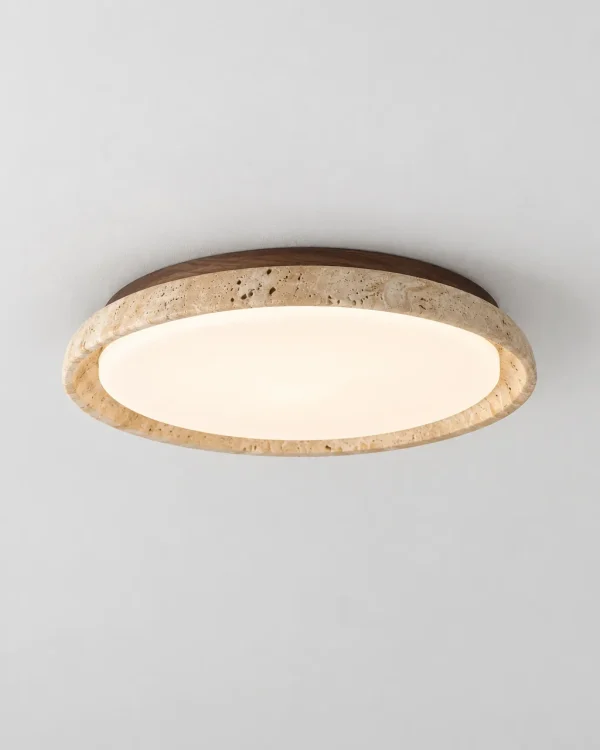
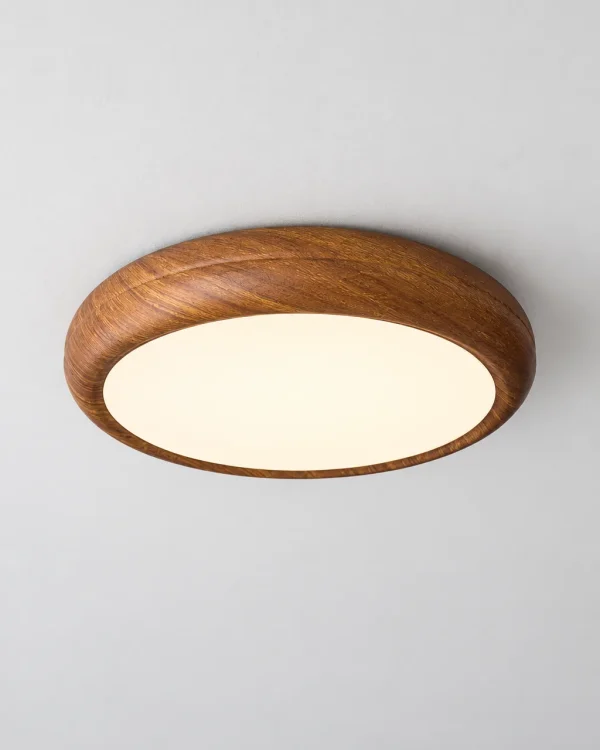
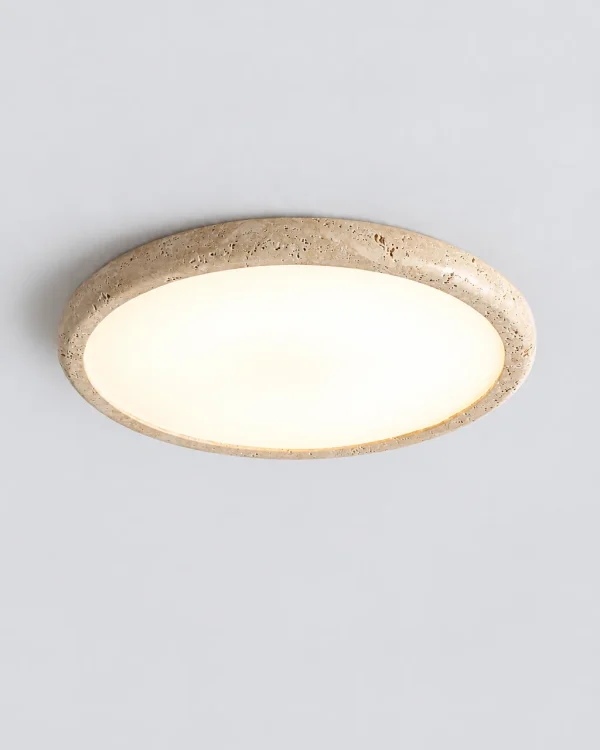
Some of our LED ceiling lights state the luminous flux directly. NADIA, with a travertine frame and 7 cm deep, gives 1980 to 5280 lm depending on size (Ø 30, 43 or 55 cm). On paper, the largest version can therefore light a living room of 35 m² and more. JILO, with a wood-effect frame, gives 1800 lm (18 W) to 3600 lm (36 W), warm white at 3000 K. Its LED module is replaceable. Neither is specified as dimmable, and both work as bright general light, complemented by dimmable floor or wall lights. ZELIA is ultra-slim at 5.5 cm and frames the light panel with travertine, in Ø 38, 48 or 58 cm.
Which dimmable ceiling light for the living room, bedroom and hallway?
In the living room, dimming is most worthwhile: bright for tidying up, dimmed for watching TV. Choose a large, flush light with enough lumens, such as FENZE in Ø 50 cm or BATRAZ in Ø 60 cm with 48 W. You will find measurements and spacing for the living room ceiling in our guide Living room ceiling lights: size and brightness.
In the bedroom, the light should be warm and low in the evening. A remote control like JANNE’s saves you the walk to the switch. More on this in our guide Bedroom lighting.
In the hallway, a small light such as CIBI or BILPI in Ø 20 to 30 cm is often enough. Dimmed, it serves as a guiding light at night. The Hallway ceiling lights collection shows suitable flush models. Stairs have their own rules; see Stair lighting.
 Collection · 13 designsDimmable Ceiling LightsView all 13 designs
What are the common mistakes when dimming LED ceiling lights?
- A non-dimmable light on a dimmer: flickering, humming and a shorter service life are the result. If in doubt, use a normal switch.
- An old incandescent dimmer: the minimum load is too high, so the LED flickers at the bottom of the range or goes out completely.
- Too few lumens bought: a dimmed light can never get brighter than its maximum. Better to plan 20% in reserve.
- Cool white in a living space: dimmed 6000 K light looks grey and dreary. For living spaces, 2700 to 3000 K is more pleasant.
- Remote control plus wall dimmer: a light with its own dimmer belongs on a normal switch, not on a dimmer as well.
Frequently asked questions
Can you dim any LED ceiling light?
No. An LED ceiling light with built-in LED is only dimmable if the manufacturer expressly specifies it, for example as “triac dimmable”. With lights that have a lamp holder, you need a dimmable LED bulb. If the description says nothing about it, treat the light as not dimmable.
What does triac dimmable mean?
Triac dimmable means that the light works with a phase dimmer in the wall box, the type commonly found in homes. The dimmer itself is usually not included. Make sure it is suitable for LEDs and has a low minimum load.
Why does my dimmable LED ceiling light flicker?
Usually the dimmer doesn’t match: its minimum load is higher than the LED’s wattage, or it is designed for incandescent bulbs. An LED-compatible trailing-edge or universal dimmer solves the problem in most cases. If the light also flickers without a dimmer, have the wiring checked.
How many lumens does a living room need?
For general light in the living room, allow about 100 to 150 lumens per square metre. A 20 m² room therefore needs around 2000 to 3000 lm. With dark walls or high ceilings, plan 20 to 30% more.
Is an LED ceiling light with a remote control better than a wall dimmer?
A remote control needs no work on the wall and is practical in the bedroom. A wall dimmer, on the other hand, is always in the same place and can’t get lost. You shouldn’t combine both on the same light.
Can I dim a ceiling light with an E27 lamp holder?
Yes, if the LED bulb fitted is marked as dimmable and an LED-compatible dimmer is installed. In a multi-light fitting, always use identical bulbs. Whether the light itself is approved for use with a dimmer is stated in the product description.