Rattan Lamp: How It Shapes the Light, Styling Ideas and Care
How rattan and bamboo filter light, what size a rattan pendant light needs, how to style it in a boho or Japandi room and how to look after it.
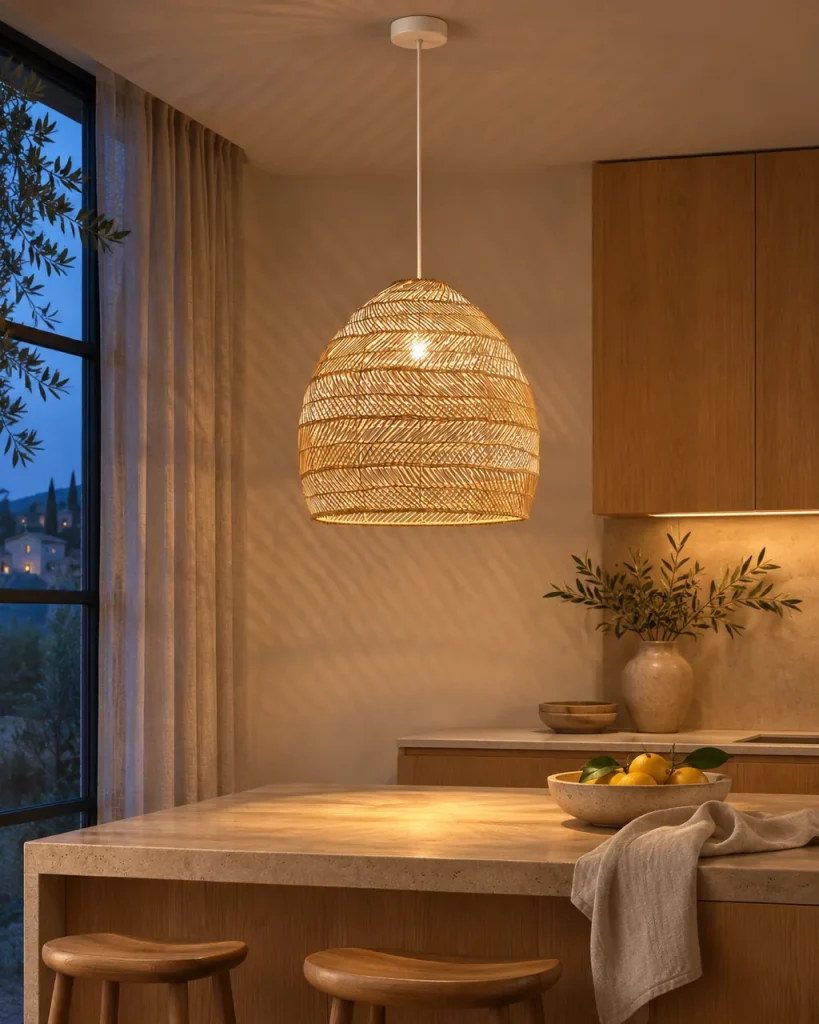
A rattan lamp filters light through a weave of natural fibres: the denser the weave, the more light is directed downwards; the more open it is, the more the lamp draws a pattern of light and shadow on the walls and ceiling. Rattan and bamboo feel warm, light and natural, which is why they suit boho, Japandi and Scandinavian rooms. To look after it, regular dusting with a soft brush is enough; a rattan lampshade rarely needs water.
In this guide you will find out how rattan and bamboo differ, which weave gives which light, what size a rattan pendant light needs and how to style it in a boho or Japandi room.
Rattan, bamboo or wicker: what’s the difference?
In everyday language, almost any woven lamp is called a “rattan lamp”. In fact, there are two different plants behind it, with different properties.
- Rattan comes from tropical climbing palms. The stems are solid inside, flexible and can be bent into round shapes after steaming. For lampshades, thin canes or the stripped outer skin are woven together. Rattan is honey-coloured and darkens slightly over time.
- Bamboo is a grass with hollow stems. For lamps, it is split into flat, narrow strips and woven diagonally or in a diamond pattern. Bamboo weave is lighter and more even, and the surface looks a little smoother.
- Wicker is the umbrella term for both techniques. A “wicker lamp” can be made of rattan, bamboo or other natural fibres.
For the effect of the light, the plant matters less than the density of the weave. In our Rattan lamps collection you will find both: shades of real rattan such as BINE, ASTA and ARVE, and lights in woven bamboo with a rattan look, such as ANNI, AMRA or KARLA. Every product page states what the shade is made of.
What kind of light does a rattan lamp give?
The weave determines how the light reaches the room. The overview below helps you choose the right rattan lamp for your purpose.
| Weave | Effect of the light | Ideal for | Example |
|---|---|---|---|
| Densely woven | light focused downwards, the shade glows warmly | dining table, kitchen island, reading corner | BINE |
| Open canes | stripes of light on the wall, bulb visible | high rooms, hung above head height | ARVE natural or black |
| Open diamond weave | a distinct pattern of light and shadow on the ceiling and walls | mood light, hallway, bedroom | ANNI, KARLA, ARNE |
| Weave with diffuser | soft and glare-free, pattern only on the shade | dining table, living room, general light | AMRA |
| Leaves or fringes | filtered light downwards and to the side | statement light over a table or seating area | ASTA, ALDA |
Rattan pendant light: what size and how high?
The same rules apply to a rattan pendant light as to any pendant. Over the dining table, the lower edge hangs 60 to 75 cm above the tabletop, and the diameter is about half to two thirds of the table’s width. All the details are in our guide Pendant lights over the dining table. Because woven shades look light, a rattan shade can be one size larger than a metal or stone shade.
| Spot | Recommended diameter | Note |
|---|---|---|
| Round dining table Ø 90–110 cm | Ø 50–60 cm | a single light |
| Dining table 180–200 cm long | 2 × Ø 40–50 cm or 1 × Ø 80 cm (shallow) | shallow shapes stay airy |
| Kitchen island | 2–3 × Ø 30–40 cm | about 60–80 cm between the centres of the lights |
| Living room, centre of the room | (room length + room width in m) × 8 = Ø in cm | lower edge at least 200 cm above the floor |
| Bedroom, hallway | Ø 30–40 cm | compact shapes or a ceiling light |
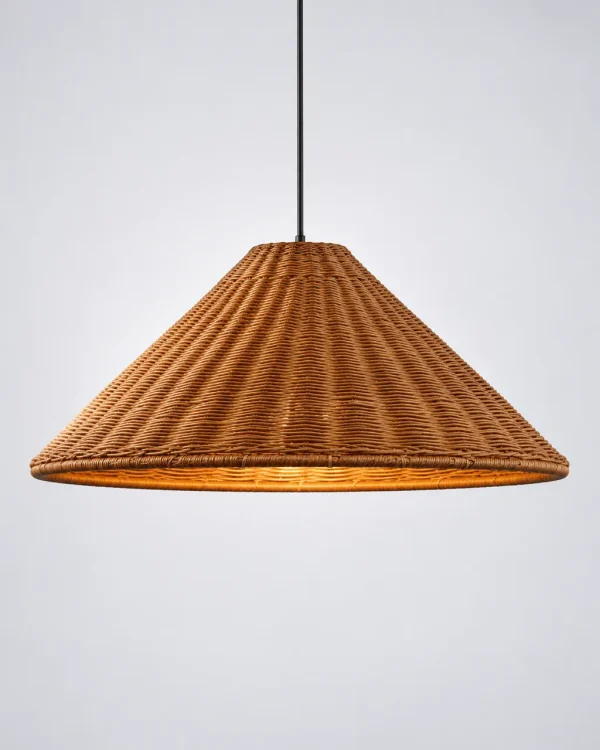
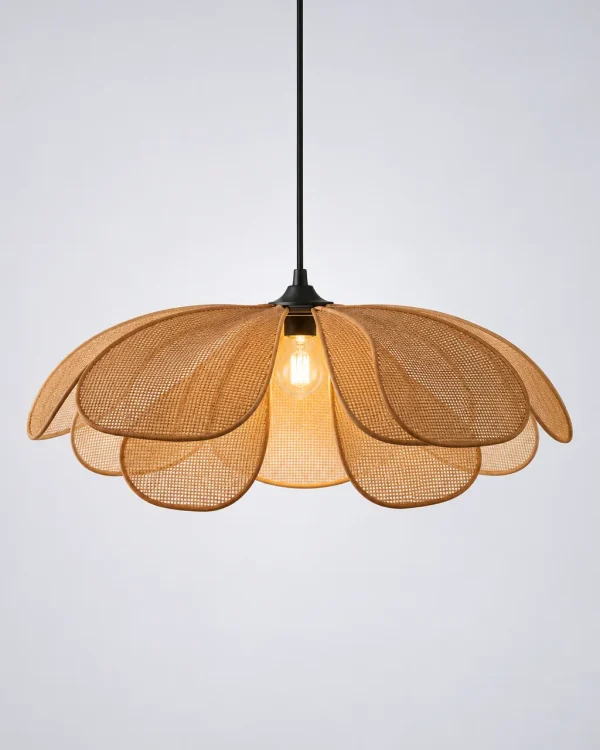
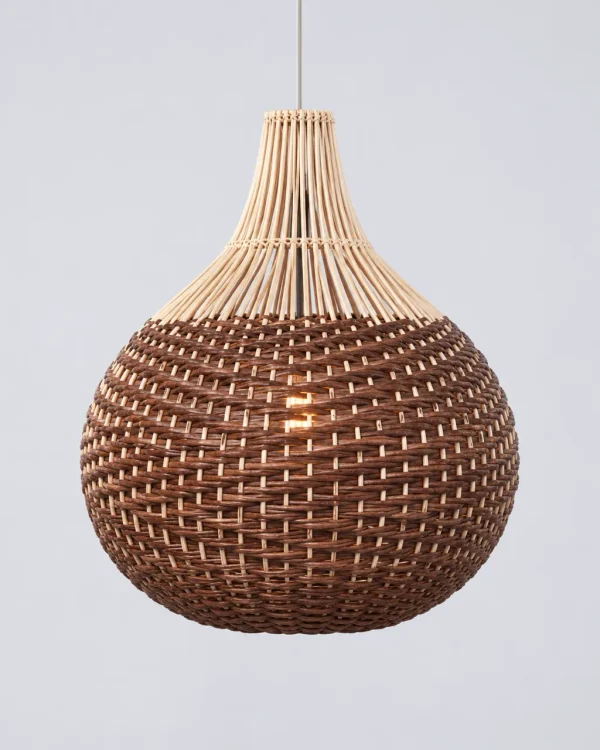
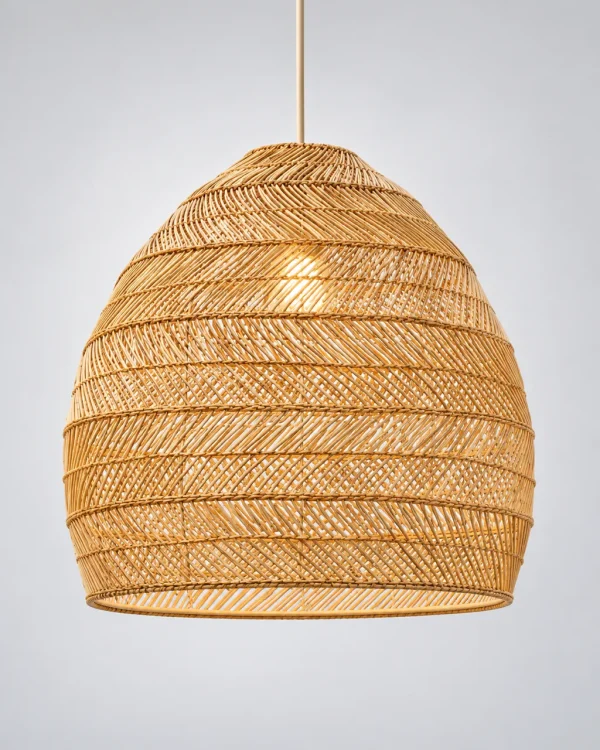
BINE is a shallow, densely woven rattan cone in natural or brown, in Ø 40 × 20 cm, Ø 50 × 20 cm or Ø 60 × 24 cm. The light falls mainly downwards, which makes it a good choice over the dining table. ASTA is made of ten overlapping leaves with rattan weave, in Ø 50, 60, 80 or 100 cm with a 120 cm adjustable cable, and the large sizes suit long tables. ARVE has a rounded teardrop shape in four finishes and four sizes from 30 to 60 cm. ANNI is a dome of woven bamboo, as tall as it is wide, from Ø 35 × 35 cm to Ø 60 × 60 cm, in natural or black.
You will find all the hanging models in the Rattan pendant lights collection.
Rattan lampshade: which bulb is right?
A rattan lampshade is a natural material and reacts to heat. With an LED bulb you are on the safe side, because it gives off very little heat. Also follow these rules:
- LED instead of incandescent or halogen. The maximum permitted wattage is stated on the product page or on the lamp holder.
- Distance from the weave: the bulb must not touch the shade. With narrow shades, a smaller bulb shape helps.
- Colour temperature 2,700 K: warm white makes the honey tone of rattan and bamboo glow. Cool white light makes the weave look grey.
- Brightness: open weaves absorb less light than dense ones. For a densely woven dining table light, you can plan 800 to 1,000 lumens; for mood light, 400 to 500 lumens is enough.
Most of our rattan and bamboo lights have an E27 lamp holder, so you choose the bulb yourself. Whether it is included is stated on each product page. Our guide Colour temperature, kelvin and lumens explains more about choosing kelvin and lumens.
Rattan floor lamp, table lamp, wall light or ceiling light?
Natural weaves don’t only work as pendants. With a second light in the same material, you connect different areas of a room.
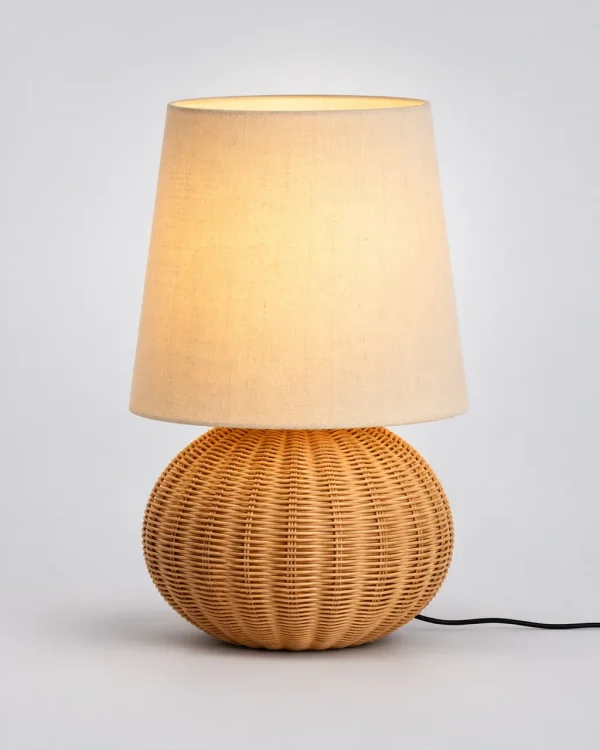
- Table lamp: RONJA has a woven rattan base with a cream fabric shade, either as a round base with a Ø 27 cm shade and 45 cm tall, or as a column with a Ø 35 cm shade and 47 cm tall. A warm white bulb is included.
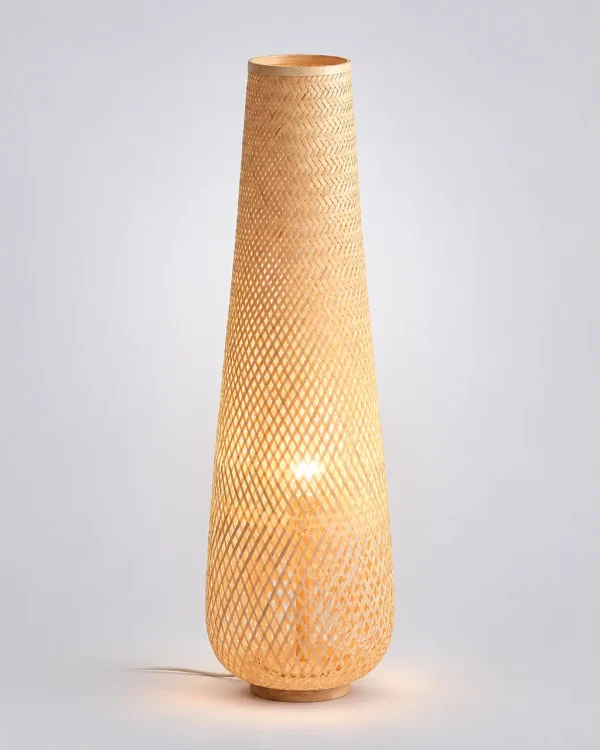
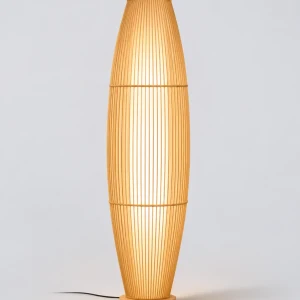
- Floor lamp: ARNE is a woven bamboo body in natural or black, 93 cm tall and Ø 28 cm. It is a low floor light for mood beside a sofa, armchair or bed.
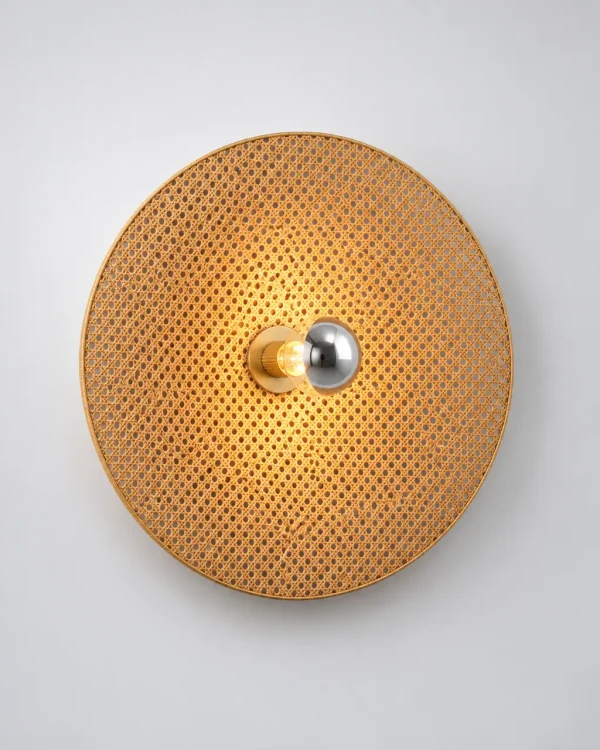
- Wall light: SANNA is a round disc of woven bamboo in Ø 30, 40, 50, 60 or 90 cm with a visible E27 bulb in the centre, both a light and a wall piece.
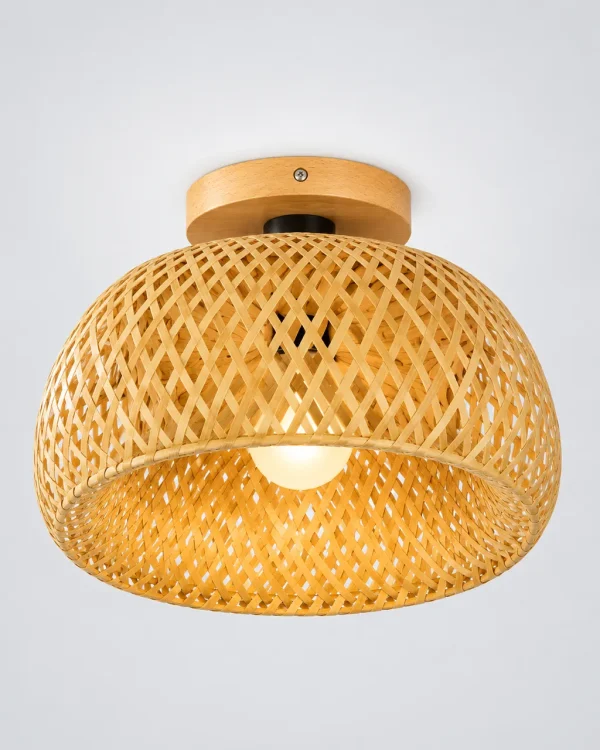
- Ceiling light: KARLA is a dome of woven bamboo, Ø 30 cm with a shade only 14 cm high, on a wooden base, which suits low ceilings in the hallway or bedroom.
Boho or Japandi: how do you style rattan lamps?
Rattan is at home in both styles, but it is used differently.
Boho thrives on abundance: different weaves, fringes, plants, jute, linen and warm earthy tones. Here you can mix shapes, for example a fringed light over the table, a woven wall disc and a rattan table lamp. ALDA combines a woven bamboo head with long, freely falling strips, from Ø 15 × 65 cm to Ø 45 × 62 cm.
Japandi is calmer: few materials, muted colours, clean shapes and dark accents. Choose a single, calm shape, for example a shallow shade with a diffuser or a black version, and combine it with light wood, linen and paper. AMRA is a shallow, lens-shaped bamboo shade with a white inner diffuser, from Ø 40 × 20 cm to Ø 80 × 30 cm, and the light comes through softly and without glare. You can read more about this style in our guide Japandi and wabi-sabi lamps, and about paper lights in our guide Rice paper lamps.
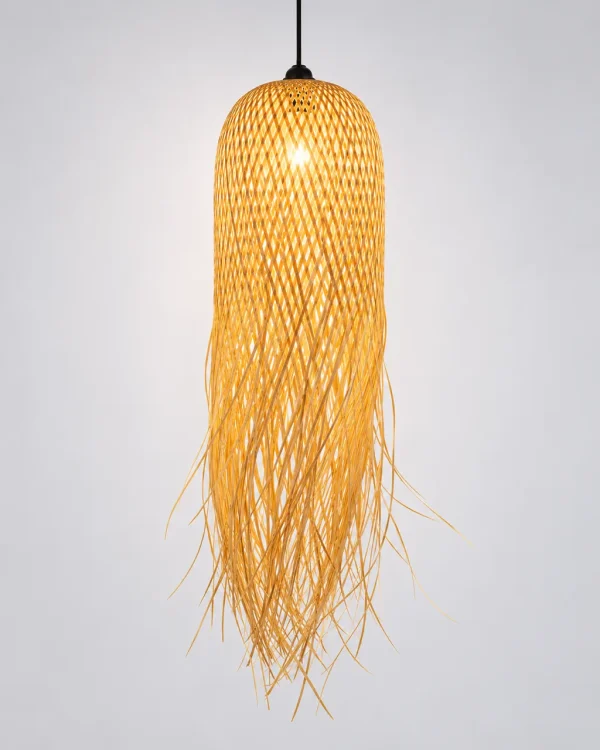
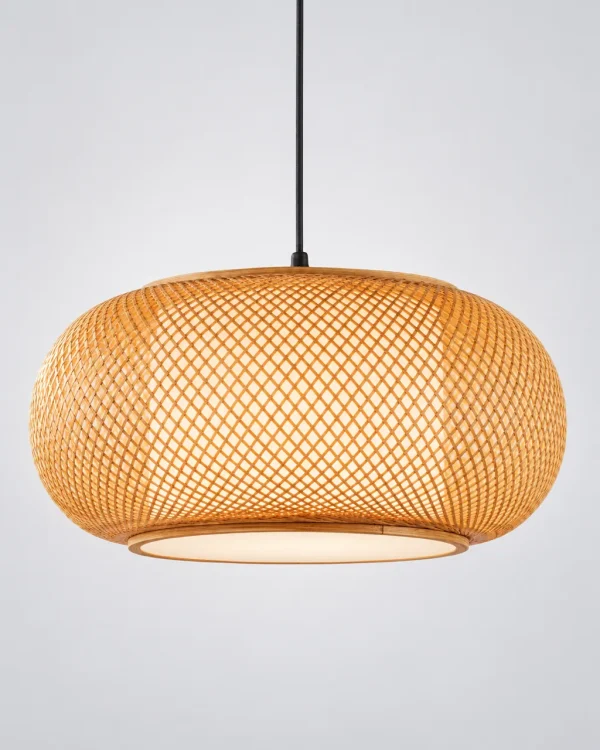
For both styles: two to three lights in natural weave per room are enough. Vary the size and height, not the material. And match the tone: natural goes with oak and ash, brown and black with walnut and dark floors.
 Collection · 15 designsRattan LampsView all 15 designs
How do you clean and look after a rattan lamp?
Rattan and bamboo are hard-wearing as long as they stay dry. This is how to keep your rattan lamp looking good for years:
- Switch it off and let it cool.
- Dust every two to four weeks: with a soft brush, a clothes brush or the brush attachment of the vacuum cleaner on a low setting. Work in the direction of the weave.
- For marks, wipe with a slightly damp cloth: well wrung out, with a little mild soapy water, then pat dry straight away. Never soak it.
- Let it dry before switching the lamp back on.
- Mind the location: natural weaves belong in dry indoor rooms. Very dry air directly above a radiator makes them brittle, and permanently damp air can warp them.
Rattan darkens over time in light and sun. That is normal and part of the material’s character. If one side of the lamp gets a lot of sunlight, you can turn it now and then so that it darkens evenly.
What are the most common mistakes with rattan lamps?
- A bulb that runs too hot. Incandescent and halogen bulbs give off a lot of heat. Use LED.
- A clear bulb in a low-hanging lamp. With open weaves it dazzles. A frosted bulb or a shade with a diffuser solves the problem.
- Too much weave in the room. Four or five wicker lights quickly look like a beach shop.
- Too small over the table. A Ø 35 cm shade disappears over a 2 m table. Use two lights or one large, shallow shape.
- The lamp as the only light source. Open weaves give an atmospheric but restless light. Add a floor or table lamp. Ideas in our guide Pendant lights for the living room.
Frequently asked questions
Is a rattan lamp safe?
Yes, if you use an LED bulb and keep to the maximum wattage stated on the product page. LEDs give off very little heat. Make sure the bulb doesn’t touch the shade.
Which is better, rattan or bamboo?
Both work well for lamps. Rattan is more flexible and looks a little bolder and more honey-coloured, while bamboo is lighter and its weave more even. For the light, what matters most is how densely or openly the shade is woven.
How do you clean a rattan lampshade?
Ideally dry, with a soft brush or the brush attachment of the vacuum cleaner. Remove marks with a well wrung-out cloth and mild soapy water. Then let the shade dry completely before switching the lamp back on.
Which bulb goes in a rattan lamp?
An LED with a colour temperature of 2,700 K. For a sharp shadow pattern, use a small clear bulb; for soft light, a frosted globe bulb. The right lamp holder, usually E27, is listed on the product page.
Can you use a rattan lamp outdoors?
Our rattan and bamboo lights are designed for indoor use. Rain and permanent damp warp the natural weave. For the patio and front door, the models in our Outdoor wall lights collection are suitable.
How high should a rattan pendant light hang over the dining table?
The lower edge sits 60 to 75 cm above the tabletop. With open weaves and a visible bulb, go towards the lower end, so that nobody looks into the lamp when seated. The diameter is about half to two thirds of the table’s width.
Does a rattan lamp suit a modern interior?
Yes, especially in a calm, pared-back shape. Black versions, shallow shades with a diffuser or a single large light go well with clean-lined furniture. Combine rattan with wood, linen and dark metal accents.