Bedroom Light Fixtures: Ceiling Lights, Sconces and Reading Lights
Which ceiling light suits the bedroom, how high to hang a sconce by the bed and what light you need for reading, with measurements, kelvin and small-room tips.
Good bedroom light fixtures start with a ceiling light that is flush, glare-free and warm white, yet it is only one of three light sources: on top of that you need an adjustable reading light by the bed on each side and one or two soft mood lights. A wall sconce for reading has its light output about 50 to 65 cm (20 to 26 in) above the mattress and 15 to 30 cm (6 to 12 in) to the side of the edge of the bed. Choose 2700 to 3000 kelvin throughout the bedroom and at least one dimmable fixture.
What bedroom light fixtures do you need?
In the bedroom you often lie on your back and look straight up at the ceiling. That is why lighting is planned differently here than in the living room. Instead of a single bedroom light, plan three layers:
- Ambient light: a bedroom ceiling light for getting dressed, picking up and making the bed. It has to light the room evenly without glare.
- Reading light: one directional light per person at the head of the bed, for example a bedside wall sconce for reading with a joint or swing arm.
- Mood light: a bedside lamp, a glowing stone sconce or a small pendant. This is the light that stays on in the evening when the ceiling light is off.
In the bedroom, the ceiling light is the least-used fixture. The lights by the bed, on the other hand, are on every evening. So invest in good light by the bed first.
Bedroom ceiling light fixtures: how big and how bright should they be?
For ambient light in the bedroom, around 100 lumens per square meter (about 9 per square foot) is enough. That is less than in a kitchen or bathroom, because nobody is chopping vegetables or putting on makeup here. Choose the diameter according to the size of the room:
| Bedroom | Ceiling light diameter | Lumens, ambient light (approx.) | Suitable type |
|---|---|---|---|
| up to 10 m² (110 sq ft) | 30–40 cm (12–16 in) | 800–1,000 lm | flush mount LED disc, small dome |
| 10–15 m² (110–160 sq ft) | 40–50 cm (16–20 in) | 1,000–1,500 lm | flush disc of stone or glass, fabric shade |
| 15–20 m² (160–215 sq ft) | 50–60 cm (20–24 in) | 1,500–2,000 lm | large fabric shade, wide stone ring |
| over 20 m² (215 sq ft) | from 60 cm (24 in) | from 2,000 lm | large ceiling light plus sconces, or two fixtures |
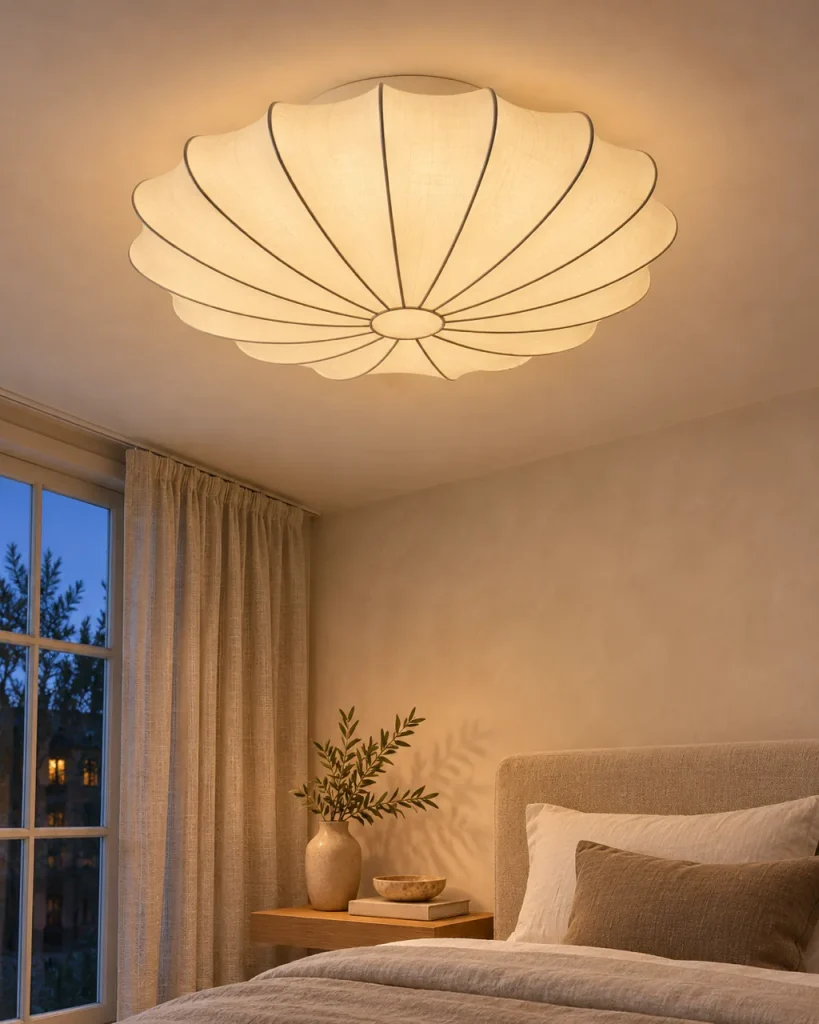
More important than size is freedom from glare. From the bed, you should never see the light source directly. An opal diffuser, a fabric shade or an alabaster disc is ideal. Clear glass with a visible bulb is blinding when you lie down. Place the ceiling light in the center of the room or above the foot of the bed, not directly over the pillow.
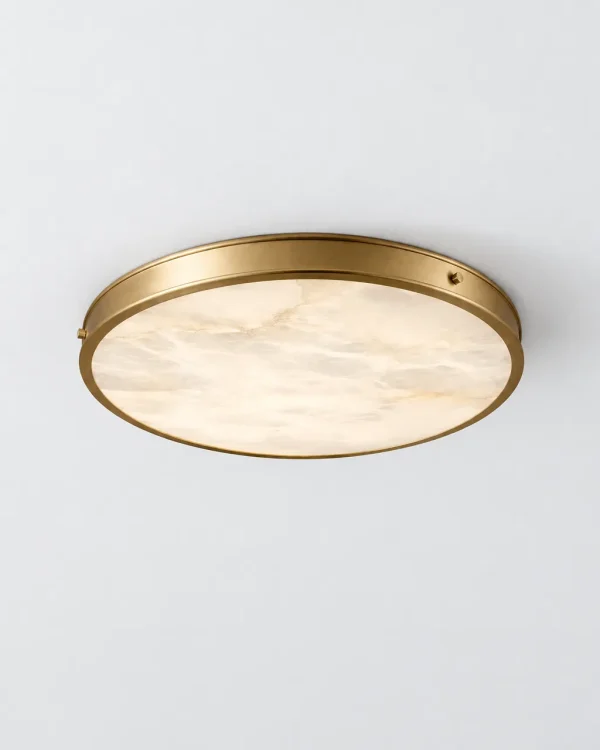
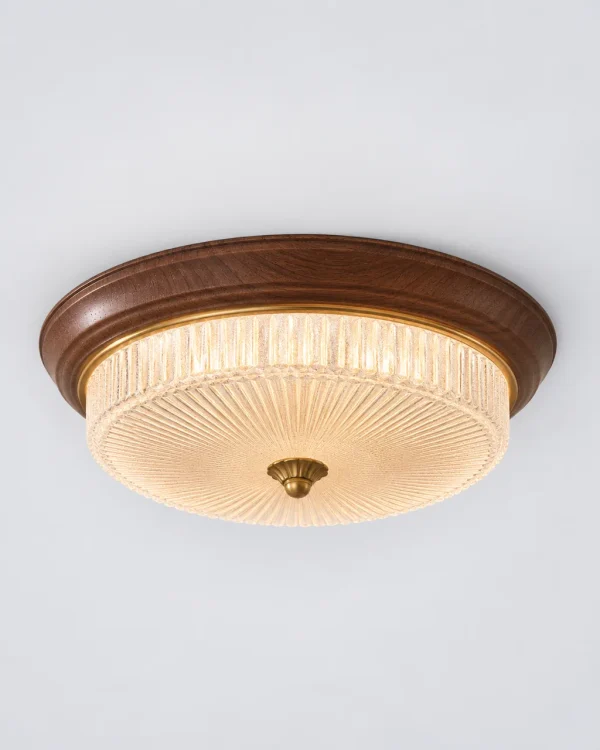
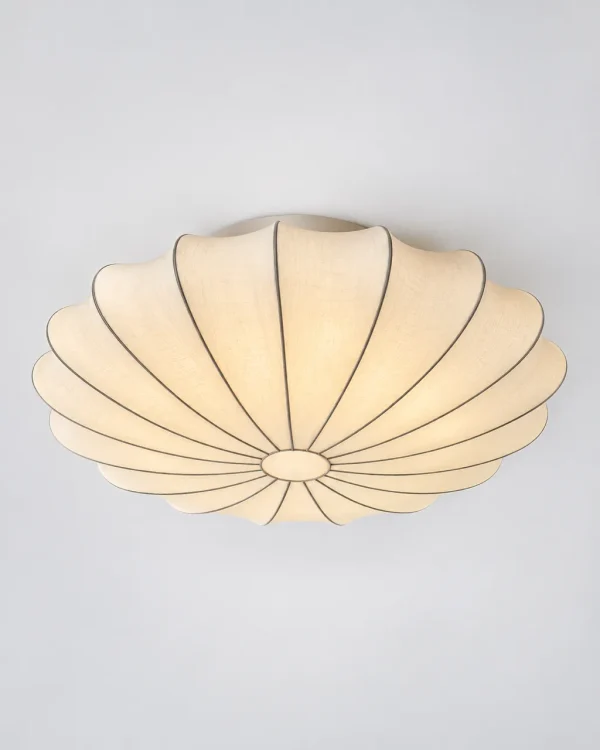
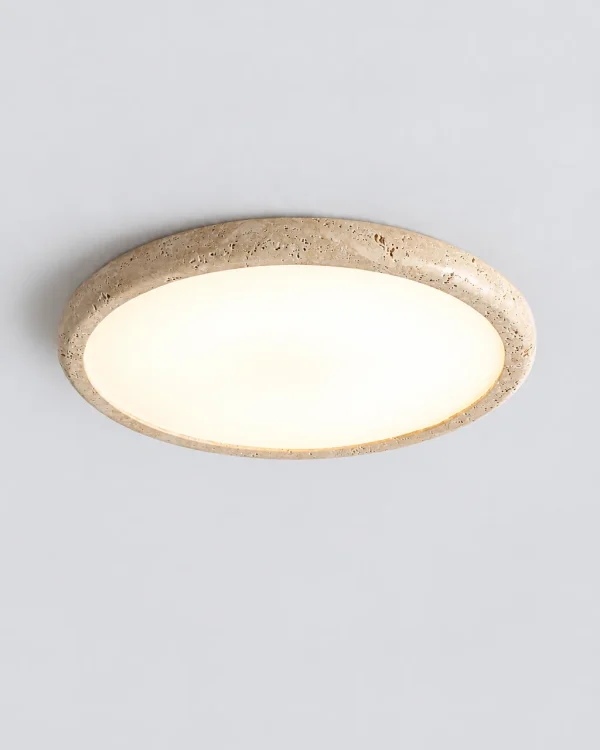
FENZE is a flush alabaster disc just 5 cm (2 in) deep, in Ø 30, 40 or 50 cm (12, 16 or 20 in). The light is warm white at 3000 K, and there is also a triac-dimmable version. JANNE, with fluted glass in a walnut-look frame, is 10 cm (4 in) deep and can be controlled from the bed by remote control; according to the manufacturer, it dims too. KELDA diffuses the light especially softly through a silk shade (Ø 40, 50 or 60 cm / 16, 20 or 24 in). For low ceilings, ZELIA is a good fit, a travertine ring only 5.5 cm (2 in) deep.
How to work out the diameter and brightness for larger rooms is explained in our guide to living room ceiling lights.
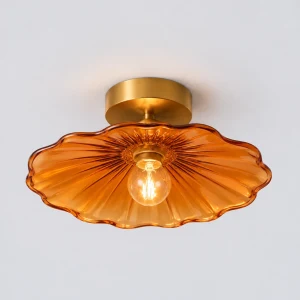 Collection · 55 designsBedroom Ceiling LightsView all 55 designs
Pendant lights in the bedroom: when are they a good choice?
A pendant light in the bedroom needs ceiling height. From about 2.50 m (8 ft 2 in), one is possible in the center of the room. Its bottom edge must be at least 2.00 m (6 ft 7 in) above the floor wherever you walk or sit up in bed. With a 2.40 m (7 ft 10 in) ceiling there is hardly any room for that, so a flush mount ceiling light is the better choice.
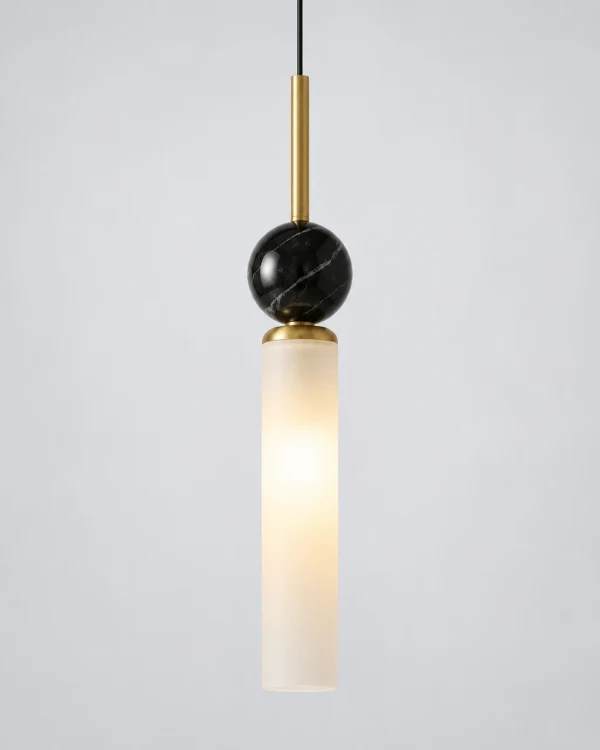
Small pendants beside the bed work especially well. They replace the bedside lamp and keep the nightstand free. The bottom edge hangs about 45 to 60 cm (18 to 24 in) above the nightstand, just above shoulder height when you sit up. You will find a selection among our bedroom pendant lights.
How high should bedroom wall sconces be?
The right height depends on whether the sconce is meant for reading or for mood. For reading light, always measure from the top of the mattress, not from the floor. On beds with a box spring, the mattress is often 60 to 70 cm (24 to 28 in) high; on low platform beds, only 40 to 50 cm (16 to 20 in).
| Fixture | Guideline | From the floor (mattress or nightstand approx. 55 cm / 22 in high) |
|---|---|---|
| Wall sconce as a bedside reading light | light output 50–65 cm (20–26 in) above the mattress | approx. 105–120 cm (41–47 in) |
| Wall sconce as mood light above the nightstand | center of the fixture 65–85 cm (26–33 in) above the nightstand top | approx. 120–140 cm (47–55 in) |
| Side distance of the sconce | center 15–30 cm (6–12 in) beside the edge of the bed | – |
| Pendant beside the bed | bottom edge 45–60 cm (18–24 in) above the nightstand | approx. 100–115 cm (39–45 in) |
| Bedside lamp for reading | bottom of shade 40–50 cm (16–20 in) above the mattress | lamp approx. 50–65 cm (20–26 in) tall |
| Pendant in the center of the room | bottom edge at least 200 cm (79 in) | ceiling height from approx. 250 cm (98 in) |
If your bed has a tall headboard, one extra rule applies: the wall sconce above the bed sits to the side of the headboard or high enough for its arm to reach over it. A reading light directly behind your head lights your hair instead of your book.
Bedside reading light: what matters?
A good reading light for the bed casts a focused beam onto the book, not into the room. That also protects the person next to you, who may already be asleep. Look for three things:
- Adjustable head: a joint or gooseneck lets you follow with the beam when you change position.
- Shielded light source: the LED or bulb sits deep inside the shade, so you don’t look straight into it.
- Switch within reach: a pull chain, a toggle switch on the wall plate or an in-line switch on the cord. You should be able to work the light without getting up.
TALOS is a slim travertine spotlight (Ø 4 cm / 1.5 in) on a walnut plate, with 3000 K, a pull chain and the spotlight on either the left or the right. That gives you a mirror-image pair for both sides of the bed. SOLRA delivers noticeably more light at 640–790 lm and swivels. FINA has a metal gooseneck and a toggle switch on the wood plate. SAKARI reaches 30 to 45 cm (12 to 18 in) out from the wall thanks to its articulated arm, ideal with a wide nightstand.
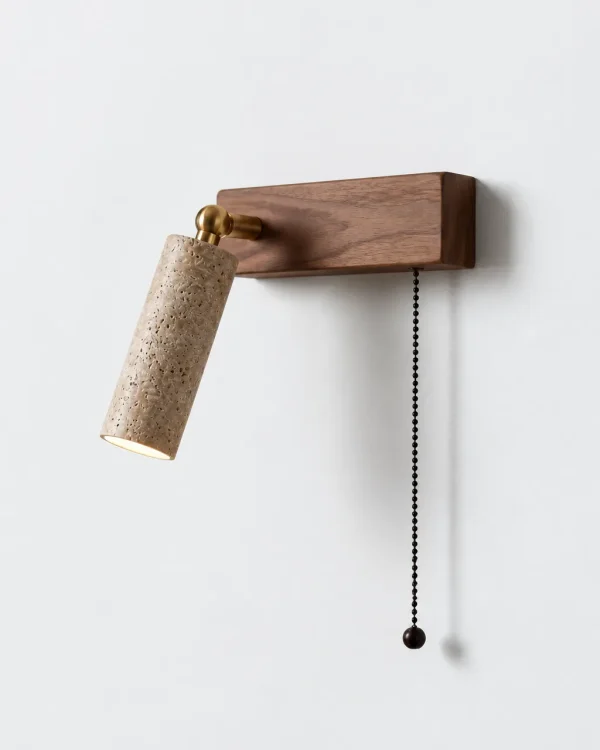
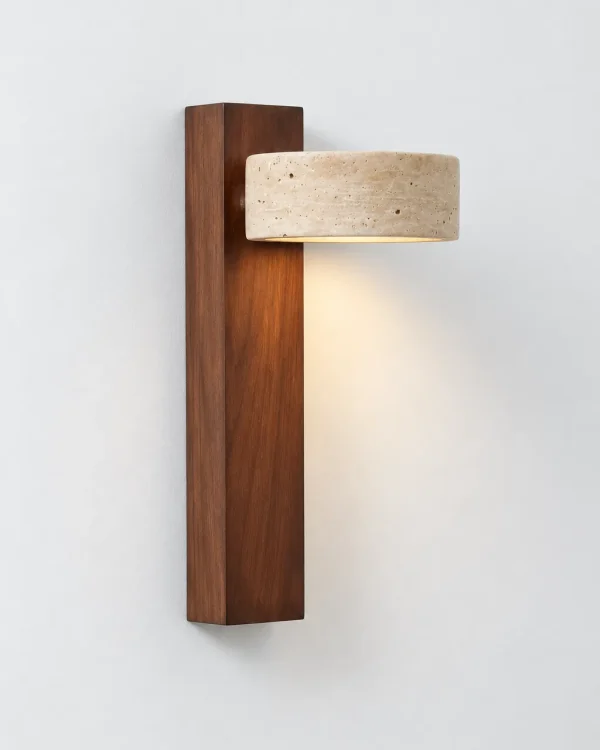
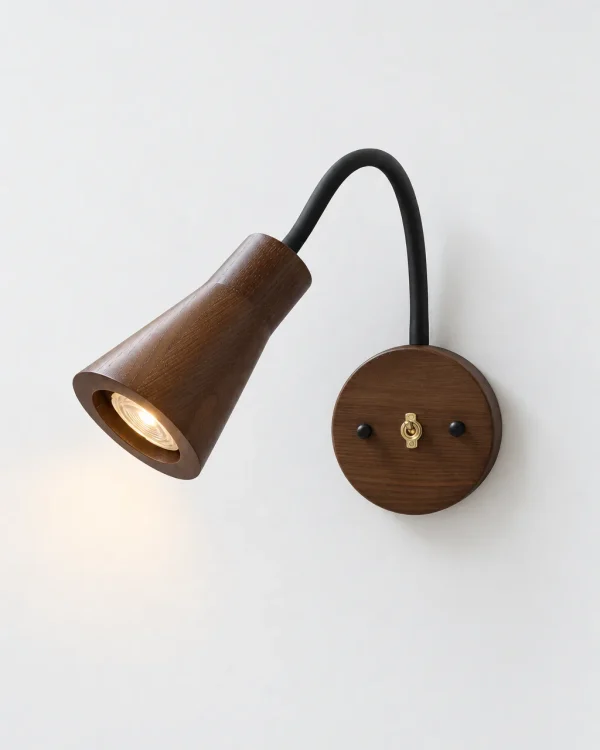
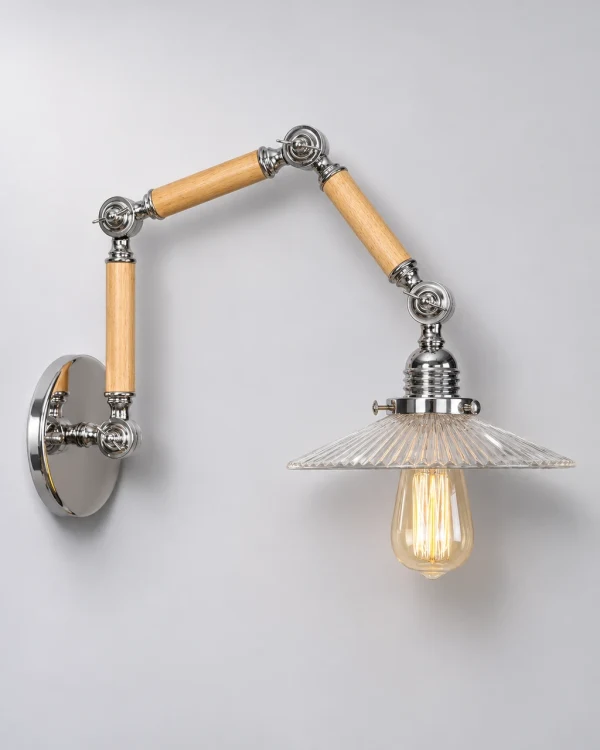
You will find more models in our bedside wall sconces for reading collection. If you would rather read by a table lamp, take a look at our reading lamps.
Plug-in wall sconces: what if there is no junction box?
Many bedrooms have no junction box on the wall next to the bed, only an outlet behind the nightstand. In that case, a plug-in wall sconce is the simplest solution. You screw it to the wall and plug in the cord, with no electrician and no opening up the drywall.
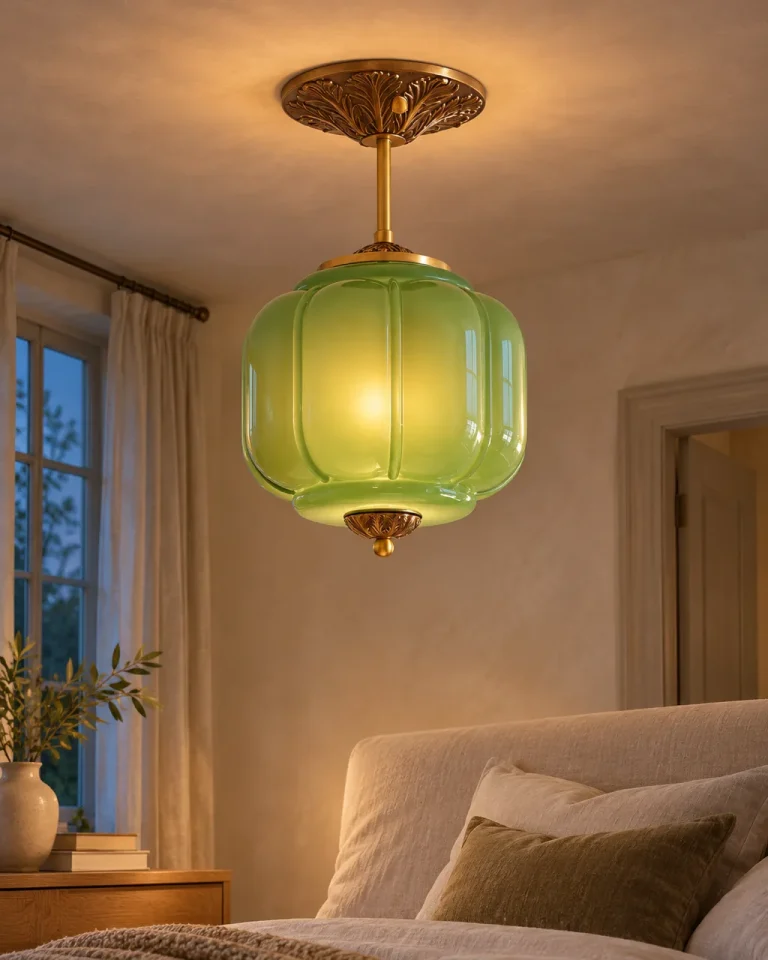
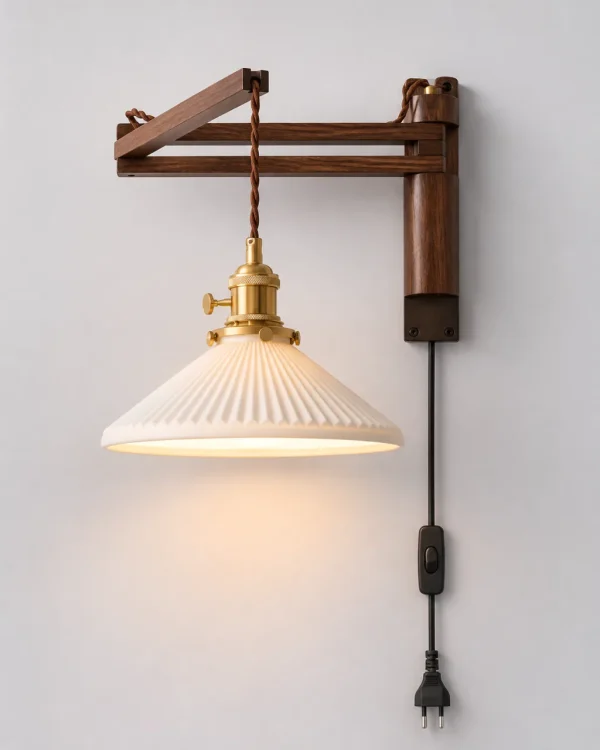
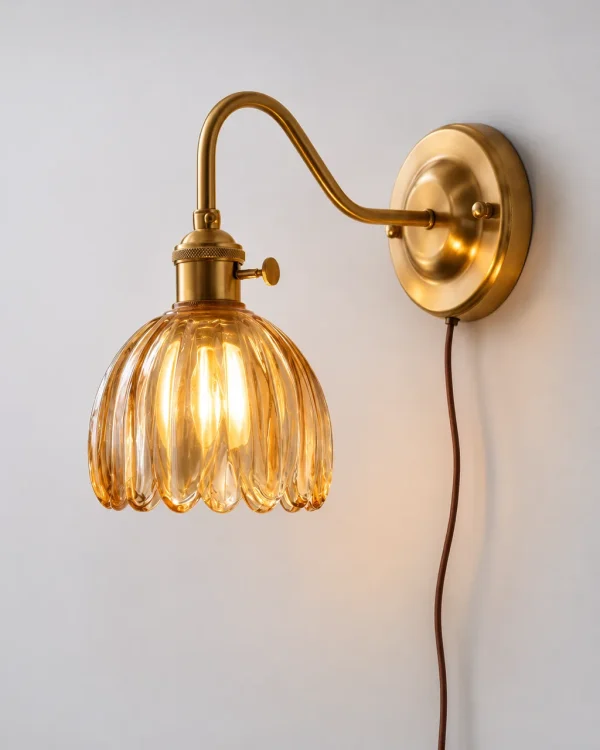
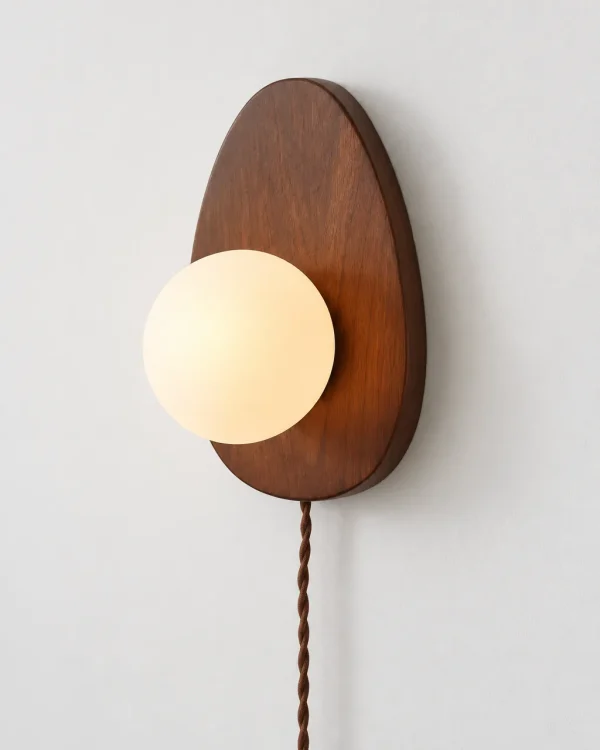
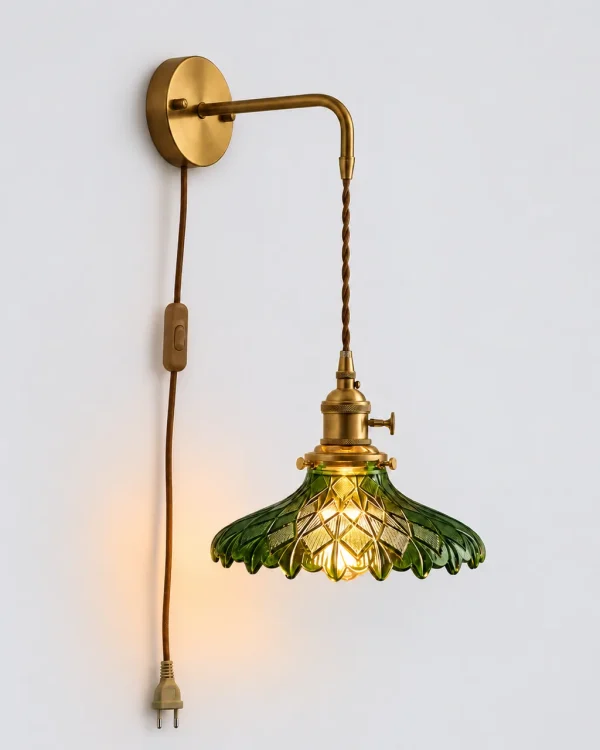
TUVA has a wood swing arm (arm 31 cm / 12 in, swiveling section 28 cm / 11 in), a ceramic shade of Ø 23 cm (9 in) and an in-line switch on the cord. TINE carries a ribbed glass flower on a gooseneck, projects 24 cm (9.5 in) from the wall and has a 1.8 m (6 ft) cord with a rotary switch on the lamp socket. CORI combines a wood plate with an opal glass globe and has a 150 cm (59 in) cord with a switch. On VANJA, green glass hangs from a 70 cm (28 in) adjustable pendant cord.
Which wall sconce works as mood lighting beside the bed?
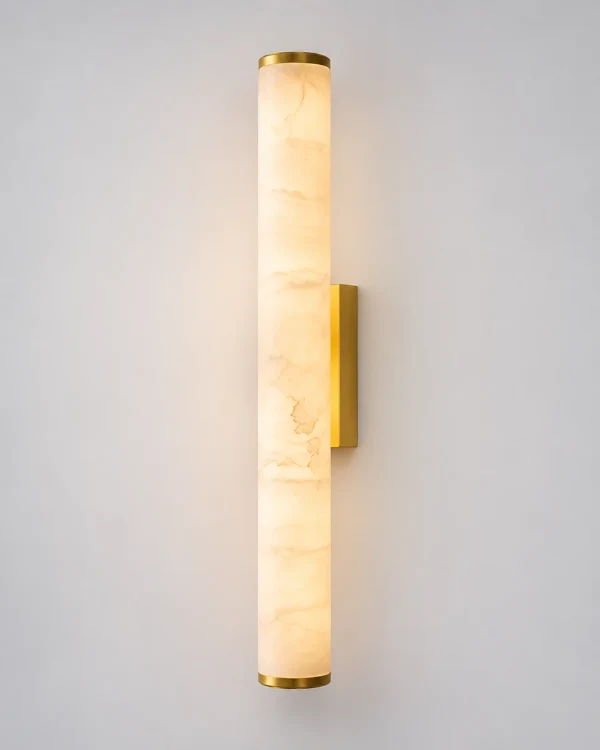
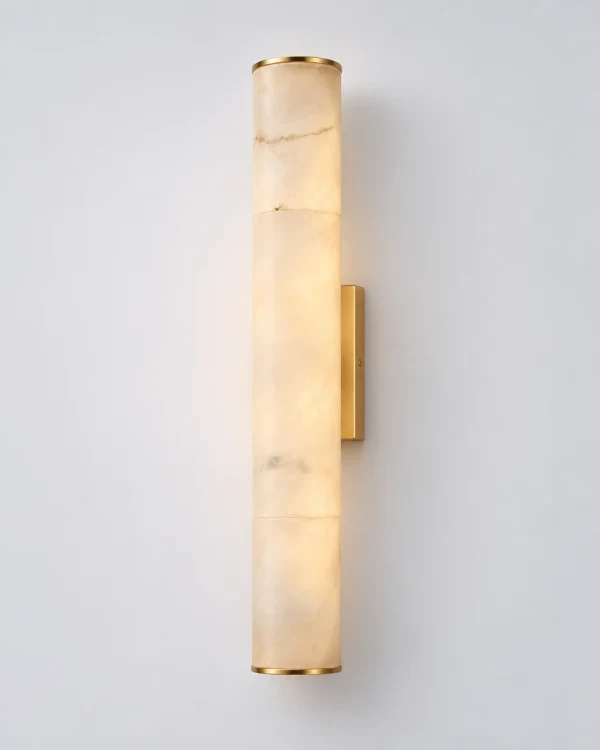
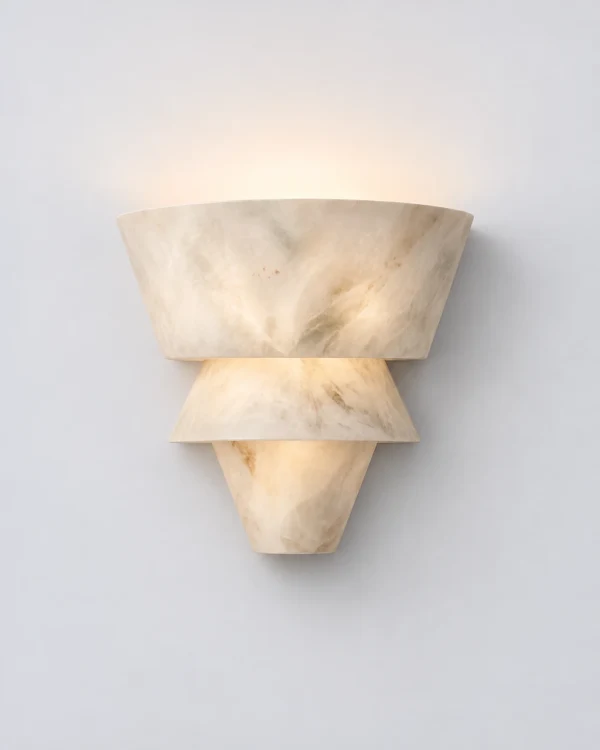
Not every bedroom wall sconce has to be a reading light. Glowing stone cylinders and bowls give a calm, indirect light that softens the room in the evening. They are usually too diffuse for reading, so combine them with a spotlight or use them on the side of the bed where nobody reads.
MERLE is a marble cylinder only 6 cm (2.5 in) in diameter and 30 to 60 cm (12 to 24 in) tall. The 30 cm (12 in) version fits beside a bed without taking up the nightstand. ERLE is made of dolomite rings with gold edges. HJALTE, made of three stepped marble cones, sends the light upward (22 cm / 9 in wide, 23 or 30 cm / 9 or 12 in tall). If you like wood, choose PAAVO: a curved wood body with an acrylic diffuser, about 18 × 26 cm (7 × 10 in).
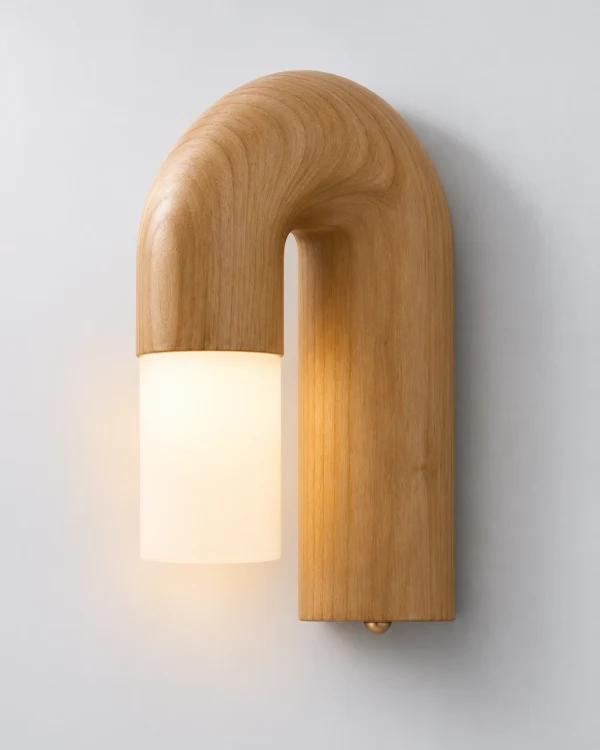
Read more about materials and mounting heights in living spaces in our guide wall sconces for the living room. You will find every stone model under travertine and stone wall sconces.
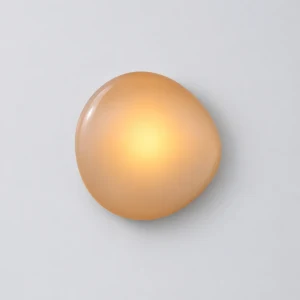 Collection · 246 designsBedroom Wall SconcesView all 246 designs
Bedside lamp, wall sconce or pendant: which is better?
A sconce saves space on the nightstand and can be aimed precisely. A bedside lamp needs no drilling and moves with you when you rearrange. A pendant beside the bed looks the lightest, but needs a ceiling box or a swag hook with a cord.
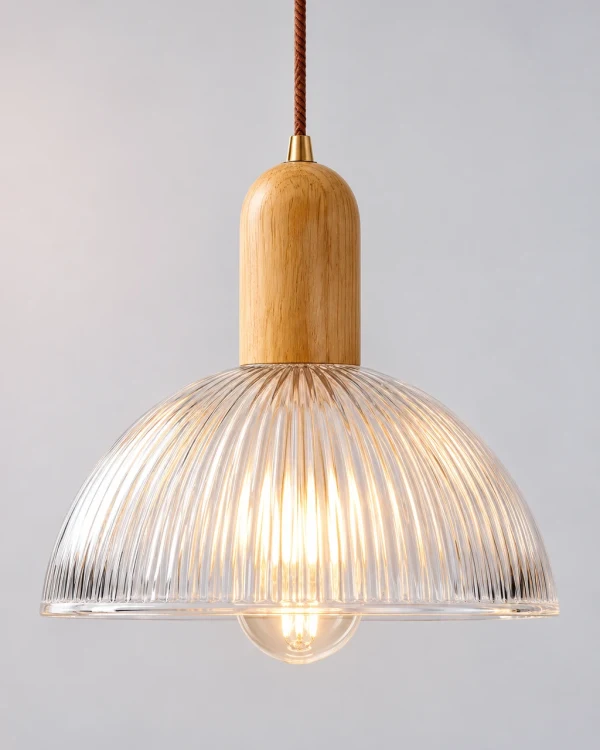
SIRI, at 25 cm (10 in) tall, is a compact marble bedside lamp with a cream fabric shade. It fits even on narrow nightstands. NORA is a cordless rechargeable lamp, 35 cm (14 in) tall, on a base just 5 cm (2 in) across, with touch dimming. ODDA comes as a wall sconce and as a pendant; the pendant has a 1.6 m (5 ft 3 in) adjustable cord. KIIA, in fluted glass with a wood top, comes from Ø 14.5 cm (5.7 in), with a 200 cm (79 in) adjustable cord.
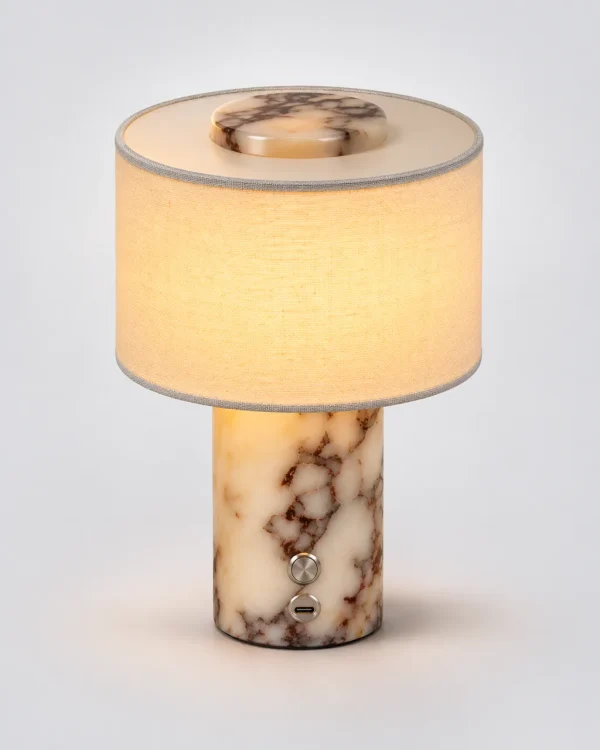
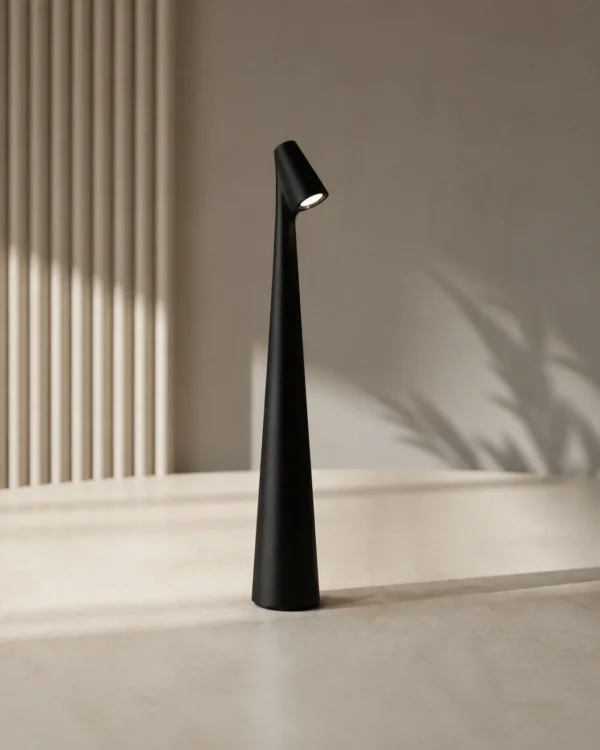
How to find the right bedside lamp is shown in our guide how to choose a bedside lamp. Whether rechargeable or corded suits you better is settled in our comparison cordless or corded table lamp.
Which color temperature and how many kelvin for the bedroom?
For every light in the bedroom: 2700 K for mood and bedside light, 3000 K for the ceiling light and reading light. Neutral white light from 4000 K feels cool and alerting in the evening and belongs in a home office. Avoid mixing very different color temperatures in the same room, or the walls will look patchy.
Dimming matters more in the bedroom than in any other room. A dimmable ceiling light or a dimmable wall sconce can be turned down to a third of its brightness in the evening. When you buy, check how it dims. Some fixtures have a remote control or touch control. Others need a compatible wall dimmer and a dimmable bulb.
How do you light a double bed symmetrically?
At a double bed, two identical fixtures at the same height look calm and high-end. If the two nightstands differ in height, measure the height from the floor, not from the nightstand. The distance between the centers of the fixtures is roughly the width of the bed plus 30 to 60 cm (12 to 24 in). For a bed 160 cm (63 in) wide, that means 190 to 220 cm (75 to 87 in).
Each side needs its own switch, so one person can read while the other sleeps. Fixtures with a choice of spotlight side, such as TALOS, can be mounted as a mirror-image pair, so both beams point toward the middle of the bed.
How do you light a small bedroom?
- Flush to the ceiling: an LED disc such as HILDE is just 2.4 cm (1 in) deep and takes up no ceiling height.
- Light on the wall rather than the nightstand: sconces and pendants keep narrow nightstands free.
- Small shades: on nightstands under 40 cm (16 in) wide, shades 12 to 15 cm (5 to 6 in) across are enough.
- Wash light-colored walls: light that falls upward or onto the wall makes a small room feel bigger.
- No floor lamp in the walkway: a floor lamp in the bedroom is only worth it if there is room for a reading nook with an armchair. Read more in our guide to floor lamps for the living room.
The most common bedroom lighting mistakes
- Only a ceiling light: the light comes from above, glares when you lie down and makes the room look flat.
- Visible bulb above the bed: clear glass and bare sockets have no place in your line of sight from the pillow.
- Cool white light: above 4000 K, the bedroom feels like an office.
- Reading light too high: if the light output sits higher than about 70 cm (28 in) above the mattress, the shadow of your head falls on the book.
- No switch by the bed: if you have to get up to switch off, you either leave the light on or read in the dark.
- Connection not checked: first measure where the junction box and outlet are, then choose between a hardwired fixture and a plug-in wall sconce.
Frequently asked questions
Which ceiling light is best for the bedroom?
A flush mount ceiling light with an opal diffuser, fabric shade or alabaster disc works best, because it won’t glare when you lie down. Choose warm white light at 2700 to 3000 K and, if possible, a dimmable version. For 10 to 15 m² (110 to 160 sq ft), a diameter of 40 to 50 cm (16 to 20 in) fits.
How high should a wall sconce by the bed be?
A sconce for reading has its light output about 50 to 65 cm (20 to 26 in) above the top of the mattress. With a mattress height of 55 cm (22 in), that is around 105 to 120 cm (41 to 47 in) from the floor. To the side, the center of the fixture sits 15 to 30 cm (6 to 12 in) beside the edge of the bed.
Which color temperature is best for the bedroom?
Warm white at 2700 K for mood light and 3000 K for the ceiling light and reading light. Light from 4000 K feels cool in the evening. Keep the color temperatures in the room as consistent as possible.
Can you install a wall sconce without a junction box?
Yes, with a plug-in wall sconce. You screw it to the wall and plug it into a regular outlet. Make sure the cord is long enough and there is a switch on the cord or on the fixture.
Is a pendant light above the bed a good idea?
Only with enough ceiling height, because the bottom edge should hang at least 2.00 m (6 ft 7 in) above the floor. Small pendants beside the bed, hanging about 45 to 60 cm (18 to 24 in) above the nightstand, are more practical. They replace the bedside lamp and keep the nightstand free.
How many lumens does a bedroom need?
For ambient light, about 100 lumens per square meter (about 9 per square foot) is enough, so around 1,200 lm for 12 m² (130 sq ft). Add the reading light by the bed, which shines straight onto the book. With a dimmer, you can adjust the brightness in the evening.