Wall Sconces for Living Room: Height, Spacing and Material
How high, how far apart, which material: every measurement for wall sconces above the sofa, beside the TV, in the hallway and by the bed, with a handy chart.
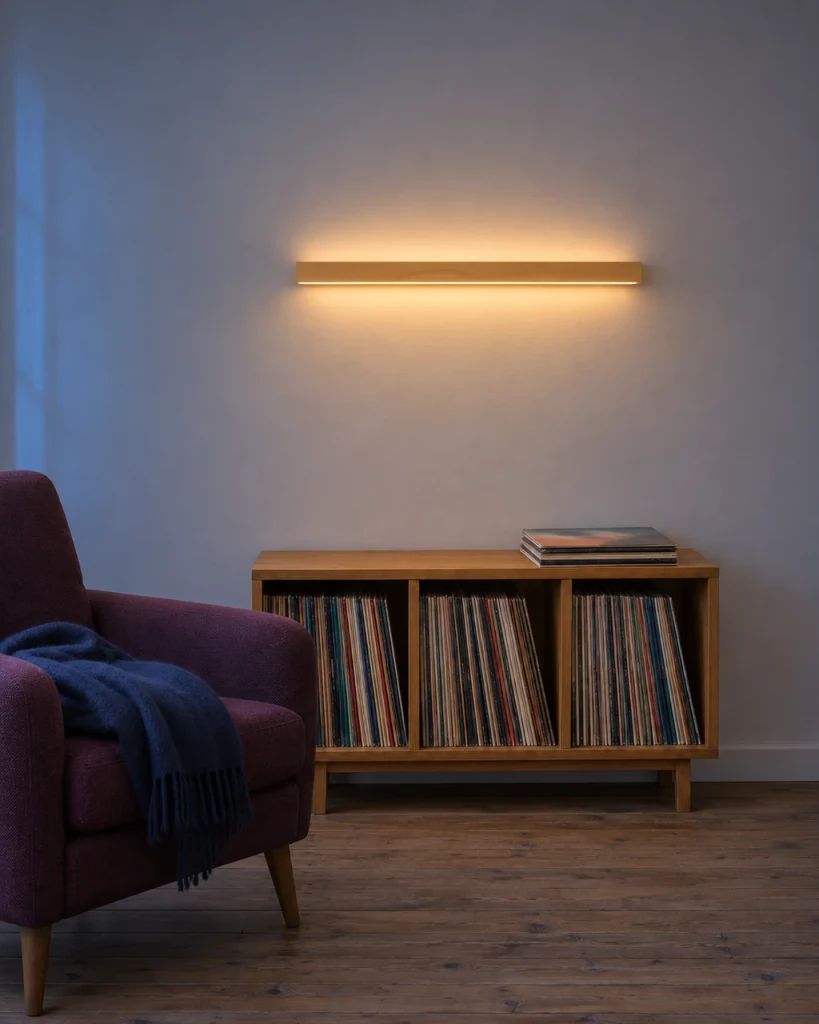
Mount wall sconces for the living room so that their center sits 160 to 180 cm (63 to 71 in) above the finished floor: just above standing eye level, so you don’t look straight into the bulb. Above the sofa, 150 to 170 cm (59 to 67 in) is enough; in the hallway, 170 to 190 cm (67 to 75 in) is typical, and on the stairs 180 to 200 cm (71 to 79 in) above the edge of the step. Place two sconces as a symmetrical pair, with 10 to 30 cm (4 to 12 in) of space to the edge of the mirror, art or TV.
How high should wall sconces for the living room be?
A standing adult’s eye level is about 150 to 170 cm (59 to 67 in). If the light source sits just above it, your eye lands on the shade, stone or glass rather than the bare LED. When you sit, your eyes are at about 110 to 120 cm (43 to 47 in), which is why sconces at 160 to 180 cm (63 to 71 in) feel pleasantly high and glare-free from the sofa.
Measure from the finished floor to the center of the fixture. If the backplate isn’t centered, as with a gooseneck, use the dimensions in the product description to work back to the junction box. These values apply to a ceiling height of about 2.50 m (8 ft 2 in). With the high ceilings of older homes, from about 2.80 m (9 ft 2 in), go 10 to 20 cm (4 to 8 in) higher or choose a longer fixture.
Wall sconce height: where at what height? The guidelines in a chart
These guidelines apply to a ceiling height of about 2.50 m (8 ft 2 in) and adults between 1.65 and 1.85 m (5 ft 5 in and 6 ft 1 in) tall. Our living room wall sconces collection shows suitable models.
| Location | Mounting height (center of fixture from floor) | Spacing and position |
|---|---|---|
| Living room, mood light | 160–180 cm (63–71 in) | at least 40–60 cm (16–24 in) from room corners and door frames |
| Above the sofa | 150–170 cm (59–67 in) (bottom edge 25–30 cm (11.8 in) / 10–12 in above the seated head) | as a pair, each 20–40 cm (8–16 in) inside the ends of the sofa, projection up to approx. 12 cm (5 in) |
| Reading light beside a sofa or armchair | bottom of shade 110–140 cm (43–55 in) | to the side, behind the shoulder, adjustable head |
| Beside the TV | roughly level with the top edge of the screen | 20–40 cm (8–16 in) to the side of the screen |
| Above a sideboard or fireplace, beside a mirror or art | 60–90 cm (24–35 in) above the top of the furniture, usually 140–170 cm (55–67 in) | as a pair, 10–30 cm (4–12 in) outside the edge of the mirror or art |
| Uplight or up & down | 160–180 cm (63–71 in) | top edge at least 40–60 cm (16–24 in) below the ceiling |
| Hallway | 170–190 cm (67–75 in) | every 2–3 m (6.5–10 ft), first fixture 50–100 cm (20–39 in) past the door |
| Stairs and stairwell | 180–200 cm (71–79 in) above the nosing of the step | every 2–3 m (6.5–10 ft) along the stairs |
| Bedroom, by the bed | 100–130 cm (39–51 in) (approx. 45–70 cm (27.6 in) / 18–28 in above the mattress) | centered above the nightstand |
Beside the TV, choose light that stays on the wall so it doesn’t reflect in the screen. If two sconces frame a mirror, their light should graze the frame rather than shine into the glass from the front. For the reading nook, there are dedicated wall sconces for reading with an adjustable head.
By the bed, a bedroom sconce hangs lower, because you use it sitting up. Read more in our guide bedroom light fixtures; whether a sconce or a table lamp suits you better is covered in how to choose a bedside lamp.
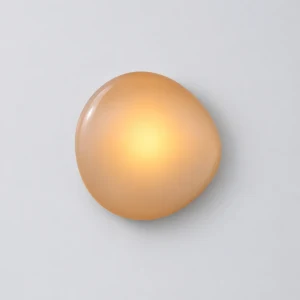 Collection · 253 designsLiving Room Wall SconcesView all 253 designs
How high should a sconce be above the sofa?
The back of a sofa is usually 75 to 90 cm (30 to 35 in) high, and a seated adult’s head reaches about 120 to 130 cm (47 to 51 in). The bottom edge of the fixture sits 25 to 30 cm (10 to 12 in) above that, so nobody knocks it when they stand up. That gives 150 to 170 cm (59 to 67 in) for the center of the fixture. Choose flat models with a projection of no more than about 12 cm (5 in); a shade sticking far out above the back of the sofa becomes an obstacle.
You have two options for the layout: two sconces, each 20 to 40 cm (8 to 16 in) inside the ends of the sofa, so 140 to 180 cm (55 to 71 in) apart on a 220 cm (87 in) sofa. Or a horizontal light bar centered above it, half to two-thirds the width of the sofa.
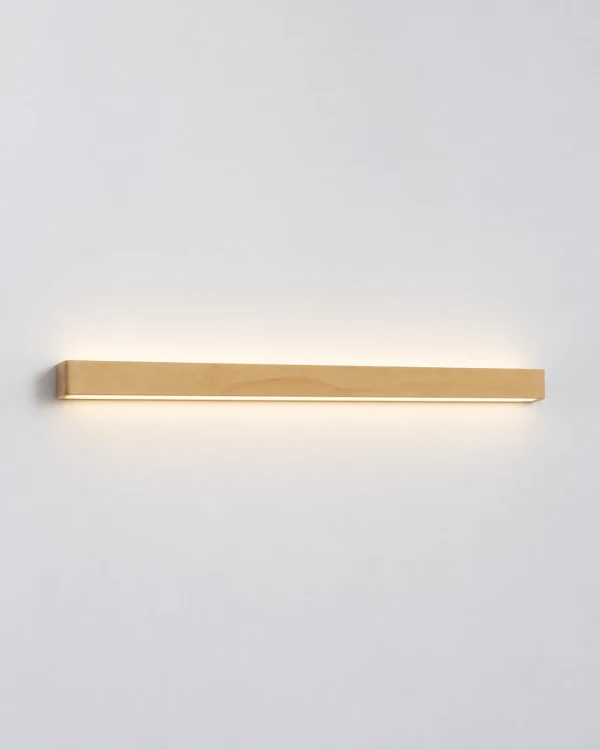
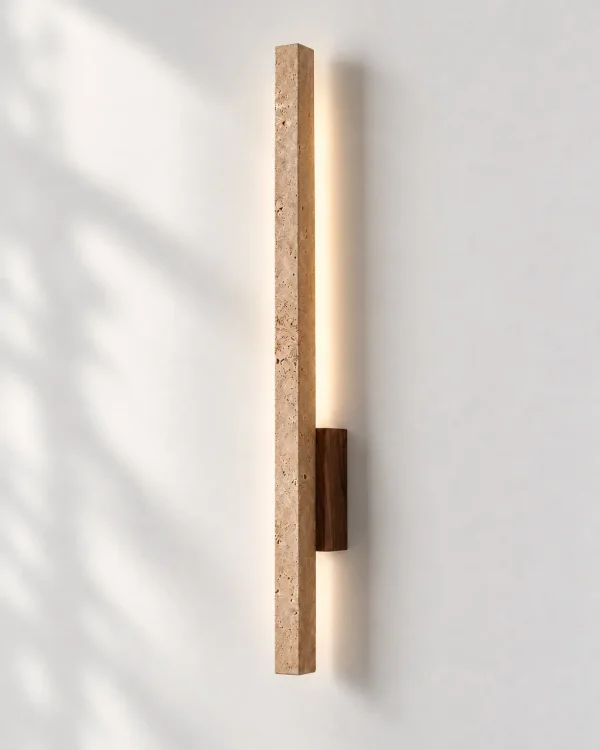
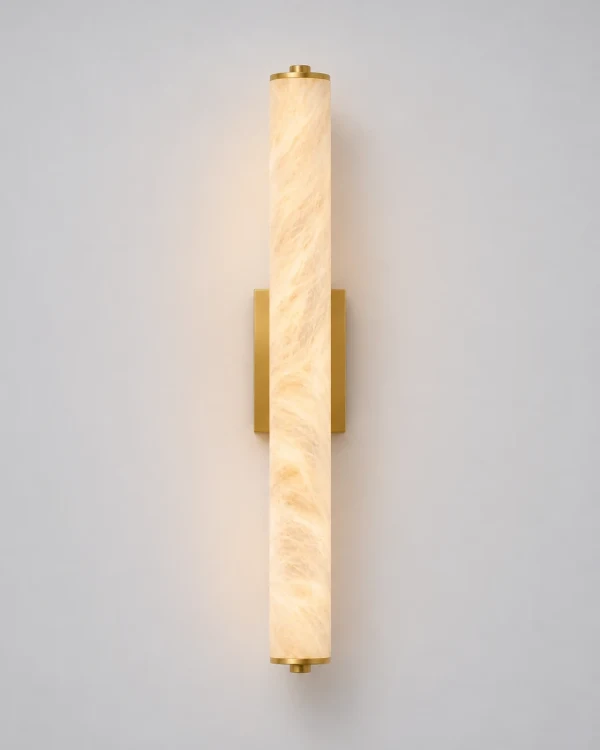
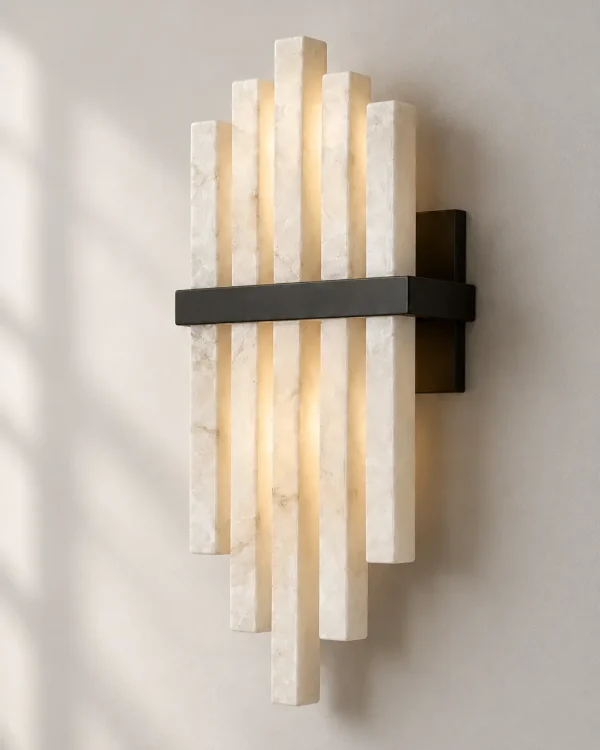
ESPEN is a bar of light-toned wood with integrated LED, 60, 80 or 100 cm (24, 31 or 39 in) long and only 4 cm (1.5 in) high; the 100 cm (39 in) version fits above a 2 m (79 in) sofa. ANKA is a travertine bar just 2.5 cm (1 in) wide, 55 or 90 cm (22 or 35 in) tall, with indirect light, which works as a vertical pair beside a bookcase or TV wall. MIRJA, a marble cylinder 6 cm (2.5 in) in diameter and 40 to 80 cm (16 to 31 in) long, projects only 10.5 cm (4 in) from the wall. BELBA, made of staggered rods of genuine alabaster, measures 20 × 45 cm (8 × 18 in) and remains a wall sculpture above the sideboard even when it is switched off.
What is the right spacing between two wall sconces?
- As a pair: symmetrical about the center line of the sofa, sideboard, mirror or TV, with the distances from the chart. Check with a level or line laser that both sit at exactly the same height.
- In a row: 2 to 3 m (6.5 to 10 ft) between the fixtures. The closer they are, the more the beams merge into a band; the farther apart, the more distinct the pools of light.
- From corners and door frames: at least 40 to 60 cm (16 to 24 in), so the light can fan out.
- From the ceiling: with upward light, leave 40 to 60 cm (16 to 24 in) clear, or you get a harsh bright patch instead of a soft fan.
In hallways narrower than 1.20 m (4 ft), the projection matters too: you will find flat models among our hallway wall sconces. For the height of a sconce on the stairs, measure from the nosing of the step below, not from the floor.
Up & down, indirect or directional: what light should the sconce give?
With sconces for the living room and hallway, there are five light directions:
- Uplight: brightens the ceiling and makes the room feel taller. This is classic indirect wall lighting for the living room.
- Downlight: highlights whatever is below, such as a sideboard, plant or armchair.
- Up & down: two beams draw a vertical line on the wall; in pairs beside a fireplace or TV, the effect is architectural.
- All-around glow: opal glass and alabaster glow themselves and look best dimmed.
- Adjustable: a spotlight or shade on a joint for reading and accent light.
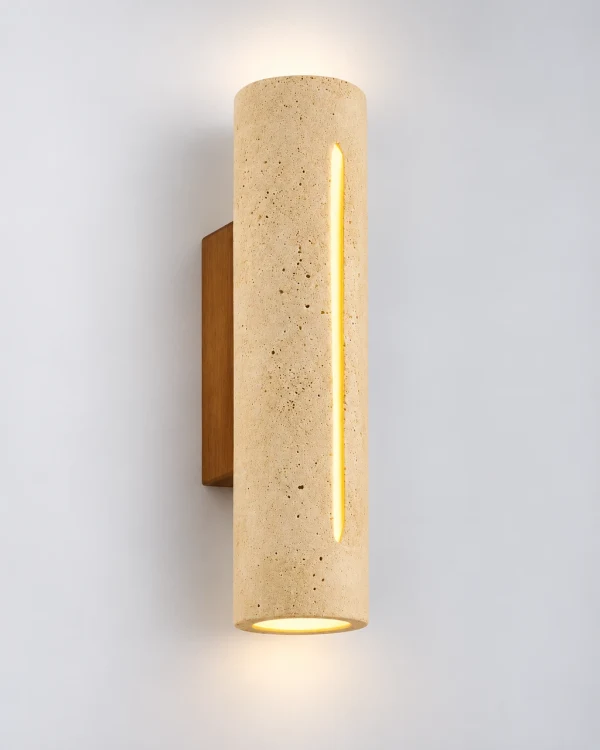
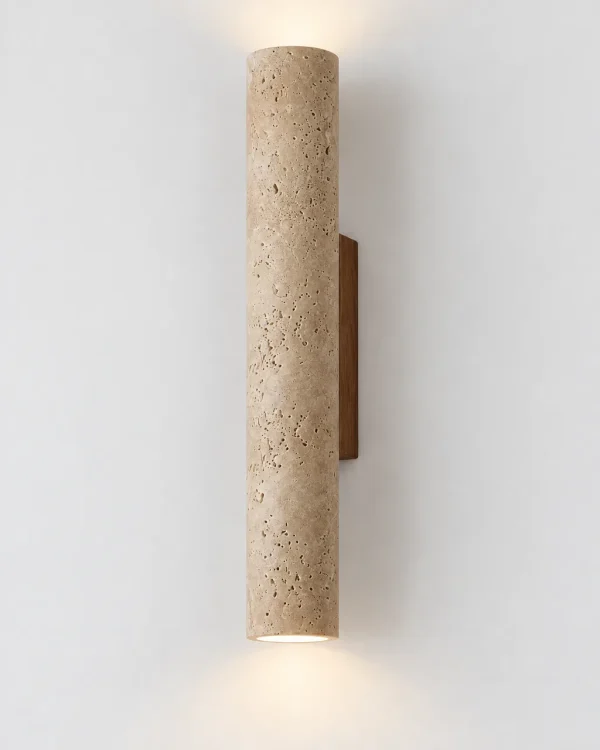
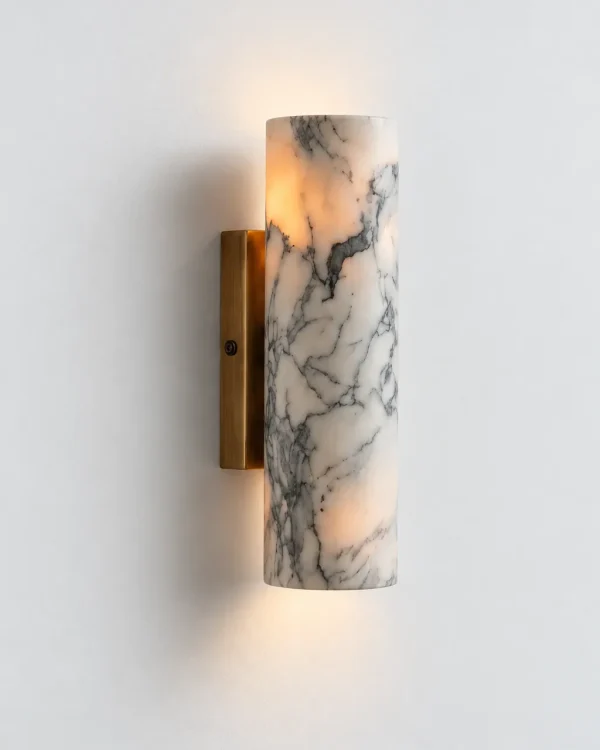
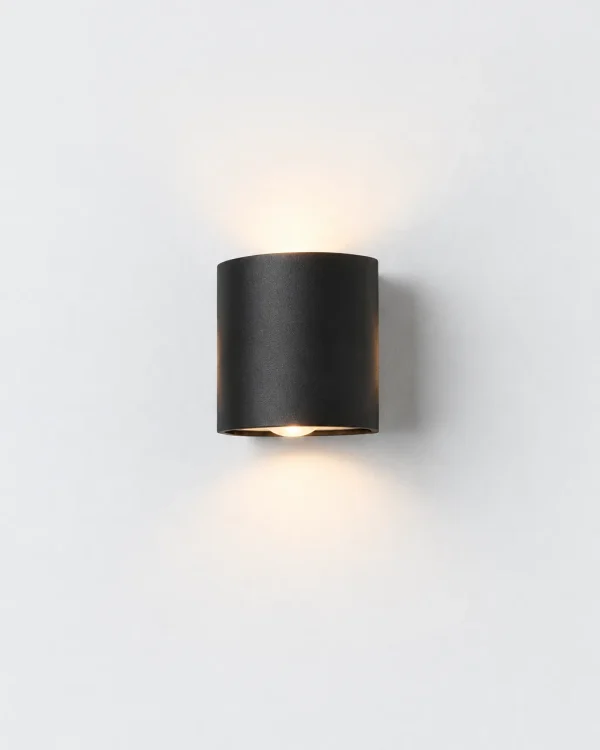
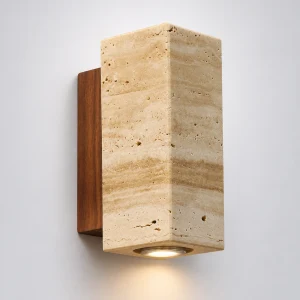
Slim cylinders work well for up & down light in natural stone. FRIDA is a travertine cylinder 6.5 cm (2.5 in) in diameter, 28 or 32 cm (11 or 12.5 in) tall, on a wood plate, with G9 LEDs included. BOKI pairs a 32 cm (12.5 in) travertine cylinder with solid wood in a walnut tone and two E26 sockets. PACHO, in Viola Calacatta marble, is 24 cm (9.5 in) tall, projects only 9 cm (3.5 in) from the wall and is dimmable with dimmable bulbs. NOSCA, in aluminum, is only 4 cm (1.5 in) deep, comes in six widths from 8 to 32 cm (3 to 12.5 in) and is also available in warm white at 3000 K, ideal for narrow hallways.
Plug-in or hardwired wall sconce: which is better?
A hardwired sconce needs a junction box in the right place, and a licensed electrician makes the connection. In return, the wiring stays hidden and the fixture runs off a wall switch. A plug-in wall sconce is also screwed to the wall, but its cord runs to the nearest outlet: no electrician, no opening up the wall, ideal for rentals and the reading nook. Plug-in sconces are popular in the bedroom too, because they keep the nightstand free.
| Criterion | Plug-in | Hardwired |
|---|---|---|
| Installation | screw on, plug in | junction box, licensed electrician |
| Cord | visible down to the outlet | hidden in the wall |
| Switch | on the cord or on the fixture | wall switch |
| Ideal for | rentals, reading nook, bedside | new construction, remodels, pairs above furniture |
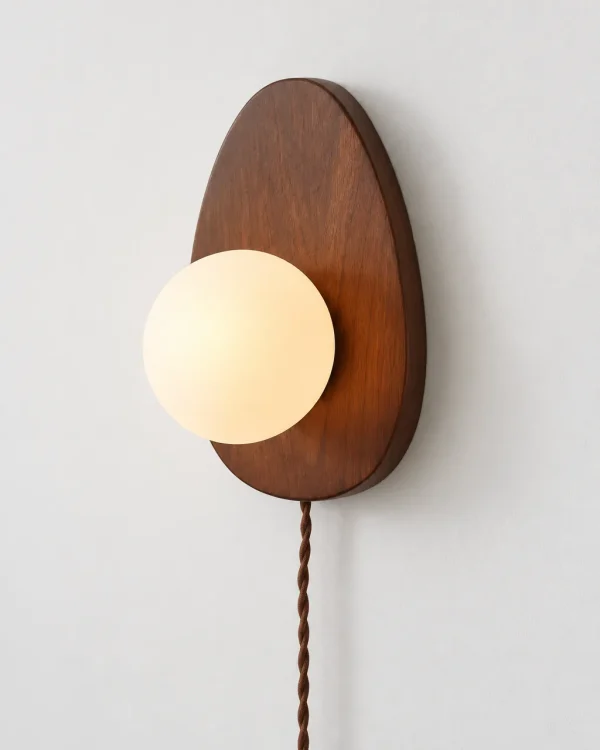
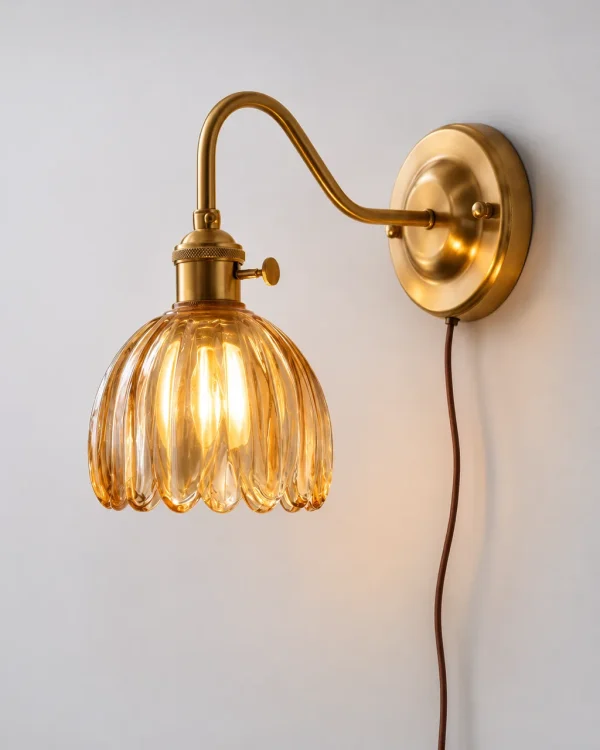
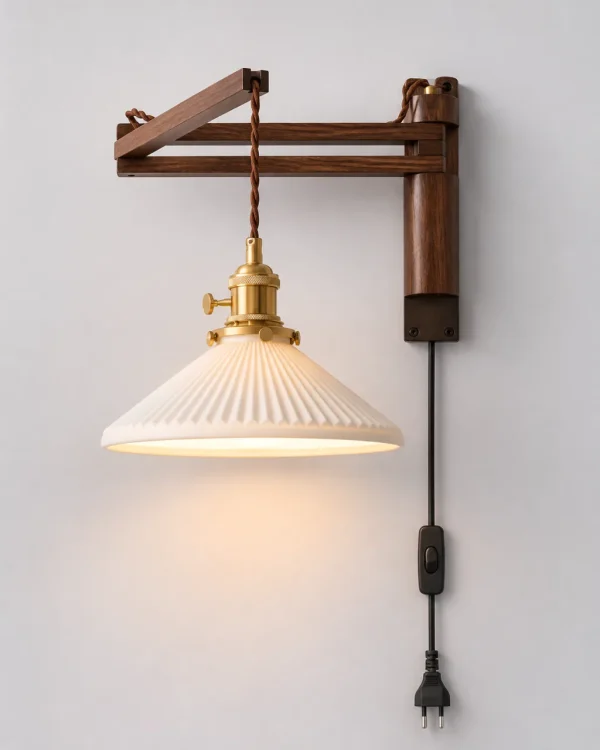
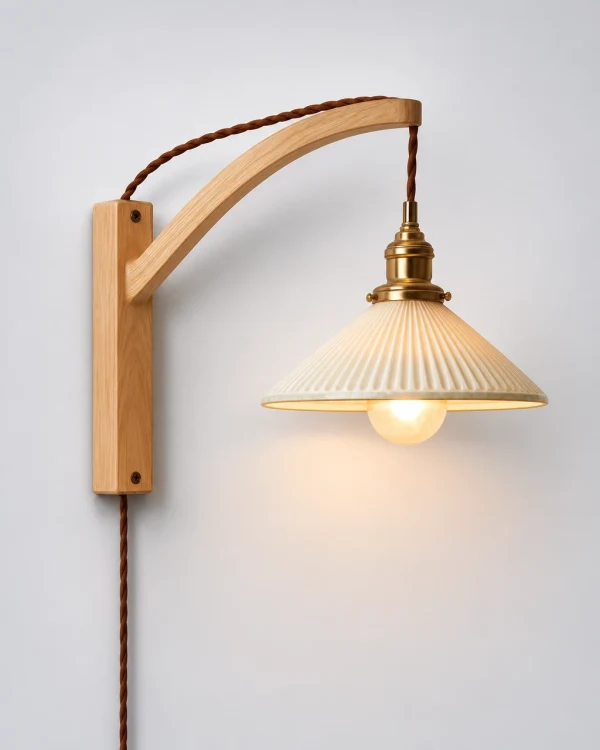
Check the cord length: if the sconce hangs at 160 cm (63 in) and the outlet sits 30 cm (12 in) above the floor, the vertical run alone uses around 120 to 130 cm (47 to 51 in). CORI has a 150 cm (59 in) cord with a switch, a dark solid wood backplate (18 × 28 cm (11 in) / 7 × 11 in) and a frosted glass globe. TINE has a 1.8 m (6 ft) cord and a ribbed glass flower 12 cm (5 in) in diameter on a gooseneck. TUVA carries a ceramic shade 23 cm (9 in) in diameter on a swiveling wood arm. With TEIJA, only the model with the high arch (51 cm (20.1 in) / 20 in) comes with a plug. All models: plug-in wall sconces.
Which material works: marble, travertine, alabaster, wood or glass?
Opaque materials direct the light up, down or onto the wall. Translucent materials glow themselves.
Marble wall sconces
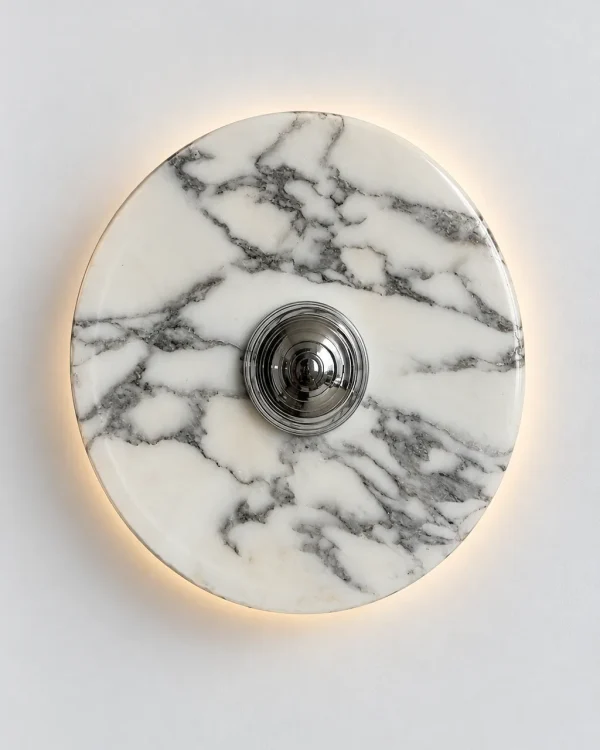
Marble is a dense natural stone whose veins run differently in every piece. Ground thin, it lets light through and the veins stand out against the light; cut thick, it stays opaque. MINA is a thin disc of genuine white marble with gray veining, Ø 20, 25 or 30 cm (8, 10 or 12 in), with an LED behind it that draws a warm white halo on the wall.
Natural stone or faux marble?
If the material description says “faux marble” or “faux stone”, the fixture is an imitation made from another material. One example is SOLVI, with two faux marble domes on a lacquered iron bracket. Imitations are lighter and more evenly patterned. Genuine natural stone is heavier, and the veining and translucency vary from fixture to fixture. So always read the “Materials” line in the product description. We bring together our genuine stone models under travertine and stone wall sconces.
Travertine and alabaster
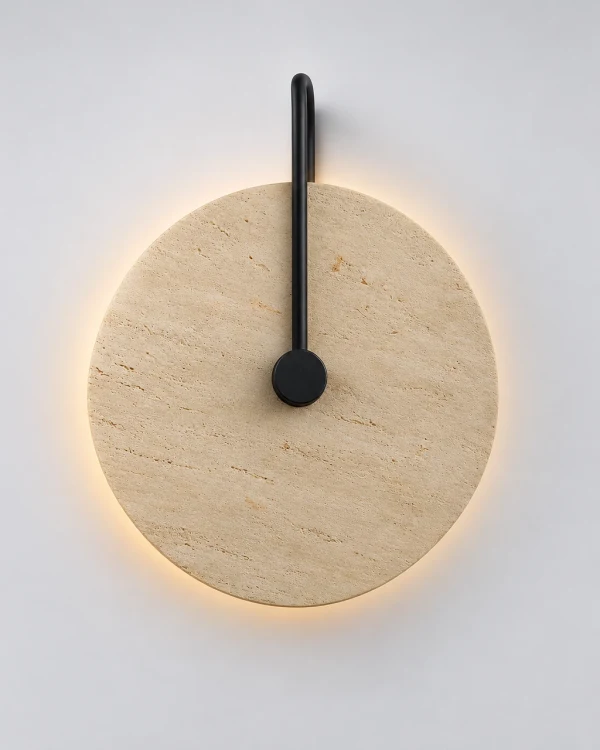
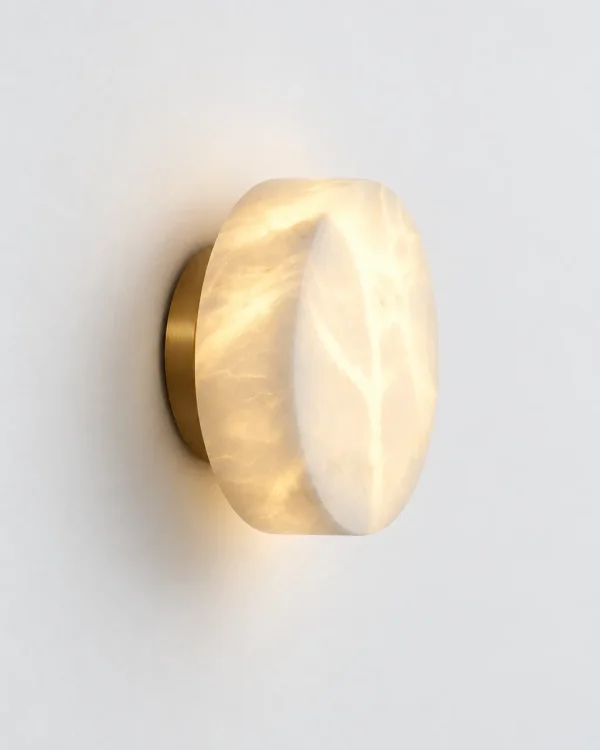
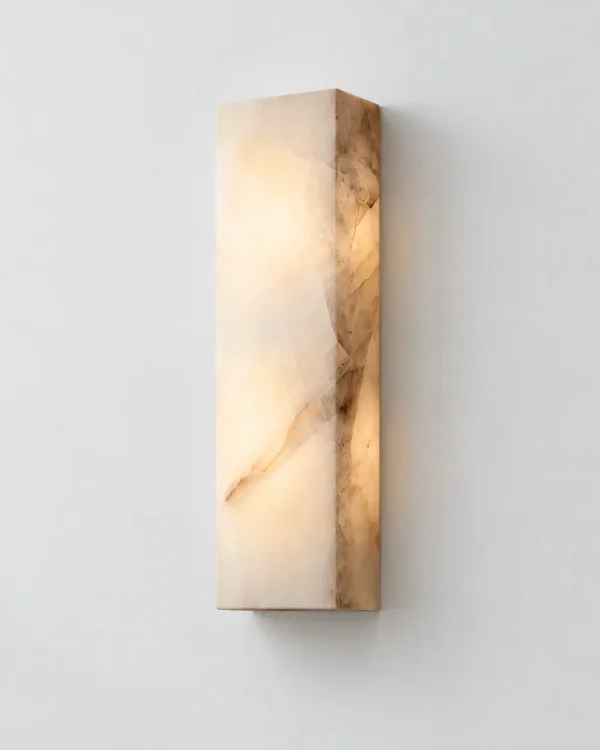
Travertine is a porous limestone in beige and sand tones and lets practically no light through. That is why travertine models shine up and down, through opal glass or with LEDs behind the stone: FALK is a travertine disc of Ø 18, 25 or 28 cm (7, 10 or 11 in) that creates a soft halo behind it. Alabaster, on the other hand, is highly translucent and glows from within. JILVA is carved from a solid block of alabaster, Ø 15 to 25 cm (6 to 10 in), at 3000 K. ZILA is a monolith of genuine alabaster measuring 65 × 16 × 10 cm (26 × 6 × 4 in) that frames a sideboard as a pair. More shapes: alabaster wall sconces.
 Collection · 71 designsTravertine & Stone Wall SconcesView all 71 designs
Wood, glass and metal
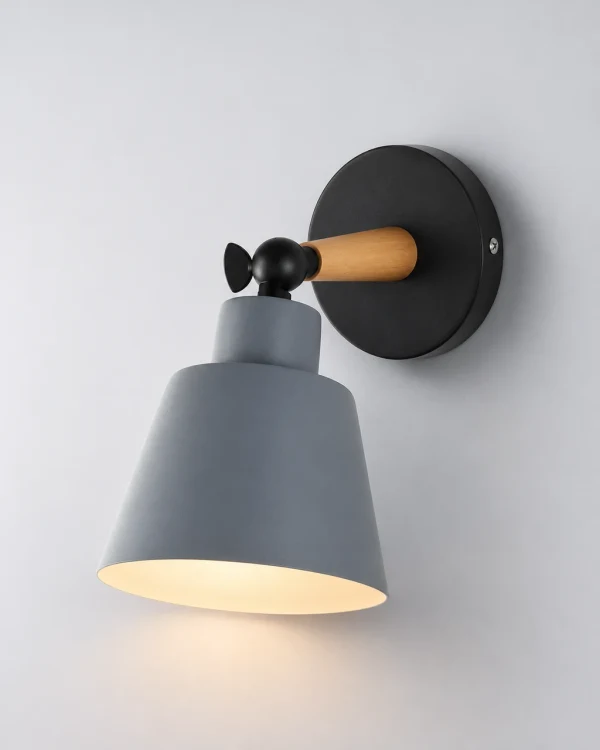
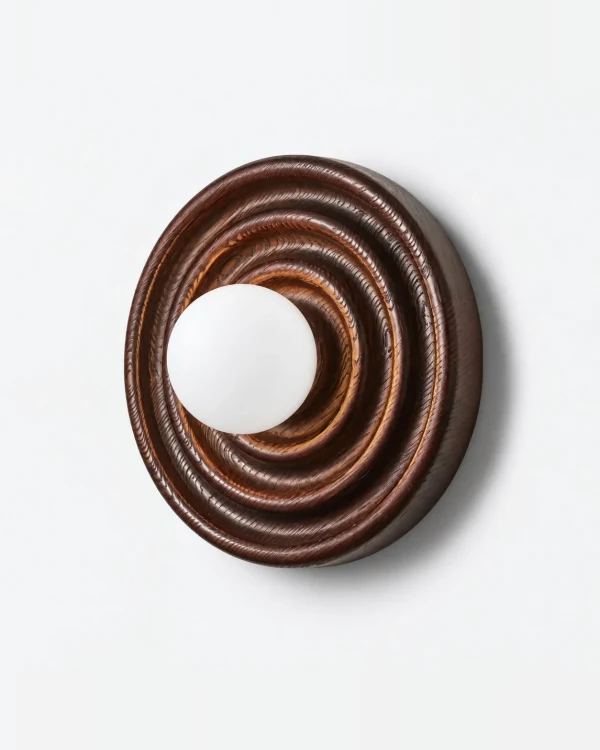
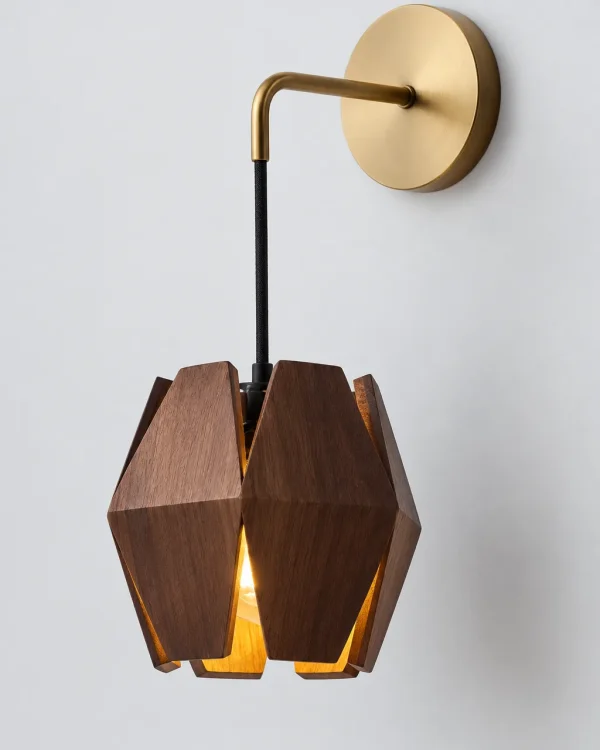
Wood doesn’t glow itself; it frames the light. A wood sconce for the living room brings warmth to pale walls and suits Japandi and Scandi rooms. Wood fixtures that take a bulb call for LED bulbs, because they barely get warm. LAURI is a compact reading light with a wood arm and a tilting metal shade (Ø 12 cm (4.7 in) / 5 in), bulb included. KYLA combines ash wood and glass in a flat disc 28 cm (11 in) in diameter. ALTO has a faceted walnut shade (16 × 17 cm (6.7 in) / 6 × 7 in) and projects around 20 cm (8 in) from the wall, so it belongs beside the armchair rather than in a narrow hallway. You will find more models among our wood wall sconces.
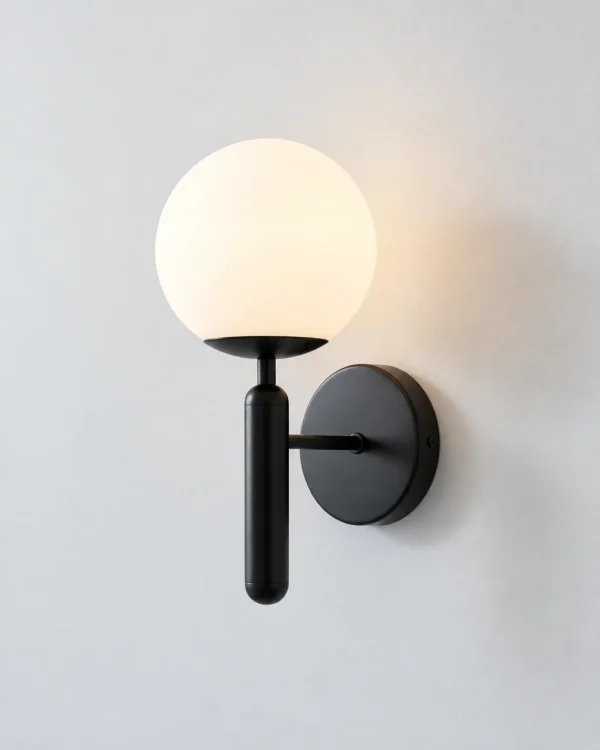
Opal glass spreads the light evenly without glare: OLAN carries an opal glass globe 20 cm (8 in) in diameter, is 35 cm (14 in) tall and comes in black or gold. Clear or fluted glass sparkles and shows the bulb; metal shades focus the light for reading. More among our glass wall sconces.
How do you combine wall sconces with a ceiling light and floor lamp?
A sconce is rarely the only light in a living room. The ceiling light provides ambient light from above, the floor lamp gives reading light at seat height, and the sconce fills the zone in between. Only these three layers make a room feel inviting in the evening.
- Spread them out: the floor lamp, sconces and table lamp form a triangle in the room rather than standing in one corner.
- Switch separately: put the ceiling light and sconces on their own switches, and leave the ceiling off in the evening.
- One color temperature: 2700 to 3000 K for every fixture in the room.
- One metal finish: repeat gold, brass or black in two or three places, and use no more than two kinds of stone per room.
- Brightness: about 200 to 400 lumens per sconce for mood light, 400 to 600 lumens for reading. Dimmable wall sconces keep you flexible.
How big the ceiling light should be is explained in living room ceiling lights: size and brightness. Which floor lamp suits the sofa is covered in our guide to floor lamps for the living room, and the overall plan in how to light your living room.
What are the most common mistakes with wall sconces?
- Mounted too low: below 150 cm (59 in) you look into the light when standing, and above the sofa people bump into it.
- Uplight too close to the ceiling: with less than 40 cm (16 in) of clearance, you get a harsh bright patch.
- Too much projection in the hallway: a shade sticking out 20 cm (8 in) into a 1 m (39 in) wide hallway gets brushed constantly.
- Junction box without a furniture plan: plan the position from the furniture dimensions before patching and painting.
- Heavy stone, wrong anchor: in drywall you need hollow-wall anchors rated for the weight.
- Mixed color temperatures: a cool white sconce next to warm white floor lamps ruins the mood.
Frequently asked questions
How high should a wall sconce be in the living room?
In the living room, the center of the sconce sits 160 to 180 cm (63 to 71 in) above the floor, just above standing eye level. Above the sofa, 150 to 170 cm (59 to 67 in) is enough. With ceilings from about 2.80 m (9 ft 2 in), you can go 10 to 20 cm (4 to 8 in) higher.
How far apart should two wall sconces be?
A pair hangs symmetrically: 10 to 30 cm (4 to 12 in) outside the edge of a mirror or art, 20 to 40 cm (8 to 16 in) beside the TV, and above the sofa each 20 to 40 cm (8 to 16 in) inside the ends. In a row along a hallway, allow 2 to 3 m (6.5 to 10 ft) between them.
How high should a sconce be above the bed?
By the bed, the center of the fixture sits at about 100 to 130 cm (39 to 51 in) above the floor, so 45 to 70 cm (18 to 28 in) above the mattress. That way you can read sitting up without looking into the light source.
Can I install a wall sconce without an electrician?
Yes, if it has a plug: screw it on and plug the cord into the nearest outlet. Hardwired sconces need a junction box, and a licensed electrician makes the connection.
Is a wall sconce with a marble pattern always made of real marble?
No. If the material description says “faux marble” or “faux stone”, it is an imitation. Real marble is heavier, and every fixture has its own veining.
Which color temperature suits living room wall sconces?
In the living room, warm white at 2700 to 3000 K is right. Use this color temperature for every fixture in the room, so that sconces, floor lamps and ceiling lights come together into a calm overall look.
How high should a sconce be in a stairwell?
In a stairwell, measure from the nosing of the step below and set the center of the fixture at 180 to 200 cm (71 to 79 in). Plan one sconce about every 2 to 3 m (6.5 to 10 ft) and choose flat models.