Living Room Ceiling Lights: Size, Brightness and Style
Which diameter suits your living room, how many lumens you need and which ceiling light works with a low ceiling, as spotlights or as a statement chandelier.
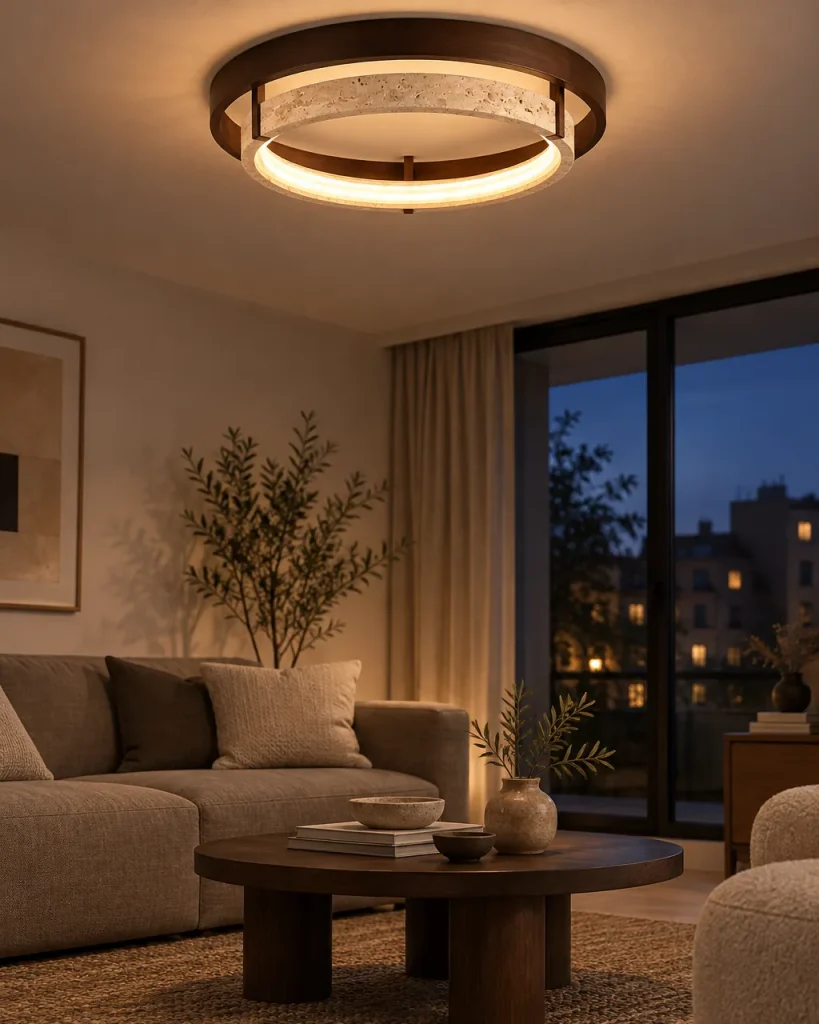
The right living room ceiling lights measure, in centimeters, roughly the room’s length plus its width in meters, multiplied by 8: for a 4 × 5 m (13 × 16 ft) room that means around 70 cm (28 in) for a pendant or statement chandelier and around 50 cm (20 in) for a flush mount ceiling light. For general lighting, 60 to 80 lumens per square meter (about 6 to 7 lumens per square foot) are enough; together with floor, table and wall lamps, 100 to 150 lumens per square meter (9 to 14 per square foot) is ideal. Choose warm white light at 2700 to 3000 kelvin and, with a ceiling height under 2.50 m (8 ft 2 in), a flush mount no more than 10 cm (4 in) deep.
Living room ceiling lights: how big should they be?
The tried-and-true rule of thumb from interior design is: (room length + room width in meters) × 8 = diameter in centimeters. In feet and inches it works the same way: add the length and width in feet, and the sum is the diameter in inches. The rule applies to lights with plenty of volume, in other words pendants, large fabric shades and statement lights that hang as a focal point in the room.
Flush mount ceiling lights sit tight against the ceiling and have hardly any volume. For these, about two-thirds of the calculated figure is enough. A 70 cm (28 in) disc of light quickly looks like an office ceiling panel in an ordinary living room.
| Living room (example) | Floor area | Flush mount ceiling light | Pendant or statement light | Lumens, general light (ceiling) | Lumens, total (all lamps) |
|---|---|---|---|---|---|
| 3 × 4 m (10 × 13 ft) | 12 m² (130 sq ft) | Ø 35–40 cm (14–16 in) | Ø 50–60 cm (20–24 in) | 700–1,000 lm | 1,200–1,800 lm |
| 3.5 × 5 m (11.5 × 16.5 ft) | 17.5 m² (190 sq ft) | Ø 45–50 cm (18–20 in) | Ø 60–70 cm (24–28 in) | 1,000–1,400 lm | 1,750–2,600 lm |
| 4 × 5.5 m (13 × 18 ft) | 22 m² (235 sq ft) | Ø 50–60 cm (20–24 in) | Ø 70–80 cm (28–31 in) | 1,300–1,800 lm | 2,200–3,300 lm |
| 5 × 6 m (16.5 × 20 ft) | 30 m² (325 sq ft) | Ø 60 cm (24 in) or 2 lights | Ø 80–90 cm (31–35 in) | 1,800–2,400 lm | 3,000–4,500 lm |
| 6 × 7 m (20 × 23 ft) | 42 m² (450 sq ft) | 2 lights of Ø 50–60 cm (20–24 in) | Ø 100 cm (39 in) or 2 pendants | 2,500–3,400 lm | 4,200–6,300 lm |
If your room falls between two rows, choose the larger size with a high ceiling from 2.70 m (8 ft 10 in) and the smaller size with a low ceiling. In rooms from about 35 m² (375 sq ft), or in L-shaped living and dining areas, a single light is rarely the best solution. Divide the room into zones instead and give each zone its own ceiling light.
How bright should a living room ceiling light be?
Brightness is measured in lumens (lm), not watts. For general light in the living room, allow 60 to 80 lumens per square meter (about 6 to 7 per square foot) coming from the ceiling light alone. A 25 m² (270 sq ft) living room therefore needs about 1,500 to 2,000 lm on the ceiling.
For reference, a classic 60-watt incandescent bulb gave around 800 lm. If you have dark floors, wood paneling or a room with little daylight, plan for the top end of the range.
More important than maximum brightness is being able to turn it down. In the evening, a living room rarely needs more than a third of its general light. A dimmable ceiling light for the living room is therefore almost always the better choice. Check how it dims: some models need a dimmable bulb and a matching wall dimmer, others such as FENZE come in a triac-dimmable version, and JANNE is operated by remote control, with a dimming function according to the manufacturer.
Which color temperature suits a living room: 2700 K, 3000 K or 4000 K?
- 2700 K (warm white): matches the light of an old incandescent bulb. Ideal for floor lamps, table lamps and anything that should feel cozy in the evening.
- 3000 K (warm white): slightly crisper and well suited to the living room ceiling light. Wood, travertine and alabaster look warm with it, but not yellowish.
- 4000 K (neutral white): suits a kitchen, bathroom or home office; in the living room it feels cool in the evening.
- 5000–6000 K (cool white / daylight): does not belong in a living room.
Keep all the lamps in a room at the same color temperature, or no more than 300 K apart. If you mix 2700 K on the floor lamp with 4000 K on the ceiling, one of the two will always look wrong. Many of our models have a fixed warm white of 3000 K, such as ZELIA and NOMI. HILDE and IDUN let you switch the color temperature; for the living room, set them to the warmest setting. If the manufacturer gives a color rendering index, it should be CRI 90 (Ra 90) or higher.
Flush mount, pendant or spotlights: which works when?
The choice depends mainly on the ceiling height and on whether the light hangs over a walkway or over a fixed zone.
| Type | Typical depth | Light effect | Ideal for |
|---|---|---|---|
| Flush mount ceiling light | 2–10 cm (1–4 in) | broad and even | general light, low ceilings, center of the room and walkways |
| Pendant light / chandelier | drop length of your choice | directed downward, often with diffused light | high ceilings, over a coffee table, reading nook or dining table |
| Spotlights on a track or bar | approx. 20–25 cm (8–10 in) | adjustable, focused | art, shelves, long rooms, accent light |
A living room pendant light only belongs where nobody walks underneath. Over walkways, its bottom edge should be at least 2.00 m (6 ft 7 in) above the floor, or your first tall guest will hit their head.
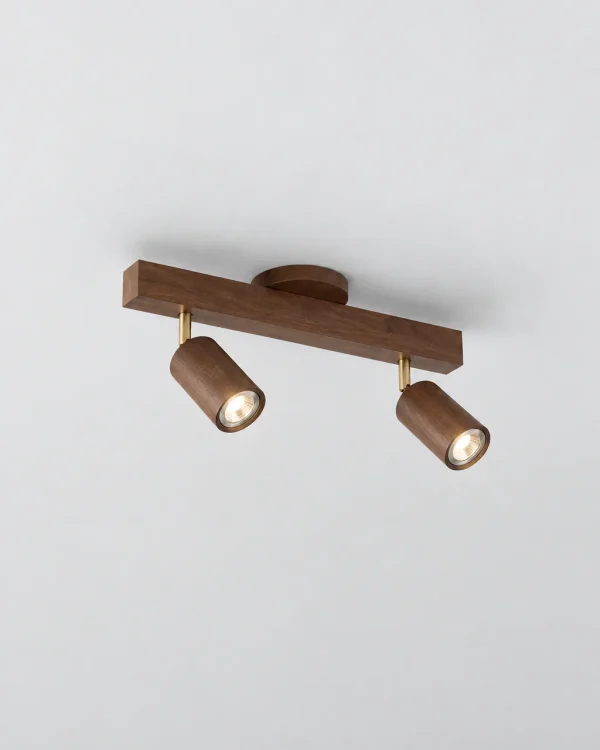
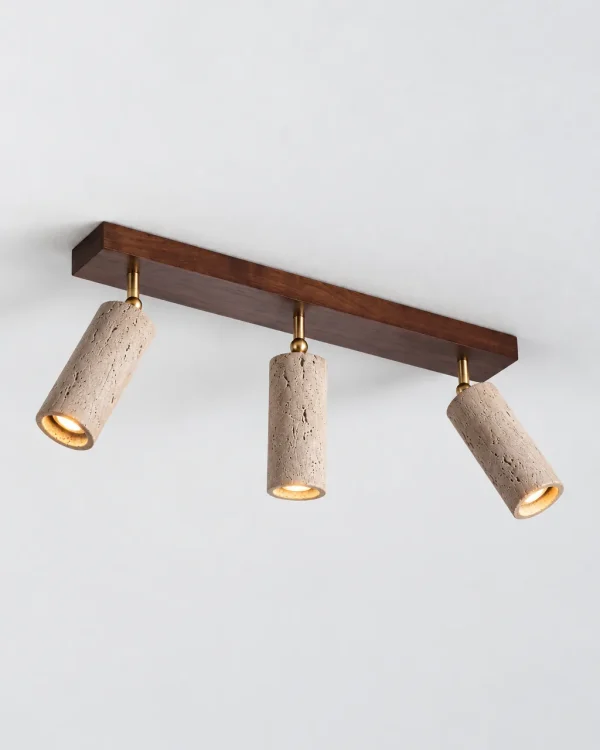
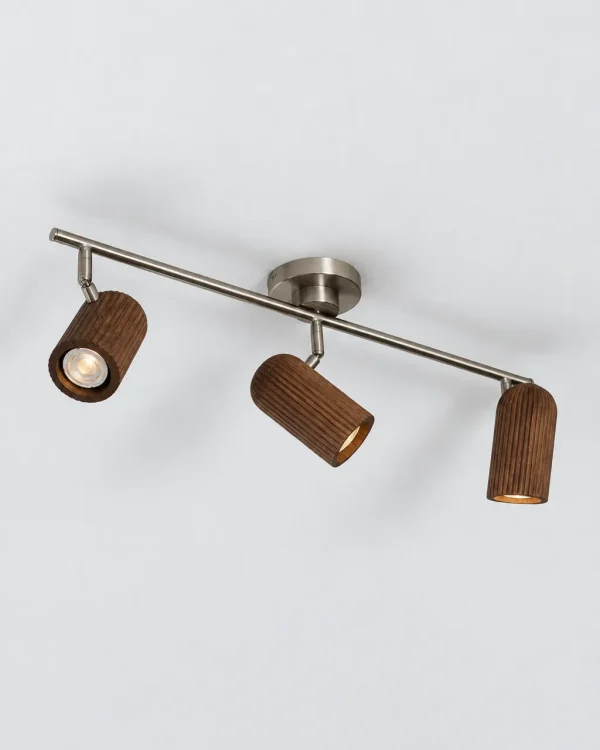
Ceiling spotlights in the living room add accents, but rarely replace general light. On PORIAT, two to five adjustable spotlights sit on a solid wood bar, 42 to 120 cm (17 to 47 in) long and 22 cm (9 in) deep, with integrated 3000 K LEDs. It is not dimmable, but it can also be mounted on the wall. BERA carries three or four travertine spotlights on a solid wood bar of 75 or 80 cm (30 or 31 in) and is dimmable with dimmable E26 bulbs and a suitable dimmer. NIKA brings three fluted wood spotlights on an 80 cm (31 in) bar and takes GU10 bulbs.
Which ceiling light works with a low ceiling?
Many homes have a ceiling height of only 2.40 to 2.50 m (7 ft 10 in to 8 ft 2 in). The rule here is: no more than 10 cm (4 in) deep, a bright light surface and no pendant over walkways. Lights that also shine sideways or onto the ceiling make the room feel taller, because the ceiling itself becomes bright.
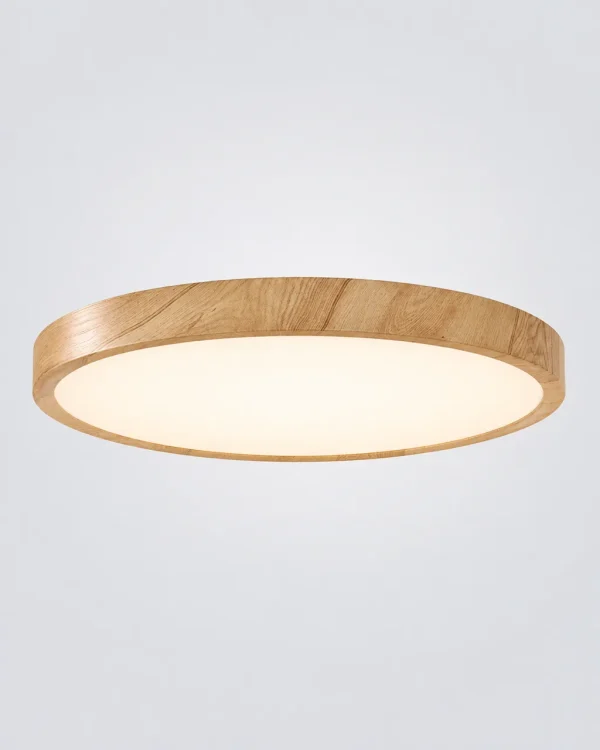
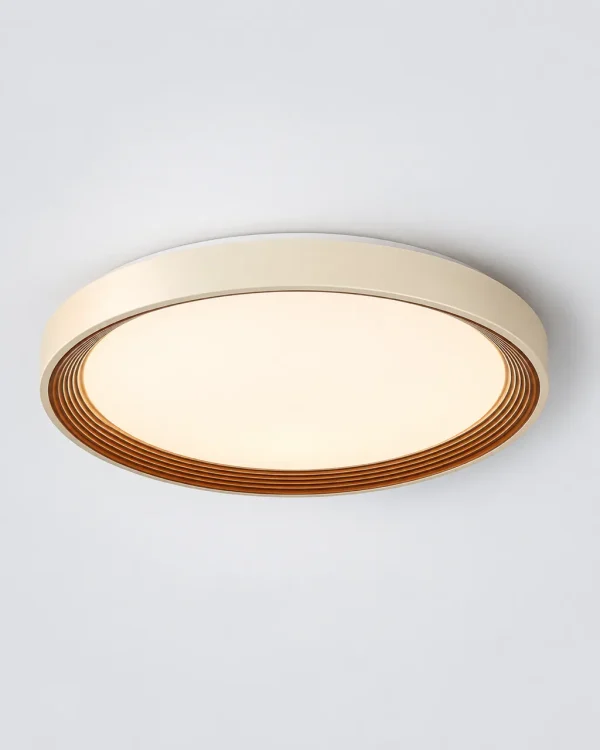
- HILDE: just 2.4 cm (1 in) deep, Ø 23, 30 or 40 cm (9, 12 or 16 in), with integrated LED. Ideal for small living rooms or as a second light in a long room.
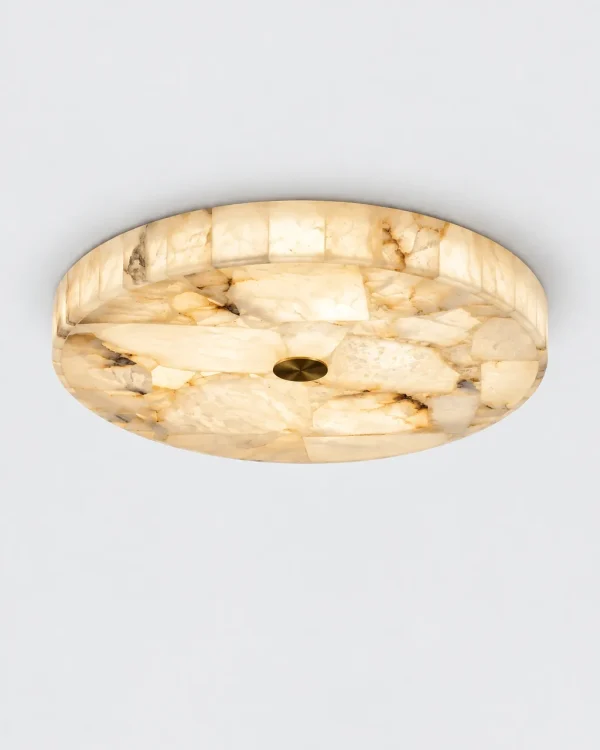
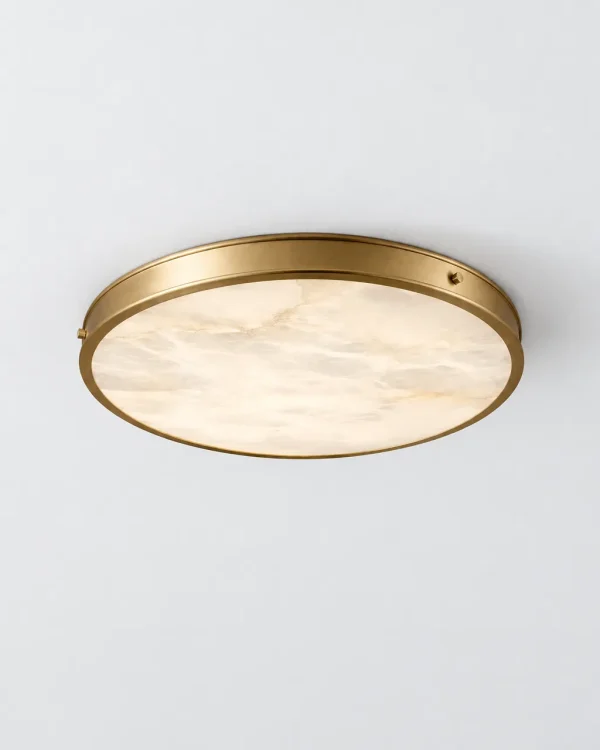
- BATRAZ: a mosaic disc of genuine alabaster, 5 cm (2 in) deep, in Ø 40, 50 or 60 cm (16, 20 or 24 in). Choose the warm white or the dimmable version.
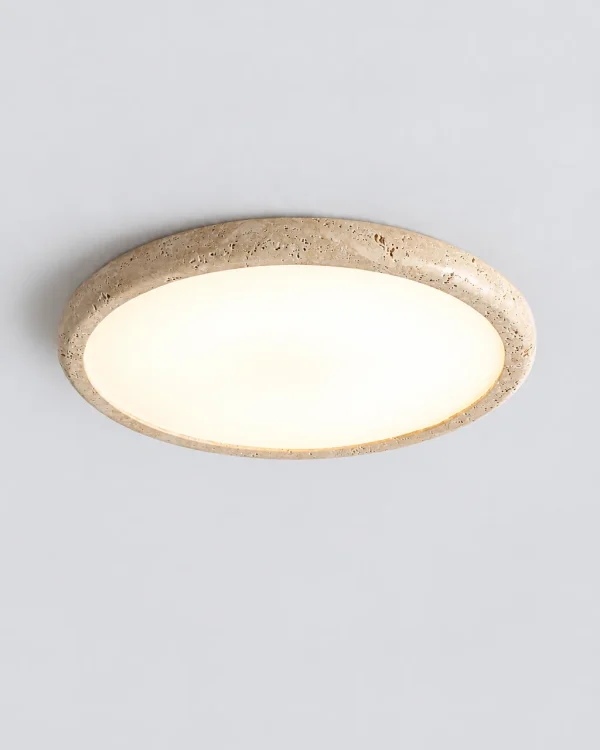
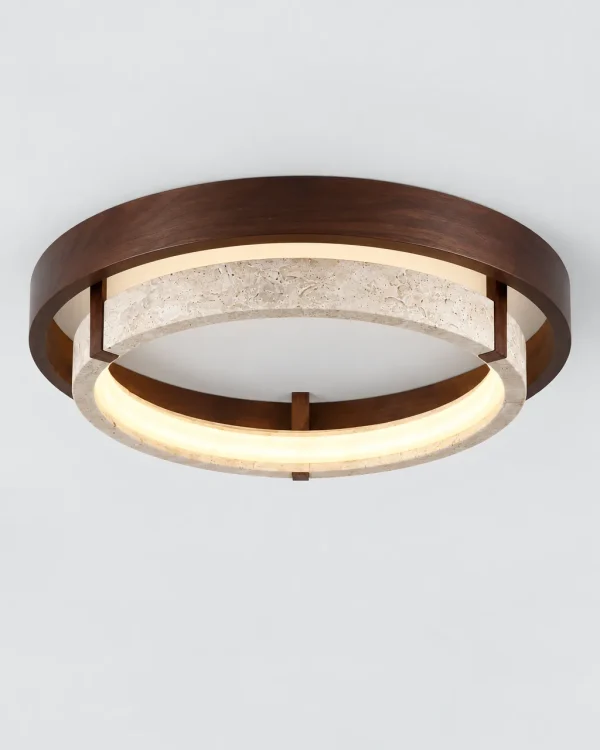
- ZELIA: a travertine ring 5.5 cm (2 in) deep in Ø 38, 48 or 58 cm (15, 19 or 23 in), warm white at 3000 K.
- IDUN: 7 cm (3 in) deep, round at Ø 50 cm (20 in), square at 50 × 50 cm (20 × 20 in) or rectangular at 98 × 68 cm (39 × 27 in). The rectangular version works well over a long sofa or in a narrow living room.
All four are part of our LED ceiling lights: a flush mount LED ceiling light for the living room takes up no ceiling height and shines without visible points of light.
How do you combine the ceiling light with other lamps?
A ceiling light alone makes a living room bright, but not inviting. Lighting designers work in layers: ambient light from the ceiling, accent light on art, shelves and plants, and mood light at eye level.
Here is a proven plan for 25 m² (270 sq ft):
- A dimmable ceiling light of 1,500 to 2,000 lm over the seating area as ambient light.
- A floor lamp or arc lamp by the sofa for reading. How tall it should be and where it goes is explained in our guide to floor lamps for the living room, and for arc lamps in our arc floor lamp guide.
- Two living room wall sconces next to the TV or a gallery wall. You will find the right mounting height in our article wall sconces for the living room: height and material.
- A table lamp on a sideboard or windowsill.
Put the ambient light and the mood light on separate switches. In the evening, dim the ceiling and leave the lamps at eye level on. Our guide how to light your living room shows how to plan the whole room step by step. The bedroom, by the way, follows different rules; read more in our article on bedroom light fixtures.
 Collection · 52 designsLiving Room Ceiling LightsView all 52 designs
Which material for a living room ceiling light: wood, travertine, alabaster, glass or rattan?
With a modern ceiling light for the living room, the material decides how the light leaves the fixture. Stone and opal glass diffuse it softly; weaves and slats cast patterns onto the ceiling and walls.
Wood
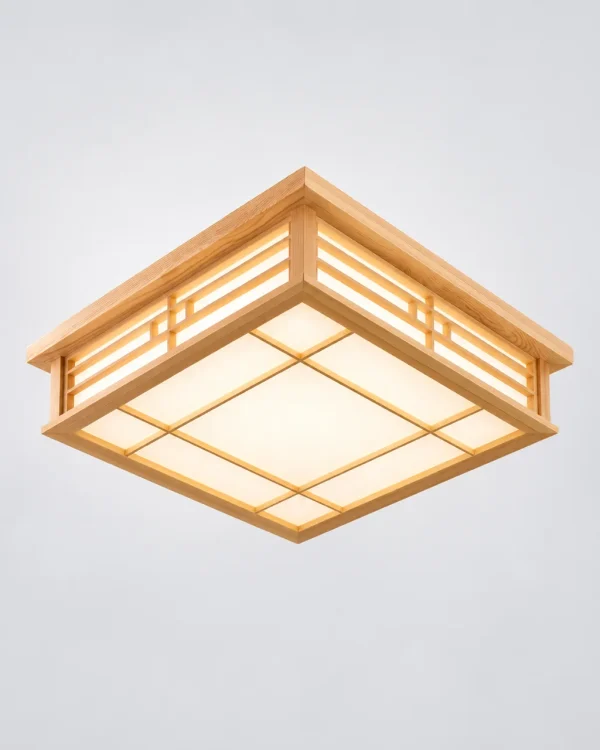
A wood ceiling light brings warmth to the living room ceiling and suits Japandi, Scandinavian and farmhouse-style rooms. INKA has a light wood frame with a lattice pattern and shines downward and sideways, in sizes from 35 × 35 to 92 × 70 cm (14 × 14 to 36 × 28 in). ILSE draws a ring of light on the ceiling with round wood slats. You will find more models under wood ceiling lights. Check the description: wood-look models such as JILO or HJORT have a metal body with a wood-grain finish.
Travertine
Travertine is a porous natural stone in warm beige tones, and every piece is patterned differently. NOMI combines a travertine ring with a solid wood ring in a walnut finish, 10 cm (4 in) deep and in Ø 49, 55, 59 or 65 cm (19, 22, 23 or 26 in). That makes NOMI suitable for large living rooms of up to about 30 m² (325 sq ft) too. You will find more models in our travertine and stone ceiling lights collection.
Alabaster
Alabaster lets light shine through the stone and reveals its veining as it does. FENZE is a flat alabaster disc in a gold or black ring, 5 cm (2 in) deep, Ø 30 to 50 cm (12 to 20 in). For more presence there is DESA, a drum of alabaster panels with brass rivets in Ø 40 or 50 cm (16 or 20 in). You will find every model among our alabaster ceiling lights.
Glass
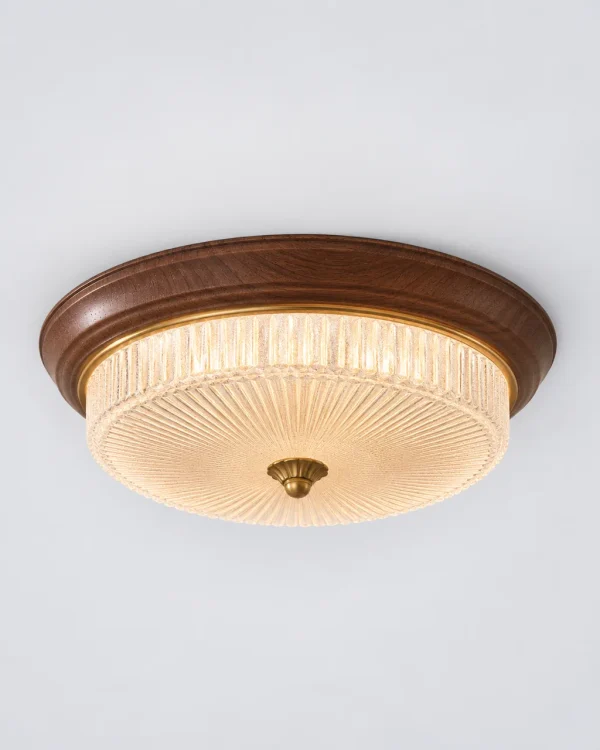
Opal glass diffuses light without glare; fluted glass breaks it into fine stripes and makes the fixture sparkle. JANNE combines a walnut-look frame with fluted glass, 10 cm (4 in) deep in Ø 33, 40 or 50 cm (13, 16 or 20 in), with integrated LED and remote control. You will find more models under glass ceiling lights.
Rattan and bamboo
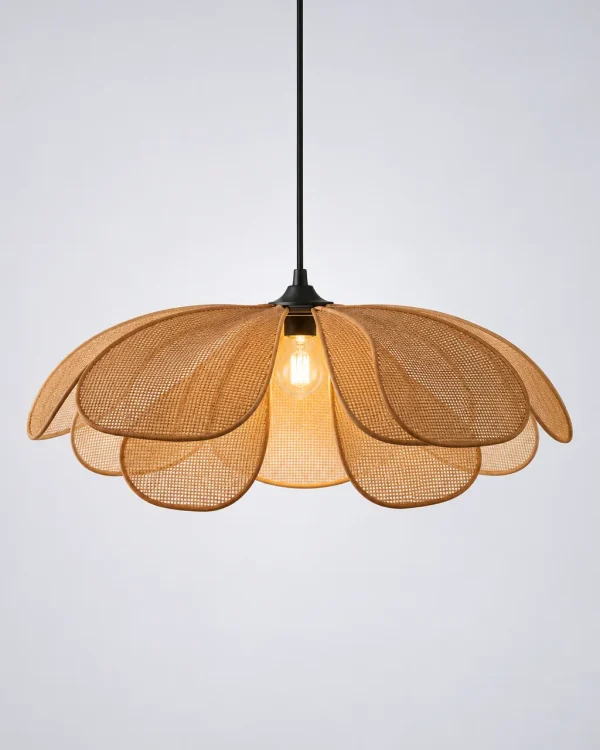
Woven shades look light and paint a pattern on the walls in the evening. In the living room, they show their strength as a pendant: ASTA is a rattan flower in Ø 50 to 100 cm (20 to 39 in) with a 120 cm (47 in) adjustable cord. Among our rattan lamps you will also find smaller ceiling models such as KARLA, a Ø 30 cm (12 in) bamboo dome for the hallway or reading nook.
Statement ceiling lights and chandeliers for the living room: when is a showpiece worth it?
A statement piece is worth it when the ceiling is at least 2.60 m (8 ft 6 in) high and the rest of the room is calmly furnished. Then the light can be large, at the top end of the chart or beyond.
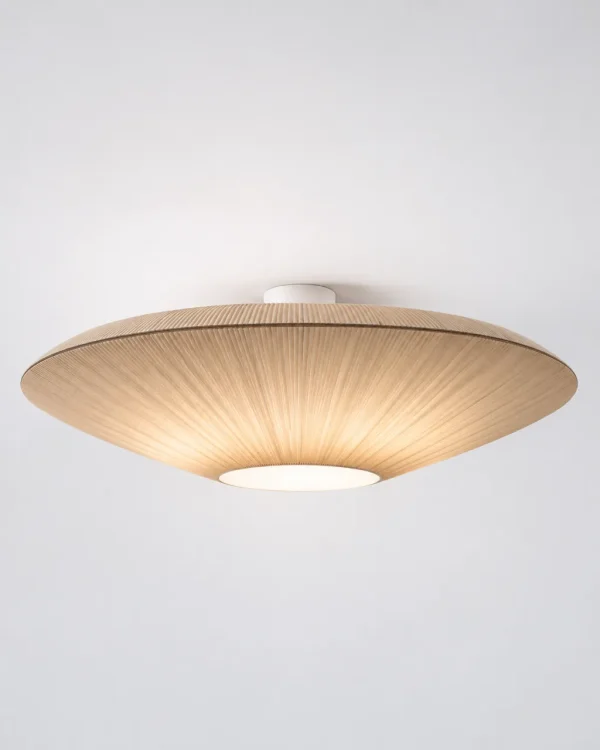
- LILJA: a flat pleated shade from Ø 50 × 18 cm (20 × 7 in) to Ø 100 × 30 cm (39 × 12 in), warm white at 3000 K. The 80 and 100 cm (31 and 39 in) versions fill even a 30 m² (325 sq ft) living room.
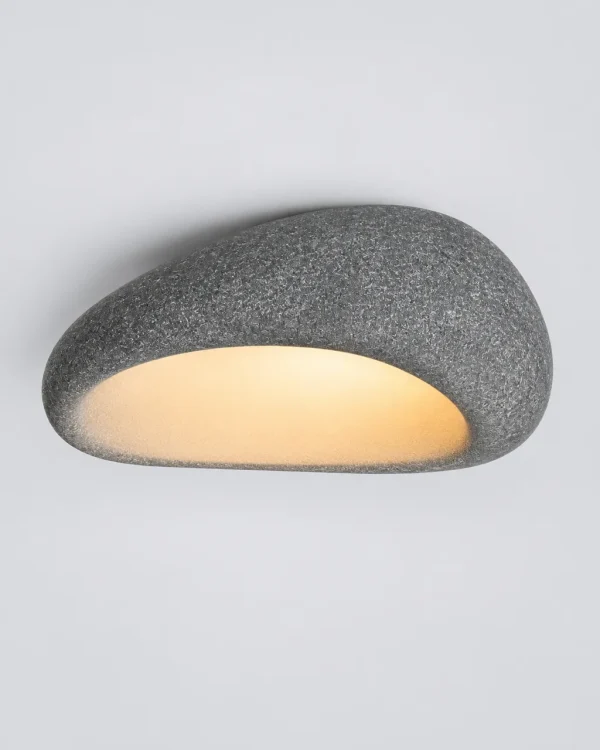
- LENA: a pebble of textured plastic with an asymmetric opening, 30 to 80 cm (12 to 31 in) wide. It goes well with bouclé, linen and white oak.
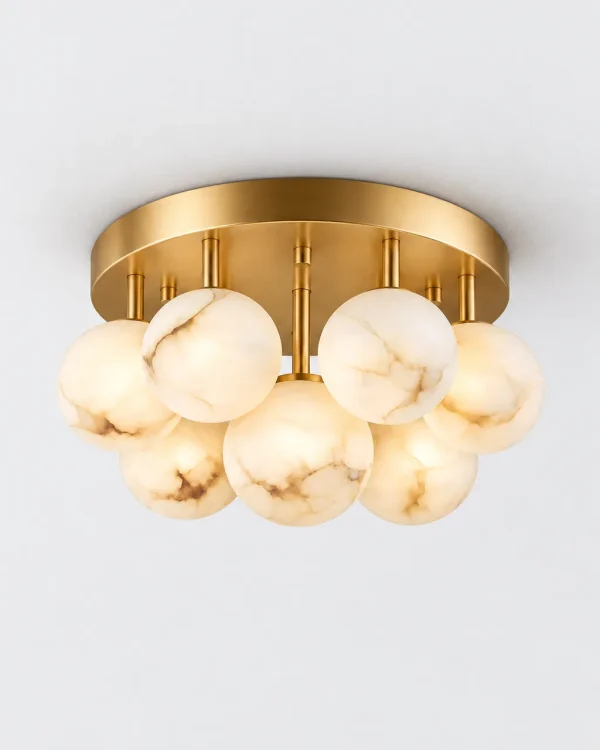
- DERPI: a cluster of alabaster globes on brass, Ø 30 to 50 cm (12 to 20 in) and 24 to 30 cm (9.5 to 12 in) high. This chandelier becomes a piece of jewelry over the seating area.
- ASTA: the rattan flower up to Ø 100 cm (39 in) for the high ceilings of older homes.
What are the most common mistakes with living room ceiling lights?
- Buying too small: a 30 cm (12 in) light visually disappears in 25 m² (270 sq ft). Work it out with the formula from the chart.
- Only one light source: light from above alone looks flat. Without floor lamps, table lamps or sconces, the room feels like a waiting room in the evening.
- Cool white light: anything above 3000 K feels uninviting in the living room in the evening.
- Buying by watts instead of lumens: with LEDs, wattage says little about brightness.
- Wrong position: the light belongs over the center of the zone you use, usually above the coffee table and seating area, not necessarily in the geometric center of the room. If the ceiling box is in an awkward place, a spotlight bar or a licensed electrician can bring the light to the right spot.
- Glare from the sofa: a bare bulb in your line of sight is blinding. Opal glass, fabric, alabaster or a diffuser prevent this.
- Dimmer doesn’t match: only fixtures explicitly described as dimmable work with a dimmer. Otherwise the light flickers or the LED fails sooner.
Frequently asked questions
How big should a ceiling light in the living room be?
Add the room’s length and width in meters and multiply by 8: the result is the diameter in centimeters for a pendant or statement light (in feet, the sum gives the diameter in inches). For a flush mount, about two-thirds of that is enough. A 4 × 5 m (13 × 16 ft) living room can therefore take a pendant of around 70 cm (28 in) or a flush mount of around 50 cm (20 in).
How many lumens does a 20 m² (215 sq ft) living room need?
For general light from the ceiling, allow 60 to 80 lm per m² (about 6 to 7 lm per sq ft), so 1,200 to 1,600 lm. Together with all the other lamps, 2,000 to 3,000 lm makes sense.
Which ceiling light suits a living room with a low ceiling?
With a ceiling height under 2.50 m (8 ft 2 in), a flush mount ceiling light no more than 10 cm (4 in) deep is the best choice. Models such as HILDE at 2.4 cm (1 in) or BATRAZ at 5 cm (2 in) deep take up practically no ceiling height. Pendants then belong only over zones where nobody walks.
Is 2700 K or 3000 K better for the living room?
Both are warm white and suit the living room. 3000 K works well for the ceiling light because it looks slightly crisper, and 2700 K for floor and table lamps in the evening. What matters is that all the lamps in the room are no more than 300 K apart.
Is one ceiling light enough for a living room?
It is enough for tidying up and for guests, but not for a cozy evening. Alongside the ceiling light, plan at least two more light sources at eye level, such as a floor lamp and a wall sconce or table lamp. Rule of thumb: one light source for every 4 to 6 m² (43 to 65 sq ft).
Pendant or flush mount: which is better for the living room?
A flush mount ceiling light is the right choice for the center of the room, low ceilings and walkways. A pendant makes a stronger statement and suits high ceilings or zones such as the coffee table, reading nook and dining table. Large living rooms often combine both.