Outdoor Wall Lights: Height, IP Rating and Light for Entry and Patio
How high outdoor wall lights go by the front door, what IP44 and IP65 mean, when up-and-down light works and which color temperature feels welcoming outside.
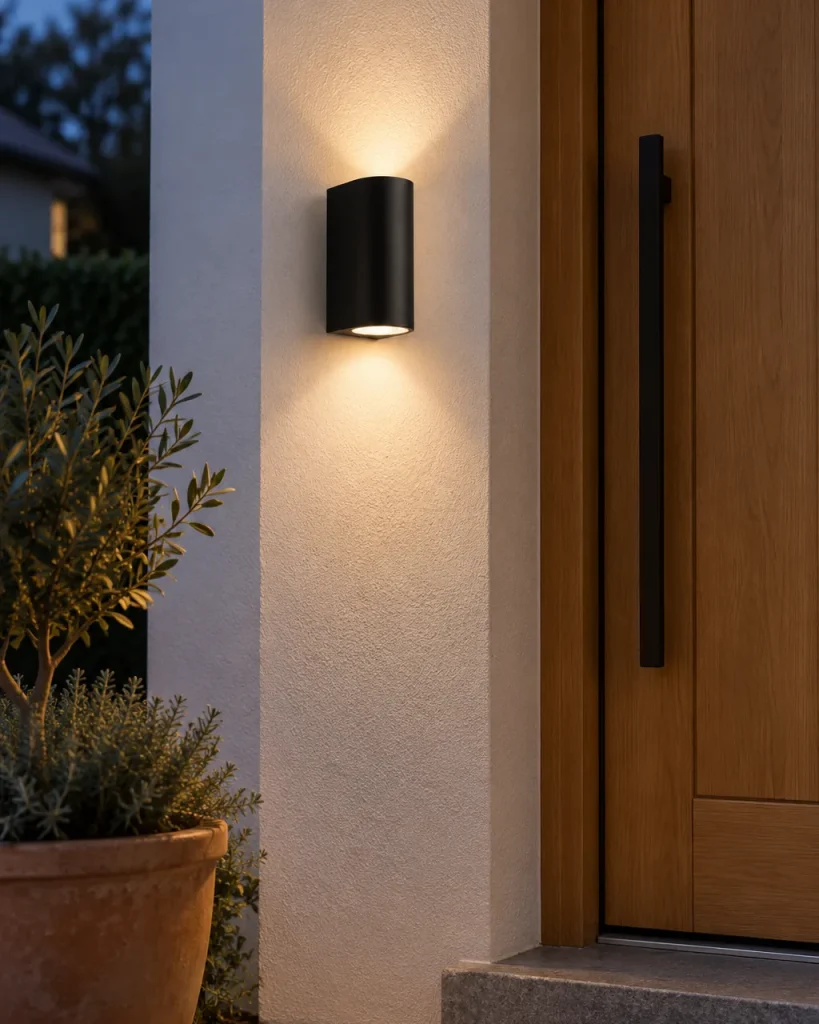
Mount outdoor wall lights beside the front door so their center sits about 170 to 190 cm (67 to 75 in) above the ground, 15 to 30 cm (6 to 12 in) to the side of the door frame. On an open wall exposed to rain, the light should have an IP65 rating; under a porch roof, IP44 is enough. Warm white light at 3000 K feels welcoming at the entrance and glares less than cool light.
How high should outdoor wall lights be mounted?
The right height depends on what the light needs to light. At the entrance, it’s about faces, the lock and the house number; on the patio, about mood; on paths and steps, about safe orientation. The following values are typical guidelines for doors about 2.00 to 2.10 m (6 ft 7 in to 6 ft 11 in) high.
| Location | Mounting height (center of light) | Spacing and position |
|---|---|---|
| Beside the front door | 170–190 cm (67–75 in) | 15–30 cm (6–12 in) from the door frame; on wide doors, left and right |
| Above the front door | 10–20 cm (4–8 in) above the door header | centered, light pointing down |
| Patio, house wall | 180–200 cm (71–79 in) | 2.5–4 m (8–13 ft) between lights |
| Garage, carport | 200–220 cm (79–87 in) | beside the door, light pointing down |
| Garden wall, gate pillar | at pillar height or 40–80 cm (16–31 in) above the ground | every 2–3 m (6.5–10 ft) along the path |
| Outdoor steps | 30–60 cm (12–24 in) above the step edge | on the side wall, light on the steps |
At the front door, a pair of lights to the left and right of the door looks symmetrical and lights visitors’ faces without harsh shadows. If the wall beside the door is narrow, one light on the lock side is enough.
What do IP44 and IP65 mean for an outdoor wall light?
The IP rating consists of two digits. The first indicates protection against solid objects and dust, the second protection against water. The higher the digit, the better protected the light is.
| Rating | Meaning | Where outdoors? |
|---|---|---|
| IP20 | protection against large objects, no water protection | indoors only |
| IP44 | protection against small objects and splashing water | under a porch roof, covered patio, entrance with a roof |
| IP54 | dust-protected, splashing water | sheltered spots, balcony under a roof |
| IP65 | dust-tight, protection against water jets | open wall, garage, garden wall, weather side |
| IP67 | dust-tight, temporary immersion | in-ground lights, areas with standing water |
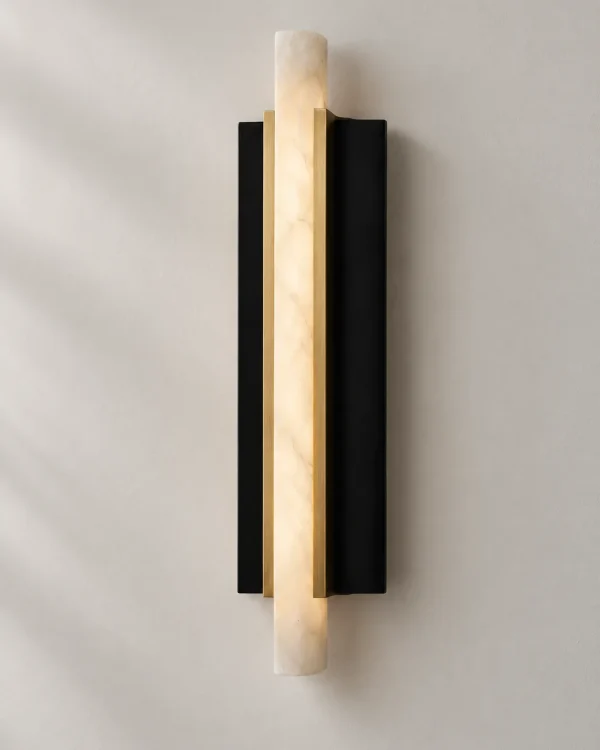
All the models in our Outdoor Wall Lights collection are rated for outdoor use, most of them IP65. One exception is BANSE, a 50 cm (20 in) tall bar of real alabaster rated IP44. According to the product description, it belongs under a porch roof, on a covered patio or in a sheltered entrance. For a wall directly exposed to rain, an IP65 model is the better choice.
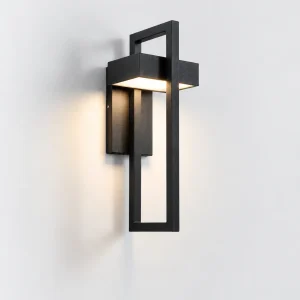 Collection · 17 designsOutdoor Wall LightsView all 17 designs
Up and down, downward or all around: which light works?
With an outdoor light, the direction of the light matters more than the shape. It decides whether the facade glows, whether the path is bright and whether the neighbors get dazzled.
Up and down: two beams on the facade
Up-and-down lights draw two beams of light up and down the wall. They bring out stucco, wood and natural stone and make a house look larger and more refined in the evening. CADOS is a 15 cm (6 in) tall aluminum body (6.5 × 6.5 cm (2.6 in) / 2.6 × 2.6 in) with 6 W and 660 lumens, IP65. CAVTO is a flat plate in five heights from 9.7 to 81 cm (4 to 32 in), in black or white. MATIO has an oval shape, 11, 17 or 30 cm (4, 7 or 12 in) wide, and a color rendering index above CRI 90. With CARDIF, a 10 cm (4 in) cube, you set the width of the beams yourself with movable flaps.
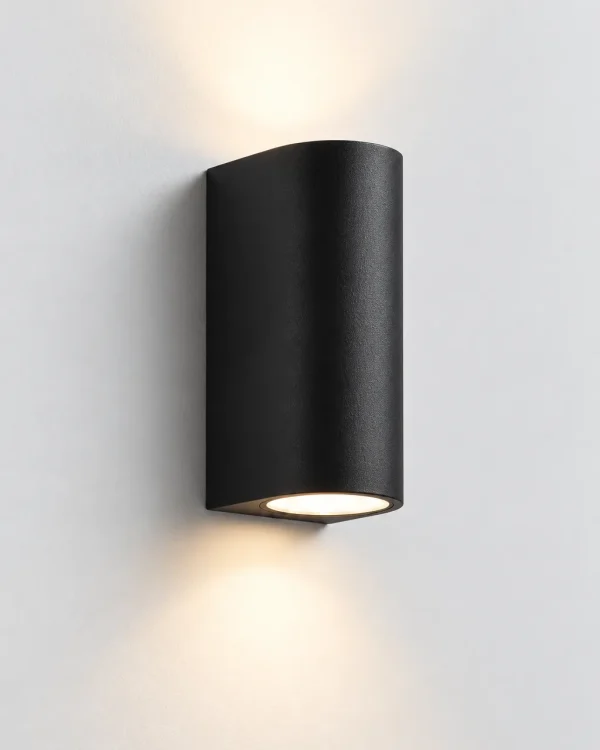
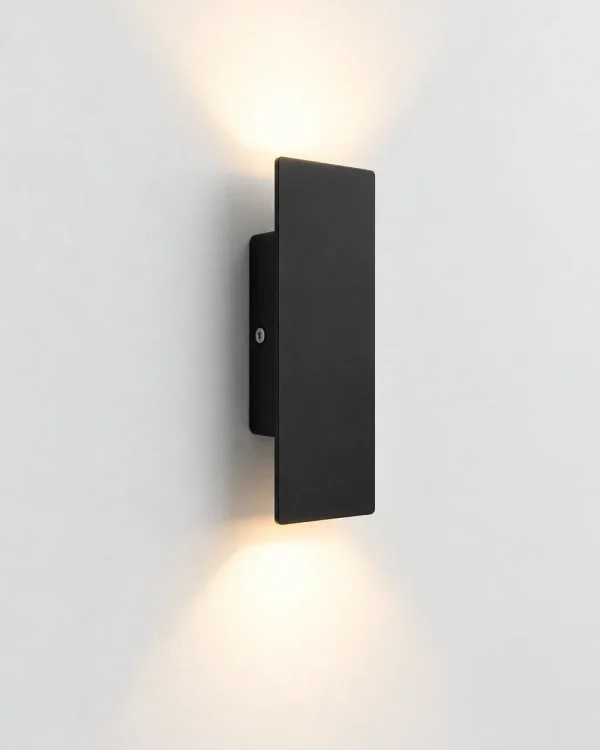
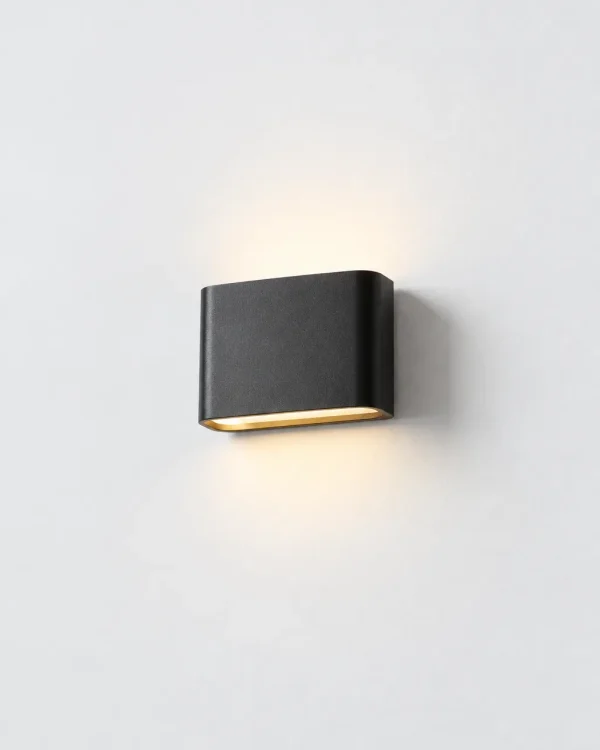
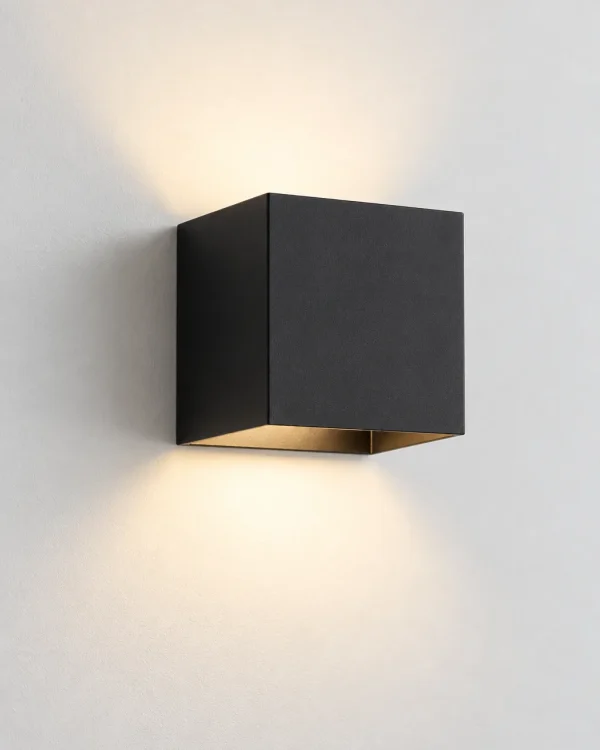
How up-and-down light works indoors is shown in our guide Indirect Lighting in the Living Room.
Downward: glare-free for entrances and paths
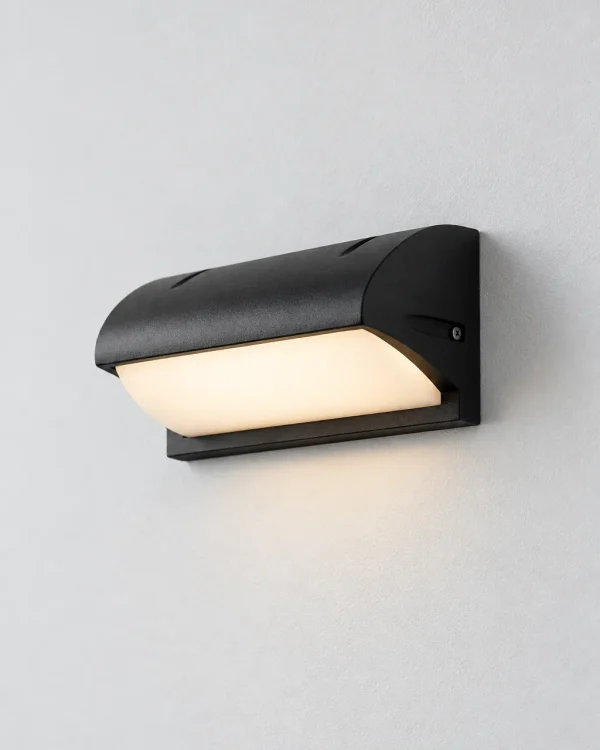
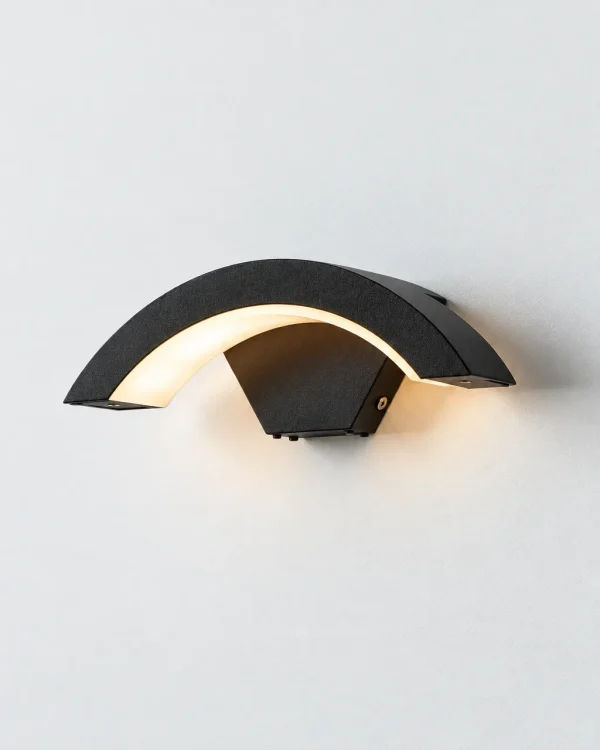
Lights that shine only downward put most of their light on steps, threshold and path and send hardly any into the night sky. DOMOT has a curved cover like a small canopy that prevents glare and keeps rain away from the light opening (26 or 38 cm (15 in) / 10 or 15 in wide). TYRIAL, in black stainless steel, sends its light downward through a UV-resistant acrylic diffuser (35 or 42 cm (16.5 in) / 14 or 17 in tall, 12 W). YALTUI stretches a flat arc across the wall and casts its light onto the facade as a soft stripe.
All around: the classic wall lantern
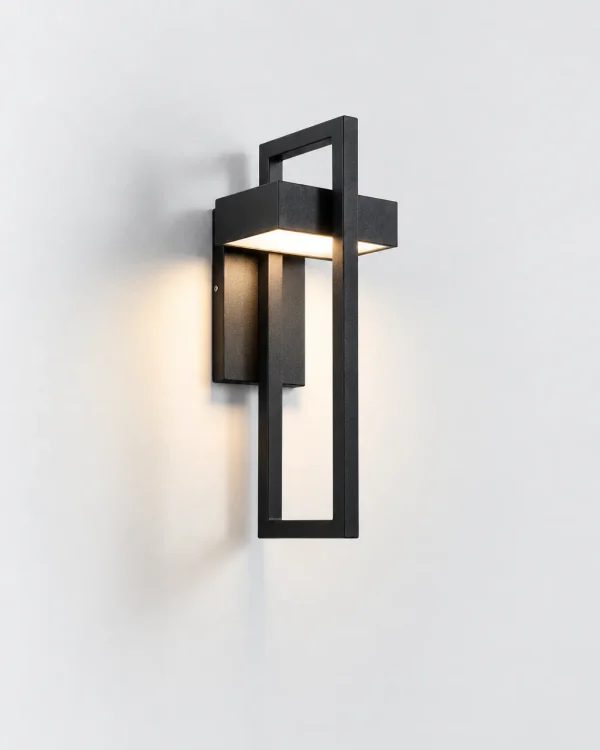
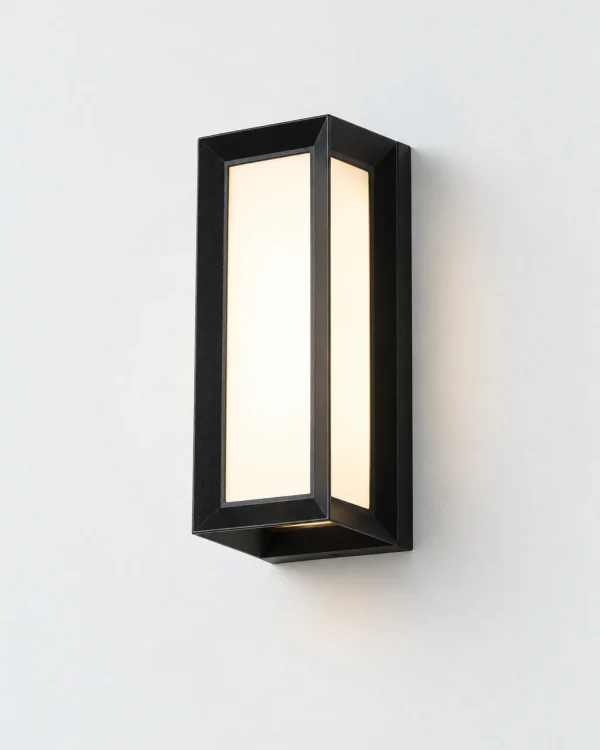
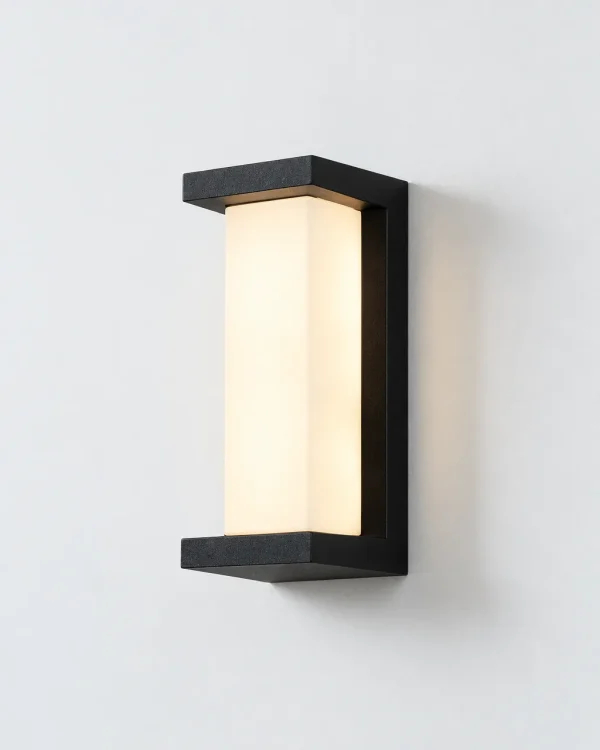
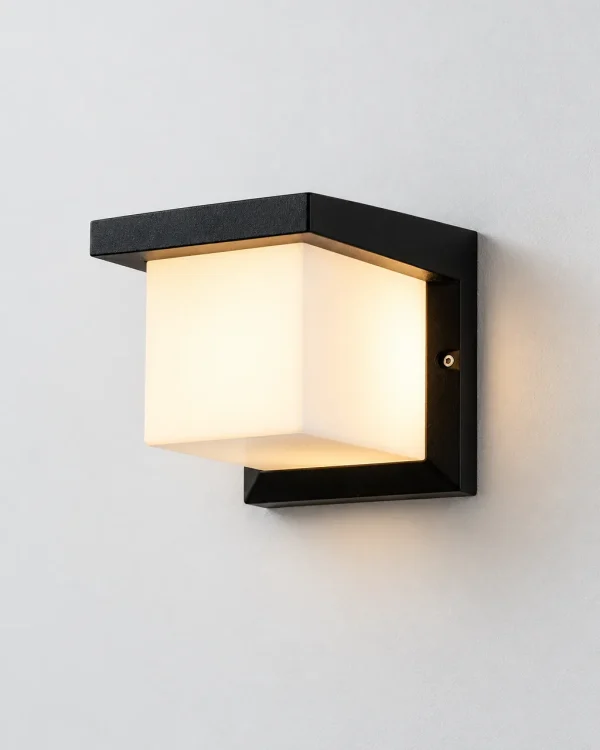
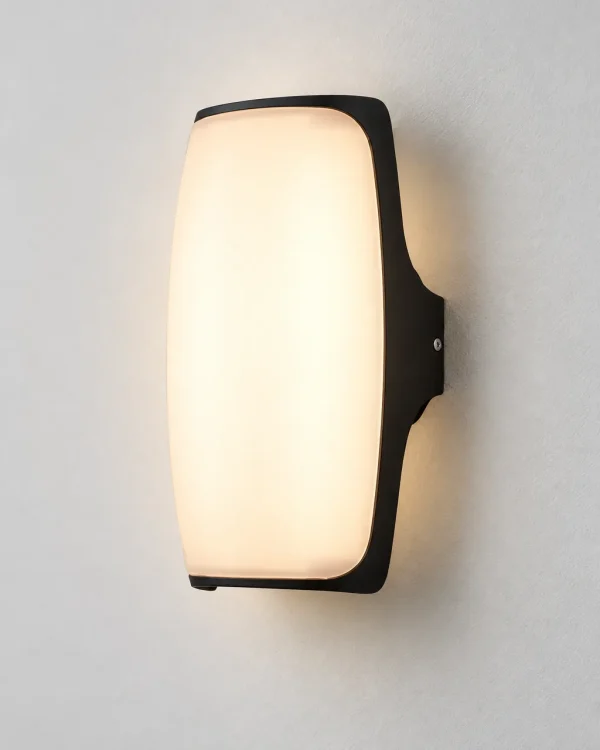
Lanterns and cubes with an acrylic diffuser shine forward, to the sides and downward. They give the brightest light at the entrance and mark the house from a distance. KIETY reinterprets the wall lantern with a black frame (26 or 30 cm (11.8 in) / 10 or 12 in tall). ESTER is a small light column 26 or 30 cm (10 or 12 in) tall, GOLDI a glowing 16 cm (6 in) cube under an aluminum roof, and CRATYA has a curved opal diffuser (26 × 14 cm (5.5 in) / 10 × 5.5 in).
What color temperature and brightness do outdoor wall lights need?
For the front entrance and patio, warm white at 3000 K is the first choice. It makes stucco, wood and plants look natural, glares less and feels welcoming. Warm light with little blue also generally attracts fewer insects than cool white light. Neutral white at 4000 K suits garages and work areas; cool white at 6000 K suits very modern, cool architecture. Most of our models come in several color temperatures, which you choose on the product page.
| Location | Recommended color temperature | Brightness per light (guideline) |
|---|---|---|
| Front entrance | 3000 K | 400–800 lm |
| Patio, seating area | 2700–3000 K | 300–600 lm, ideally several softer lights |
| Path, garden wall | 3000 K | 100–300 lm |
| Garage, carport | 3000–4000 K | 600–1,000 lm |
High color rendering makes colors look more natural. MILLAF, a glowing acrylic block in a black aluminum frame (26 or 30 cm (11.8 in) / 10 or 12 in), has a CRI above 85, MATIO above 90. More on kelvin, lumens and CRI is in our guide How to Choose Color Temperature and Lumens.
Outdoor wall lights for patio and balcony: mood, not floodlight
On the patio, the lights should accompany the evening, not floodlight the yard. Use two or three softer wall lights with up-and-down or grazing light rather than one bright floodlight, and mount them so they don’t shine in your eyes from the seating area.
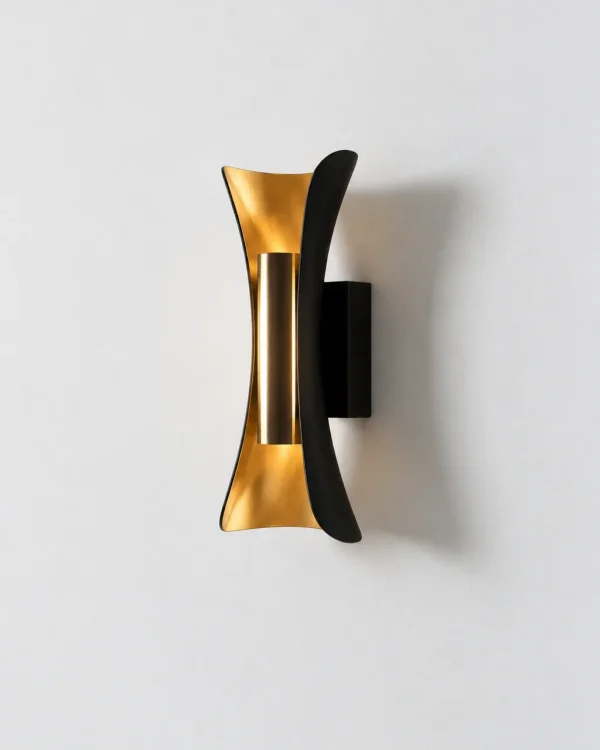
- HUGEL has a curved bowl with a gold reflector that sends its light indirectly up and down (20 or 40 cm (15.7 in) / 8 or 16 in tall, IP65).
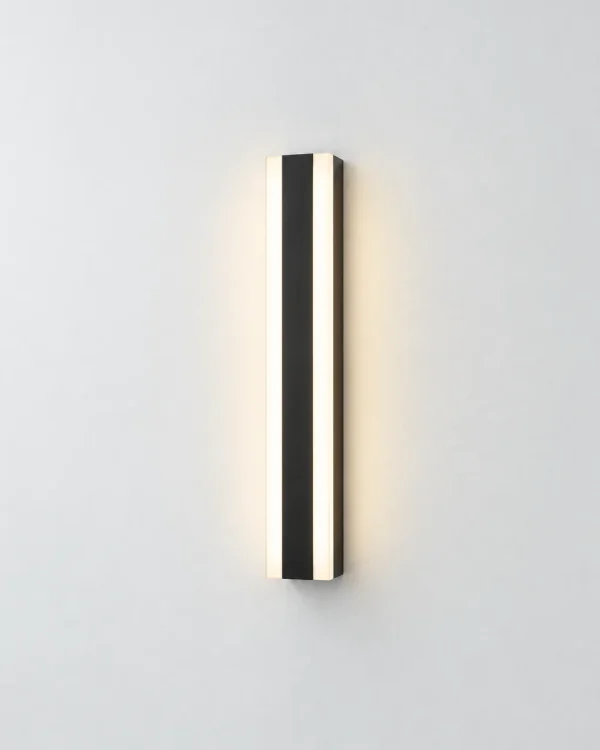
- RAFTO is a linear LED light from 30 to 240 cm (12 to 94 in) long, IP65. With a remote control, you set the color temperature from 3000 to 6000 K or choose colored light.
- BANSE, in alabaster, brings a warm, stone-filtered light to the wall under the patio roof.
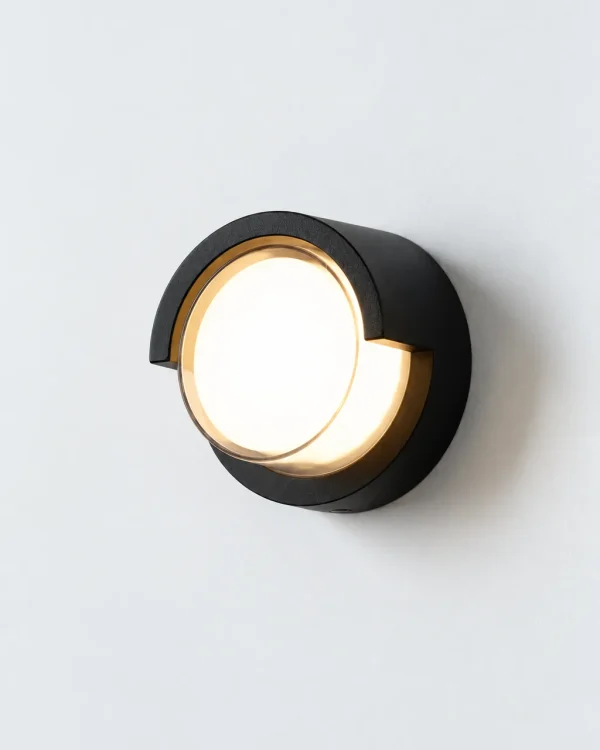
- YAXO takes up the shape of a porthole with an asymmetric shield (17 cm (6.7 in) / 7 in across) and suits narrow stretches of wall.
Outdoor wall lights with motion sensor, dusk-to-dawn sensor or solar?
Our outdoor wall lights are hardwired, and most are switched with a regular wall switch. According to the product descriptions, many models are not dimmable, and none has a built-in motion sensor. If you want light only on motion or from dusk, have a licensed electrician install a separate motion sensor or dusk-to-dawn sensor in the supply line. If in doubt, ask us before ordering whether the light you’ve chosen is suitable.
Solar lights need no wiring, but their brightness depends on hours of sunshine and the battery. For a front entrance that should be reliably bright every evening, a hardwired LED light is the safer solution.
Which outdoor wall light suits which house?
The light should echo the architecture, not compete with it. Three rules of thumb help you choose modern and classic outdoor wall lights:
- Modern facade with clean edges: angular and linear shapes in black, such as the slim body of CADOS or the flat plate CAVTO. On large walls, the long CAVTO versions at 61 or 81 cm (24 or 32 in) look like lines of light.
- Traditional house, farmhouse, older home: the lantern shape of KIETY or the ESTER light column take up the form of the traditional porch lantern without looking nostalgic.
- Light stucco, Mediterranean look: soft shapes like CRATYA, MATIO in white or HUGEL with its gold reflector suit lime plaster, wooden shutters and terracotta.
The size depends on the wall area. Beside a standard front door, lights 20 to 30 cm (8 to 12 in) tall look right. On a wide facade or a double-door entrance, they can be 40 cm (16 in) and more. A light that’s too small gets lost on the wall; one that’s too large overwhelms the door.
What should you watch for when installing?
- Licensed electrician: hardwired outdoor lights belong in the hands of a professional, who also seals the cable entry.
- Alignment: mount up-and-down lights vertically and exactly in line. Several lights on one facade go at the same height.
- Wall surface: with exterior insulation systems (EIFS), you need special anchors or mounting blocks, otherwise the light won’t hold over time.
- Neighbors and night sky: point the light at your own property. Lights that shine downward avoid stray light.
- A consistent look: one color temperature and one housing color for all the outdoor lights on the house.
From outside, the light continues inside: how to light the entryway and hallway is covered in our guide Hallway Light Fixtures, and heights for indoor wall sconces in our guide Living Room Wall Sconces. For stairs inside the house, see our guide Stairway Lighting.
Frequently asked questions
How high should an outdoor wall light be mounted by the front door?
The center of the light usually sits 170 to 190 cm (67 to 75 in) above the ground, 15 to 30 cm (6 to 12 in) to the side of the door frame. That way faces, the lock and the house number are well lit without the light glaring. Above the door, mount it 10 to 20 cm (4 to 8 in) above the door header.
What IP rating does an outdoor wall light need?
Under a porch roof or on a covered patio, IP44 is enough. On an open wall exposed to rain and water jets, the light should be rated IP65. The second digit of the IP rating stands for water protection.
What color temperature is best outdoors?
Warm white at 3000 K feels welcoming at the front entrance and on the patio and glares less. It also generally attracts fewer insects than cool white light. Neutral white at 4000 K suits the garage and carport.
What is an up-and-down outdoor light?
An up-and-down light sends its light upward and downward at the same time, drawing two beams on the facade. That brings out the texture of stucco, wood or stone. Examples are CADOS, CAVTO and MATIO, all rated IP65.
Can I add a motion sensor to an outdoor wall light?
Our outdoor wall lights don’t have a built-in motion sensor. A licensed electrician can install a separate motion sensor or dusk-to-dawn sensor in the supply line. Ask us before ordering whether the model you want is suitable.
How many outdoor lights do I need for the patio?
On the house wall, plan one light every 2.5 to 4 m (8 to 13 ft). Several softer lights of 300 to 600 lumens create a more pleasant mood than a single bright floodlight. Mount them so they don’t glare from the seating area.